Shorebird keynote highlights birding accessibility, benefits
Published 8:30 am Thursday, May 14, 2026
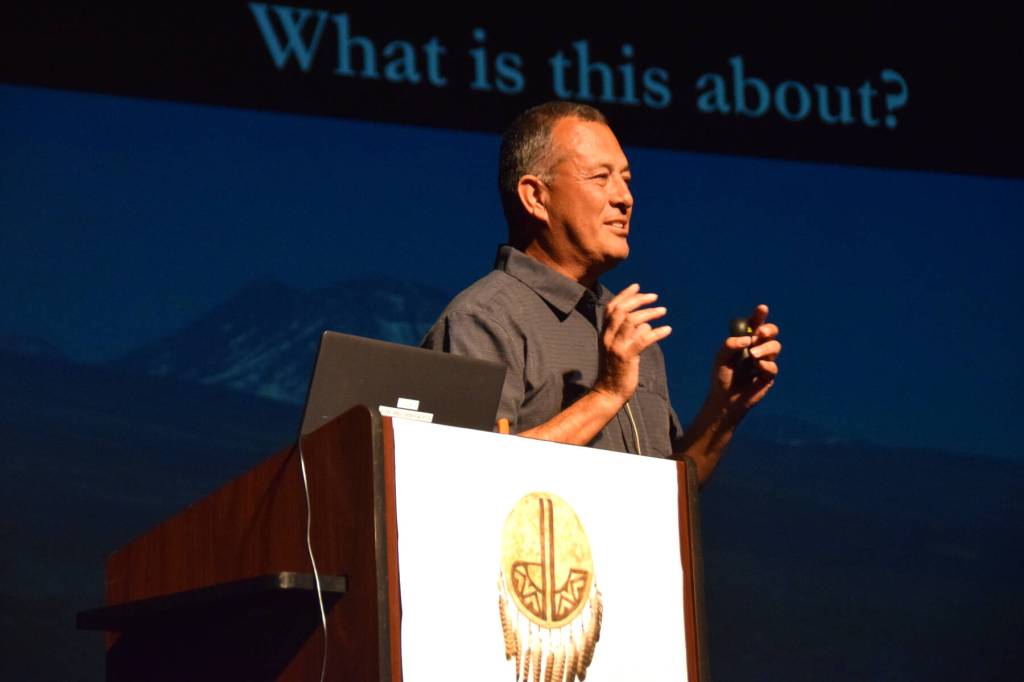



When Shorebird Festival keynote speaker Alvaro Jaramillo says birding is good for you, he doesn’t just mean in the “go touch grass” sense — although that’s true, too. He means that it’s good for your brain and overall health.
In his keynote speech Saturday evening, Jaramillo walked the crowd packed into the Homer High School Mariner Theatre through “being a birder, how our brains work, how we bird (and) how birding makes us feel.”
Jaramillo first began birding when he was 11 years old and is now a biologist, researcher, conservationist and longtime guide. His work, which is grounded in careful observation, focuses on the movement and habits of birds, and what those movements and patterns can teach people.
According to the festival website, Jaramillo is also “deeply interested in how people learn to bird,” often returning to questions about experience, attention, and how understanding grows with time in the field.
“Rather than focusing on shortcuts or rules, he emphasizes watching closely and letting patterns reveal themselves. His work reflects a belief that birding can be challenging, absorbing, and rewarding at any level, and that spending time with birds is one of the simplest ways to stay connected to the natural world,” Jaramillo’s bio on the festival website says.
The title of his talk, “Birding Fast and Slow,” was drawn from the book “Thinking, Fast and Slow” by economist Daniel Kahneman, which highlights two systems that drive the way people think. The first, which Kahneman called System 1, is fast, intuitive and emotional. The second, System 2, is slower, more deliberate and logical.
Jaramillo illustrated this point by flashing an image of a bird to the audience for a second and asking them to identify it. They correctly answered that it was a pigeon.
“But how did you know it was a pigeon?” he said. “Did you see field marks? What you just did was identify something so quickly that you weren’t thinking about it — it was an automatic response.”
Jaramillo furthered the points of Kahneman’s systems of thinking — System 1 is unconscious thinking and can be prone to errors. System 2 is conscious thinking and is much more reliable. Both systems can be and are used in birding, he said.
“Experienced birders just know what something is. A birder who’s learning is trying to figure out what they are, and there’s a point where all that comes together. You actually will ‘just know’ — because you ‘just knew’ what a pigeon was — because you’ve seen it lots of times,” he said.
Utilizing System 2 in identifying birds can also make birding more enjoyable and more of a challenge even for experienced birders, according to Jaramillo, because of the effort that goes into methodically evaluating a bird’s field marks and other characteristics.
“What happens is that you see something sometimes, and you go for the quickest answer that seems right. That’s you being automatic with it,” he said. “Then the analytical part (of your brain) will actually come out with a different answer at time. Intuition versus analysis.”
Birding presents additional various benefits to the human brain, Jaramillo said. One of those is increasing awareness and making each day distinct.
“Birding makes every specific date of the year different from another day of the year,” he said. “You don’t just go through life thinking everything is the same … everything is relevant to certain days of the year, so you’re suddenly paying attention to weather, animals, dates, all sorts of things that most people just don’t think about.”
At the same time, Jaramillo advised birders and prospective birders to avoid overtaxing their minds.
“Any time you’re trying to learn birds and you feel like, ‘Oh my god, this is too much,’ just roll back to the point where you’re comfortable, because you’ve got to be having fun with it in order to really learn this stuff,” he said. “On the other hand, you want to challenge yourself a little bit, because the more mental cognitive strain you push yourself towards, the more you actually focus and pay attention.”
Jaramillo also spoke on the benefits of nature — and birding — on the body.
He gave an example of a professor at Stanford University in California who took a group of students and had some of them walk around the city of Palo Alto, while the others were sent out to walk around in a natural area. The professor then measured and evaluated the students’ blood pressures and other body functions and found that those who had walked around the city “came back with all the signs of rumination, broodiness and actually even moderate levels of depression” while the students who walked around nature didn’t have those signs.
“They actually had the opposite,” Jaramillo said. “Nature, in a sense, was healing for them…. We have this innate need to be around living things. Birding gets you that connection with living things.”
He called birds “the gateway drug to nature” and said that birding is “the easiest way to get you out there enjoying all these benefits of being outside.”
Birding, according to Jaramillo, is also one of the most portable hobbies. It can be done anywhere, by anyone, at any level that best suits their experience and personality, from backyard birders to twitchers.
“I like to say too — you don’t have to just go birding. It’s like a good hot sauce, you can add it to other things,” he said. “You can be fishing and birding, golfing and birding, hanging out with friends and birding, walking your dog and birding, and then having a great meal after you bird.
“It’s all fine. It doesn’t take away from your birding, and it leads you to amazing experiences.”