Our Sunday best: Early churches of the central Kenai Peninsula — Part 2
Published 1:30 am Thursday, May 28, 2026

AUTHOR’S NOTE: An earlier version of this story first appeared in May 2013 in the Redoubt Reporter. The focus of this series is churches of the central Kenai Peninsula; clearly, there is also a rich church history on the southern Kenai, in the Seward area and elsewhere, but those stories, and stories of non-Christian congregations, will be a topic for another time.
A colorful Catholic presence
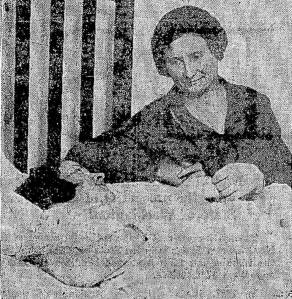
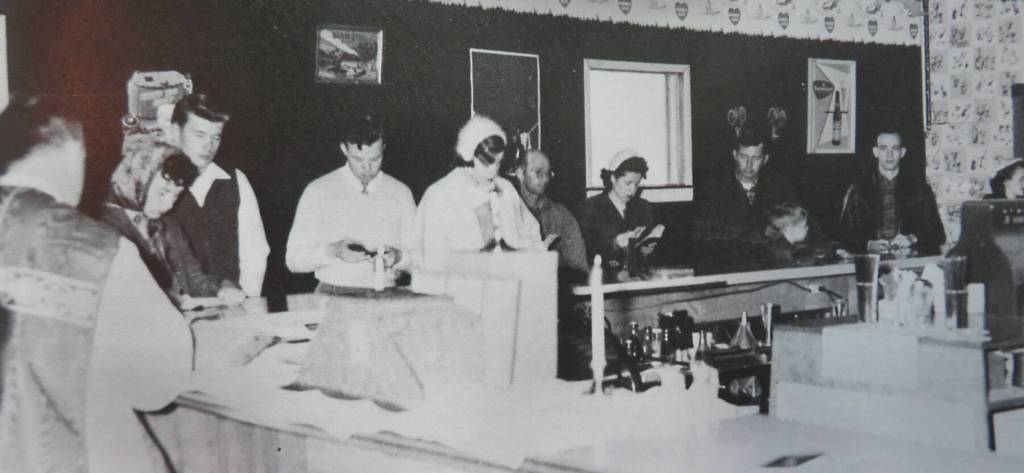
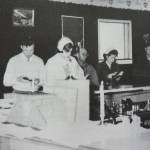
A photograph from Once upon the Kenai depicts an odd-looking Catholic mass from June 1955 in Kenai. The words in the ceremony may have been the usual fare, but the setting certainly was not: The scene was the Western Corral Bar, where an altar had been erected from two oil drums, a sheet of plywood, and an old white bedspread.
Father Thompson presided as parishioners arrayed themselves around the outside of the counter. Alcohol-related posters hung on the wall behind the congregation, and drink-mixing implements could be seen behind the bar.
Worship could be fairly primitive for Kenai’s Catholic faithful in those early days—and, truth be told, such was life for the congregations of many early churches on the central Kenai Peninsula.
Catholic services on the central peninsula began in 1951 in the home of Frank and Marge Mullen, who had moved out of their 14×16-foot cabin when Marge became pregnant with their third child and were temporarily renting a place near the Soldotna bridge from the brothers Alex and Marcus Bodnar.
The Mullens, who had lived briefly in Anchorage in the mid-1940s and had remained in contact with the Catholic hierarchy there, had been informed that if they could arrange a place of worship, an itinerant priest from Seward would make regular monthly visits to the area once the roads were passable in the spring. Thus did Father Arnold Custer, whom Marge Mullen called “a great old Jesuit,” bring mass to the masses on the western Kenai.
Later, the parishioners determined that Catholic services should be moved closer to the population center, so the meeting place was moved to Kenai, with Louisa Miller arranging the locale wherever space was available—from a bar to her own café, from the old Territorial School to the Carpenters Hall. They even met sometimes at Wildwood Army Station, when a Catholic chaplain was flown down from Anchorage to hold services in the Quonset hut that served as a base chapel.
Marge Mullen remembers that many of the church venues had their own peculiarities: Mass in the café, for instance, might be enhanced by the smell of freshly baked bread, while the smells in the bar might include ashtrays, the vestiges of old beer, or worse.
During 1955 and 1956, area Catholics employed volunteer labor to build their first church in Kenai, constructing it with logs purchased from Fred House’s sawmill. On Sundays during the cold months, according to Once upon the Kenai, the church was heated by an oil stove lighted early in the morning by Lillian Hakkinen “in hopes of removing the chill before time for services. Often it would fail to do so, and sometimes the priest would have to say mass in gloves and boots.”
In 1956, the Kenai Peninsula was accepted as a mission parish by an Oregon-based Redemptorist order, which sent four priests to tend to the various congregations. The priests served primarily as pastors, but they also began St. Theresa’s Camp near Sterling and furthered the construction of new churches, including a larger Kenai facility, Our Lady of the Angels, which was completed in 1969.
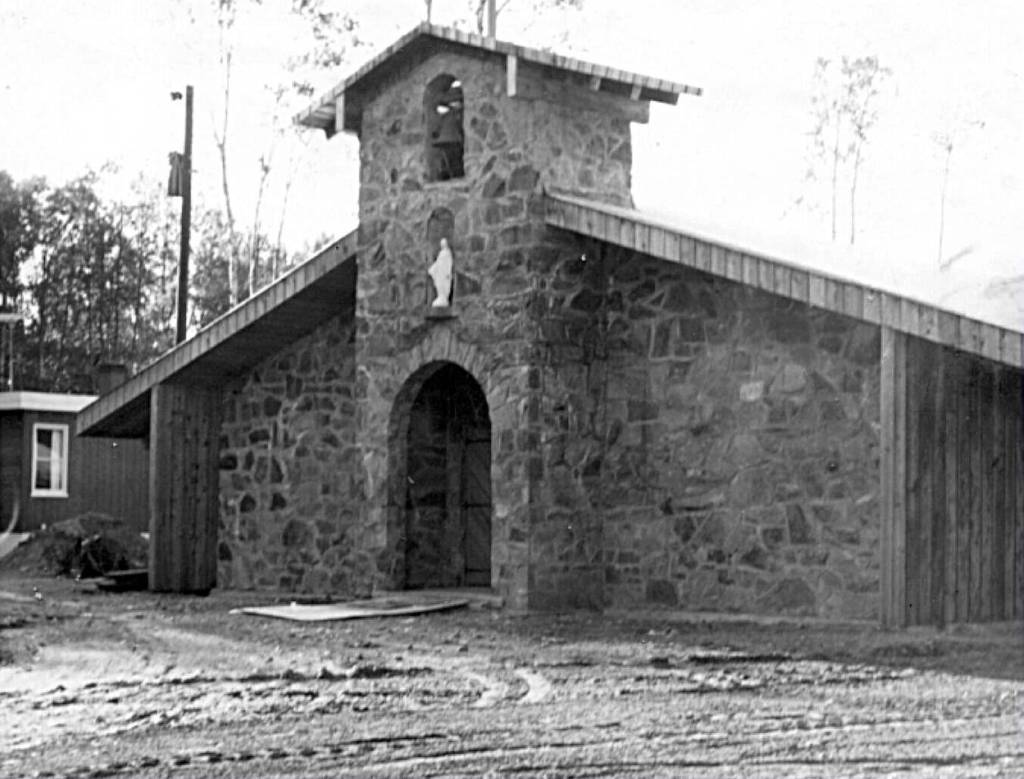
Another of the new churches was Soldotna’s Our Lady of Perpetual Help, which was mostly complete by the end of 1962 on property donated by homesteader Marvin Smith. The church included the work of a half-dozen recently transplanted (and previously unemployed) Irish stonemasons who had been living in Anchorage at the time.
Under the direction of the first pastor, James Van Hommisen, the Irishmen drove a truck out Snug Harbor Road in Cooper Landing and then climbed into the mountains to find just the right rounded stones to employ in the construction of the front and back walls of the church.
While their work on the structure was greatly appreciated, according to Mullen, their participation in the church’s first midnight mass on Christmas Eve 1962 was not so highly regarded.
Parishioners on that sloppy wet night began arriving at about 11:30, and the stonemasons were on hand with flashlights to guide congregants into parking spaces; however, said Mullen, the Irishmen had been doing some early Christmas celebrating and therefore did more staggering and stumbling than accurate direction-giving.
Indoors, where poinsettias had been arrayed to add beauty to an unfinished construction site, the Irishmen strolled in and extinguished their cigarettes in the holy water fountain. They sat backwards on the kneeling benches instead of forward in the pews, and when Jean Bardelli (later Brockel), who was wearing the lace stockings she had just received from her mother, went forward to play the organ, they directed wolf-whistles at her.
“At least the electricity was on, and the heat was working,” Mullen said.
The growing Protestant influence
Elsewhere on the central peninsula, church activities may have been somewhat less rollicking but were definitely on the rise.
In 1950, the First Baptist Church of Kenai, affiliated with the Southern Baptist Convention, was formed but soon disbanded.
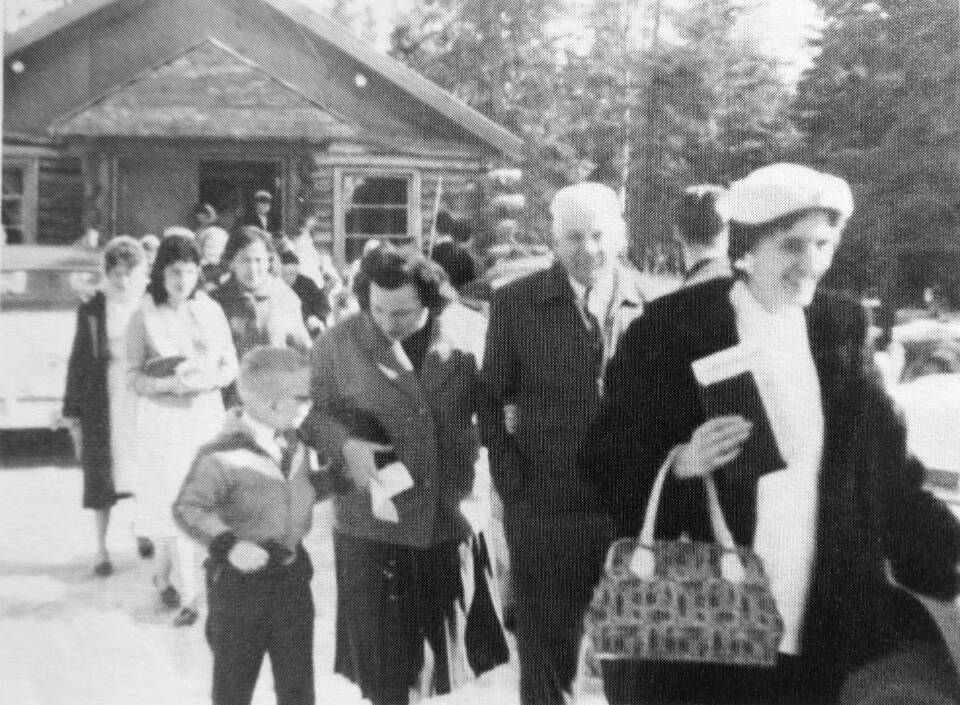
Also during that time, Carl Zehrung and his family moved to the peninsula to establish a Church of Christ. For the first year, they rented space each Sunday in an old log building that was used as a dance hall, a theater and a candy store during the rest of the week.
That structure is believed to have been the second-oldest building (after the Russian Orthodox Church) in Kenai. It was originally the Interlocked Moose Horn Club, thought to have been constructed from logs held together with wooden pegs at least as far back as 1890, possibly by renowned hunting guide Andrew Berg.
The building had been moved on skids to its location on Cook Avenue in 1940 by the Monfor family for commercial purposes.
After the Zehrungs built their own chapel in Kenai in 1951, the old building was used again by another congregation just a few years later.
In 1956, the Rev. Carl Glick, Sr., and his wife Betty arrived in Alaska from Palmstown, Penn., as missionaries for the Assemblies of God. In 1957, they purchased the entire Interlocked Moose Horn Club building and had it jacked up so that a basement and new foundation could be installed.
Meanwhile, a few miles away in Soldotna, the Methodists were marshalling their energies.
TO BE CONTINUED….