Murnane case community conversation emphasizes awareness and action on violence against women
Published 1:30 pm Thursday, May 7, 2026
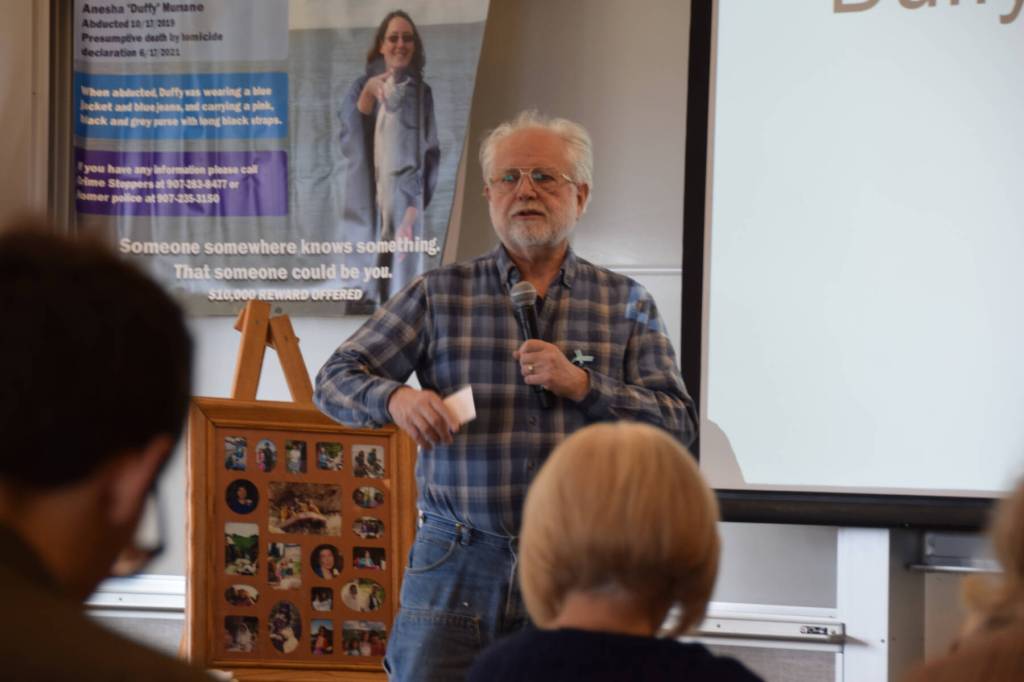
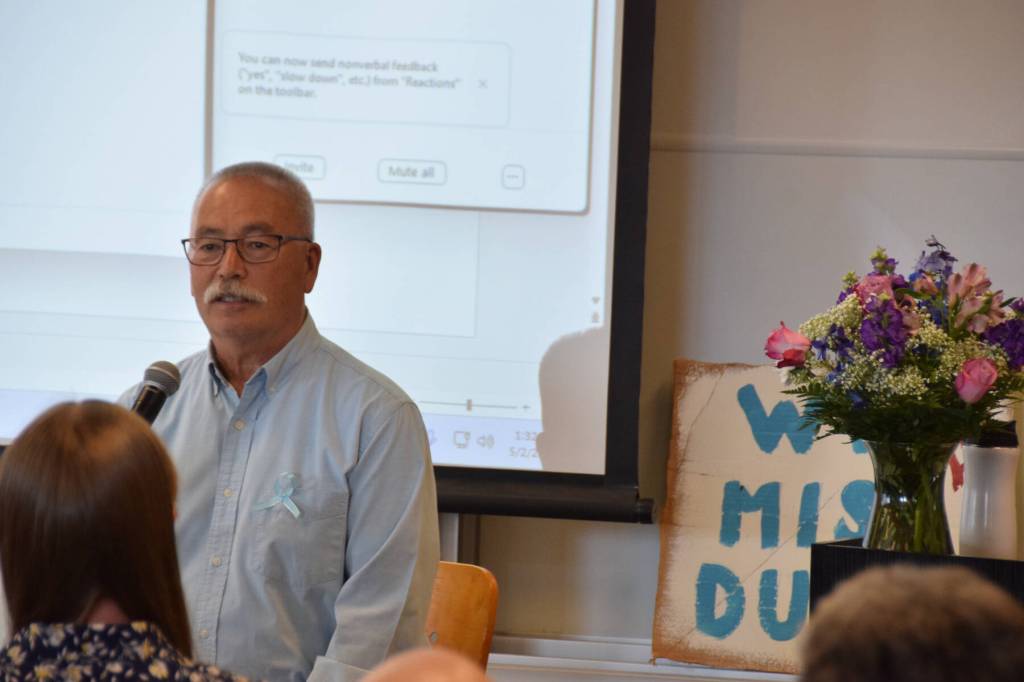




Nearly seven years after Anesha “Duffy” Murnane’s disappearance, and three months after Kirby Calderwood pleaded guilty to her murder, the Homer community gathered together on Saturday, May 2, to hear previously unreleased details of the case and Murnane’s journey to justice.
Organized by Murnane’s family and friends, the community conversation featured Murnane’s uncle, Michael Huelsman; now-retired special cold case investigator Matt Haney, who broke Murnane’s case; Ed Berg, Murnane’s stepfather; and family friend Christina Whiting, who helped to organize search efforts and served as project manager for the Loved and Lost Memorial Bench, which for the past few years has resided in front of the Homer Public Library.
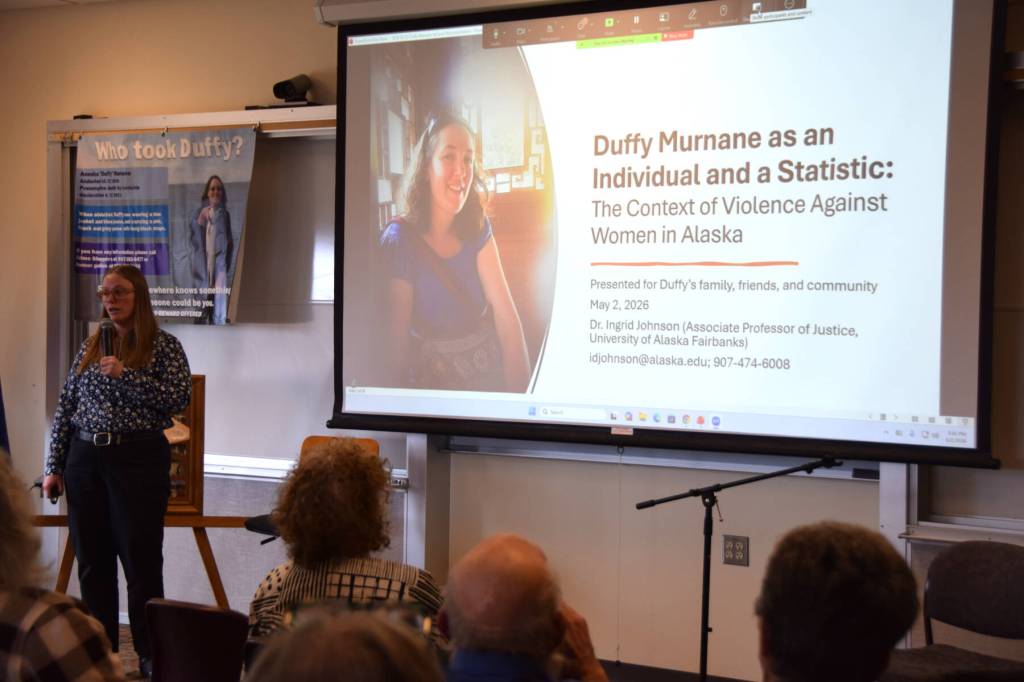
The event concluded with a presentation by Ingrid Johnson, associate professor in the University of Alaska Fairbanks’ Department of Justice & Women, Gender and Sexuality Studies. Johnson’s discussion, titled “Duffy Murnane as an Individual and Statistic: The Context of Violence Against Women in Alaska,” set Murnane’s case within the broader context violence against women and of missing and murdered individuals statewide.
Why a plea deal
Huelsman has been the spokesperson for Murnane’s family throughout the court proceedings against Calderwood. He spoke on Saturday about the plea deal, which was finalized on Feb. 5, and next steps including Calderwood’s sentencing hearing currently scheduled for July 1 at the Homer Courthouse.
Calderwood pleaded guilty to second-degree murder in February and faces an active prison sentence of 87 years, followed by 10 years’ probation, in accordance with the plea agreement. Homer News previously reported that Calderwood will be eligible for discretionary parole after serving two-thirds of the 87-year active sentence — about 58 years. At that point, Calderwood would be 94 years old.
Huelsman said Saturday that the prosecution was able to enact a plea agreement partly due to the “overwhelming” evidence against Calderwood. Moving forward with a plea deal rather than a trial also helped to ensure that justice was done sooner for Murnane’s case — otherwise, he said, a trial would have taken an additional 1-2 years.
As part of the plea agreement, the first-degree murder charge against Calderwood was reduced to a second-degree murder charge and all other charges were dropped. However, the end result for sentencing ultimately turned out the same.
“Second-degree murder and first-degree murder in this case is a 99-year sentence, so when we gave that up, the family felt like we were giving up a nothing burger,” Huelsman said.
“Frankly, the family didn’t want revenge. What we wanted was to be sure that society would be protected. So we felt that that was met.”
Huelsman called the upcoming sentencing hearing “a wonderful opportunity to move towards closure,” but also suggested there may be future appeals and attempts at release.
He clarified in an email to Homer News that as part of his talk on Saturday, he wanted to prepare community members to anticipate appeals.
“Given the long sentence, it is highly likely, almost inevitable, that appeals will be filed. The most likely one is an appeal related to the defendant was not adequately represented by the attorney,” he wrote. “Fortunately, I’ve heard nothing about Calderwood, or his defensive attorney, intending to file appeals.”
In anticipation of the possibility that Calderwood is released from prison on discretionary parole, Huelsman invited the community to submit victim impact statements, which will be provided to the judge presiding over the July 1 sentencing hearing and to the Alaska Department of Corrections, and may be reviewed by officials responsible for any future release decisions. Submissions are confidential and will not be accessible to the public.
“Our thinking is the victim was Homer, and us, and we encourage you to write a victim impact statement that will be included in a report even 58 years from now, if the parole board is evaluating him,” Huelsman said.
Victim impact statement submissions will be accepted through June 30. Printed statement forms are available at the UPS store in Homer and on bulletin boards at the Fritz Creek General Store, Kachemak Gear Shed, Two Sisters Bakery and Ulmer’s Drug & Hardware. The form is also available online through the “Bring Duffy Home” Facebook group.
The Pratt Museum will also be archiving materials related to Murnane’s case and invites community members to submit a copy of their impact statements for inclusion. These archive materials will be publicly accessible.
To submit a statement to the Pratt Museum, deliver a paper copy in an envelope labeled “Care of the Executive Director” to the museum’s admissions desk or email it to director@prattmuseum.org with “Archive for Duffy” in the subject line. For specific questions regarding the victim impact statements, email justiceforduffy@gmail.com.
During his talk, Huelsman also highlighted the adjudication process, which from the time of Calderwood’s arrest to his guilty plea, continued for three years and nine months. He acknowledged that “justice takes a long time,” but added that, compared to the Lower 48, it seems to take longer in Alaska.
He called attention to “Rule 45,” one of the rules of criminal procedures in the Alaska court system which is meant to guarantee a defendant’s right to a speedy trial. Rule 45 states that “a defendant charged with a felony, a misdemeanor, or a violation shall be tried within 120 days” generally from the date the charging document is served upon the defendant. However, periods of delay resulting from a continuance granted at the request or with the consent of the defendant and their counsel are excluded from computing that 120 days.
Rule 45 further clarifies that “the court shall grant such a continuance only if it is satisfied that the postponement is in the interest of justice, taking into account the public interest in the prompt disposition of criminal offenses, and after consideration of the interests of the crime victim, if known.”
“But defense attorneys are using that as a loophole to constantly delay, and they do it because, ethically, their job is to give a vigorous defense and use everything that they can to get the person off,” Huelsman said.
“Alaska needs to do two things — they need to do better on catching criminals, and they need to do better on adjudicating them.”
Huelsman further said that when Murnane’s family and members of the community saw the delay in adjudication, they responded using the “court watchers” strategy and attended court hearings in person to show that they cared and to provide a watchful presence.
“When we started doing that, the process started moving,” he said. “(The) court watchers here today that joined us for that, I thank them for their work, as well as the people that have worked in many other ways.”
Huelsman also highlighted the need for a “strong, robust” crime lab in Alaska.
“DNA was important in this case. It’ll be important in many other kinds of cases,” he said. “There’s 300 crime labs in the United States. In Alaska, (we have) one crime lab and it’s got to everything. We need to have the best possible crime lab in Alaska.”
In a different part of his talk, Huelsman reflected on his niece’s life and character, and her relationship with her community.
“Duffy had a mental health challenge, but in some ways, I personally see her as being a mental health success story, where she was a person who received a lot of support from the community, and she thrived on that support, and she gave back to the community with her love for children and with her wonderful personality,” he said. “That was Duffy. I’m really very proud of the Homer community, which supported her during her life, and stuck with the family through all this long journey.”
The investigation
Haney started police work in 1977 and solved his first cold case in 1981. He previously worked with the Homer Police Department in the 1990s, and his past experience prior to moving back to Alaska in 2015 also includes solving crimes related to murdered and missing individuals from the Colville Reservation and Yakama Reservation in Washington state. After living for a few years in Anchorage, Haney returned to Homer with his family in December 2019, whereupon HPD asked him to review Murnane’s case.
“I want to make crystal clear that the community and the Homer Police Department and the FBI and the K9 search teams — everybody did an outstanding job of trying to find where she was,” Haney said Saturday. “Any of these cases are very difficult and challenging.”
Haney walked the audience through the steps of his investigation, from compiling a detailed profile of Murnane through talking with her family to vetting all of the male employees from the mental health organization that worked at the supportive housing unit where Murnane lived to investigating every single crime tip that came in. He said that he first learned Calderwood’s name from a Crime Stoppers tip that came through a community member talking to a police officer.
“The actual tip was pretty bizarre and the facts of what we were being told turned out to be completely false, but that gave us his name,” Haney said. “When we looked at his name, even though he hadn’t been given to us as a person that had worked at a housing unit, he had.”
When Haney confronted the mental health organization that had previously provided the list of employee names, they said they didn’t provide Calderwood’s name “because he only worked there part time.”
“I really can’t address that. There are parts of any case that are frustrating, and that was one of many,” Haney said.
Further investigation into Calderwood revealed “that he was an extremely violent person and had a very violent past.” Through interviewing Calderwood’s two ex-wives and three ex-girlfriends, Haney grew to understand that Calderwood was very violent against women, even though he had never been arrested in the past.
In answer to a question from a community member in attendance on Saturday, Haney confirmed that if Calderwood had not lured Murnane into his car while she was walking from her home to a medical appointment, he would have victimized someone else.
“The information that I was told second-hand was that he had decided he was going to kidnap and kill someone. I’m not a psychologist, but he has a long history of, as a young person — this is documented through other sources — of torturing animals, and that’s the kind of person he is,” Haney said.
An audience member asked whether there was any indication of Calderwood having previous victims. Part of the investigation also revealed that Calderwood, who was ex-U.S. Army and had been stationed overseas, had previously committed “horrific assaults,” but Haney found no direct evidence of previous homicides.
“Like in other cases I’ve worked, you look back for former victims, and we did go back — all of us put together a really detailed timeline of where he had been stationed, where he had lived growing up, and we could find no direct evidence of actual homicide. We did find direct evidence of horrific assaults and those kind of things, but I have no evidence that he had actually murdered anyone,” he said.
Haney and former HPD Sgt. Jessica Poling, who worked with him on the case, continued investigating Calderwood and later called him in for what Haney called a “soft interview.”
“It was revealing in that there was another side of him, a dark side that he didn’t want anyone to see,” Haney said.
When Haney later called Calderwood back in for another interview, Calderwood informed him he needed to talk to his defense counsel. A week later, Haney discovered that Calderwood had moved to Ogden, Utah.
Haney and Poling were working to construct an affidavit to both search and seize Calderwood and seize physical evidence from him when another Crime Stoppers tip came in that “gave details that we had never heard before,” Haney said, including facts of the crime and the crime scene, and other information.
“With that information, Officer Poling and I then went and found the crime scene. It fit exactly the description,” Haney said.
Haney said he was able to track down the tipster and establish trust, which led to the tipster providing a series of recorded interviews that enabled Haney to get search and arrest warrants for Calderwood. Further collaboration with the Ogden Police Department later led to Calderwood’s arrest.
Several audience members asked how Calderwood, with his long history of violence, had never been stopped and was eventually hired at a mental health facility.
“I know that he was reported to the U.S. Army more than once, and I saw their 24-page documentation of their investigation, and what they documented was they didn’t do an investigation,” he said. “That’s sad, and that’s one incident. The other incidents, he would demonstrate to them clearly what he was capable of should they ever report him, and that worked. They didn’t report him.”
Regarding Calderwood’s employment at the mental health organization, Haney said the former director who hired Calderwood had stated that a background investigation was done.
“When I interviewed the person who hired him, he said, “Well, we sent his fingerprints in to the Alaska troopers, and they cleared him, and that’s all we’re required to do,” he said. “I don’t know if that’s true or not, but even if it’s true, that’s sad when you’re placing a man with vulnerable women. That just doesn’t seem logical to me.”
Haney has extensive experience conducting background checks, but also said that there are various services which are available to the public outside of law enforcement and “a lot of it comes back to what you can find out on the internet.”
“There are no secrets in the world,” he said.
Gender-based violence as a systemic issue
Johnson has spent years studying violence against women in Alaska. Prior to holding her current position as associate professor at UAF, she spent six years at the University of Alaska Anchorage where she was an associate professor with the Alaska Justice Information Center.
“Because I’m from Delta Junction and Fairbanks, the topic of violence against women and gender-based violence is very important to me personally, and I’ve made it my professional focus for over the last decade,” she said Saturday.
Johnson gave an overview of what gender-based violence is — violence that is directed against a woman because she is a woman, or that affects women disproportionately. Examples of gender-based violence against women includes intimate partner violence, sexual violence, stalking and femicide.
“What makes these gender-based is the fact that anybody of any gender can be a victim of these types of violence, but they are disproportionately committed by men against women,” she said. “Again, I want to emphasize that men and people of all genders can be victimized, but largely we’re seeing women as the victims of these types of violence committed by perpetrators.”
Data gathered from sources like the Uniform Crime Report shows that the national rate of female victims murdered by males in single perpetrator incidents — so not incidents like mass shootings — is 1.34 per 100,000 individuals. Alaska’s rate is 3.43 per 100,000 individuals — more than two and a half times the national average.
Johnson said that the UCR does include data on rapes and information on intimate partner violence, but only those incidents which are reported to the police. To better understand the scope of violence against women in Alaska, researchers like Johnson turn to the Alaska Victimization Survey, which is a general population survey of adult women in Alaska made available through a joint effort between the Alaska Council on Domestic Violence and Sexual Assault and the UAA Justice Center.
According to the AVS, last conducted in 2020, 48% of Alaskan women have experienced intimate partner violence or threats of physical IPV that would “very likely have met (state) statute to be illegal,” Johnson said. About 40.5% of Alaskan women have experienced sexual assault, and 35% have experienced stalking. Johnson also said that the 2026 AVS is currently being conducted.
She illustrated the criminology theory of deterrence, that the threat of punishment will prevent people from committing crimes if it is severe enough, swift enough and certain enough.
“After decades of research on all kinds of crime and in all kinds of contexts, what criminologists have come to figure out is that severity doesn’t really seem to matter. Swiftness is kind of difficult to measure, because we don’t have a swift criminal justice system. But certainty is something that we have seen very consistently, if we can increase the likelihood of somebody getting caught, we’re more likely to be able to deter crime,” she said.
Unfortunately, Johnson added, punishment for gender-based violence in the U.S. is not certain.
“If we really want to tackle it from the very beginning of the process and try to get more cases resulting in some kind of consequence, it’s really about increasing victim reporting,” she said. “There’s a lot of different reasons for not reporting. Some of it could be fear-based … it could be that they have no interest in putting themselves through a criminal legal process. It could be a fear of not being believed.”
The first step, Johnson said, is to believe victims.
“That culture of ‘start by believing’ is not only important for our criminal legal system actors, but it’s also important for communities to support people through the reporting process,” she said. “If they’re going to report, they need a robust network of people around them who believe them, who help them keep going through that process.”
Other potential solutions, according to Johnson, include “giving victims’ rights teeth” to make reporting safer and more comfortable.
“In Alaska, victims have a right to be treated with respect and dignity. They have a right to the timely disposition of their case. But there’s not really a good way to actually enforce what happens if they’re not treated with respect. What happens if they’re not treated with dignity? What happens if their case drags on for years and years and years?,” she said.
“We also really need to invest in criminal courts and legal professionals so that cases aren’t dropped due to time constraints” and lack of resources, she said.
Reflection on a community united
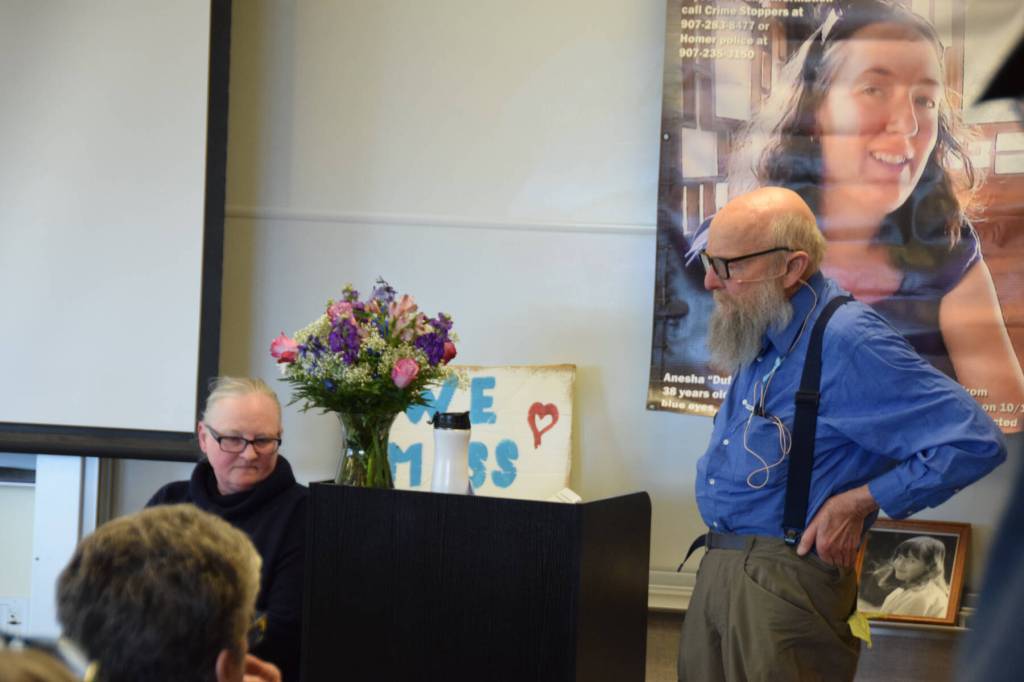
As Huelsman spoke to the journey through the court proceedings and Haney spoke to the investigative journey, Berg reflected on Murnane’s life and her family’s journey through searching for her and seeking to give her justice.
He recollected how the community gathered around him and Sara Berg, Murnane’s mother, and helped sustain hope and energy throughout the investigation.
Whiting, sharing the floor with Berg, looked out over the audience and said she could point out so many individuals who responded to Murnane’s family and offered help. She also recapped the community force behind the creation of the Loved and Lost Memorial Bench, and how Murnane’s case spurred greater action across Homer.
“Everything from searches and vigils and posting flyers and hanging banners and flying drones and people looking on their property and sharing the Facebook posts — I think that this tragedy touched a lot of people, and at the end of the day, it was Ed and Sara just refusing to have Duffy be forgotten and to keep people involved in looking,” she said.
A recording of the “Duffy’s Journey to Justice” event is available through the end of the month on the “Bring Duffy Home” Facebook page. The videos are also available by request by emailing justiceforduffy@gmail.com.
Murnane’s family is currently working to establish “Duffy’s Legacy Fund,” centered on early childhood education, through the Homer Foundation. The fund will honor Murnane’s love of and passion for working with children.
A community healing ceremony is also being planned for July 1 at the Bishop’s Beach Pavilion, following Calderwood’s sentencing. Plans are also in the works to host an audio feed of the hearing at the Homer United Methodist Church, pending approval by a judge, so that the community can witness the sentencing without hindrance from limited space at the Homer Courthouse.