Winter rescue: Saving the teacher’s life — Part 4
Published 4:30 am Thursday, July 2, 2026




AUTHOR’S NOTE: On Nov. 20, 1927, Ninilchik schoolteacher John Bess Howe accidentally shot herself in the abdomen while cleaning a gun. After waiting in pain for several days, she was transported to an Anchorage hospital, where she was operated on and convalesced for about a month. Next, she was transferred by train, steamship and ambulance to a hospital in Seattle.
John Bess Howe’s mother, Lena Dell Howe, arrived at Virginia Mason Hospital, in Seattle, from rural Texas, near the end of December 1927. Lena Howe had traveled to support her daughter, who had been transferred to Seattle from Anchorage, where she had spent nearly a month recovering from an accidental gunshot that had left five perforations in her intestines.
Miss Howe, a Ninilchik government schoolteacher, had been cleaning the weapon when it discharged, striking her in the abdomen. It had taken the combined efforts of at least three Ninilchik residents, a Kasilof fox farmer, a Seldovia radio operator, and a pilot and doctor from Anchorage to get her to the hospital in Anchorage. She was lucky to be alive.
Despite everything she’d been through, however, she told a reporter in Seattle that the worst thing about it all had been the constant attention of the press. “Of course, I close my eyes and try to shut out the events of those terrible days,” she said about the shooting and her difficult rescue, “but the worst thing about the whole affair is all this publicity. I’ve been heralded from New York, South, and all over the Middle West to the West.
“And really,” she continued, “the wonderful thing about it was the operation—the great skill of the doctors. Newspaper stories are worse than anesthetic to me…. They tell me I may be flat on my back for weeks longer, perhaps even months, but you know the main thing, I am getting well—and the whole affair is behind me, at least as far as I am able to put it there.”
Howe also expressed her desire to return to Alaska, perhaps as early as May. She later had to adjust her expectations. Even though she was able to return home to Seymour, Texas, by Feb. 1, it doesn’t appear that her goal of returning to the Last Frontier ever became a reality.
She penned a letter in mid-January 1928 to an acquaintance in Anchorage to report her continuing recovery and acknowledge again the compassion of the people of the north: “The kind interest of the Alaskans (has) done as much, almost, toward my recovery as the medical aid,” she said. She wrote to Mrs. R.B. Woolverton in Seward at the end of the month to say that she hoped to return to Alaska by June, if her health permitted her to do so.
By the end of March, she felt well enough to act as an attendant in the wedding of a friend in Wichita Falls, Texas.
In August, in an open letter to the Seward Daily Gateway, she reiterated her desire to return to Alaska and stated her disappointment at having been unable thus far to make the journey.
“I found it impossible to do so,” she wrote, “against the advice of my physician and without the consent of my parents, which I cannot gain until at least another year has been allowed for a complete recovery.” A year and a half after that letter was printed in the newspaper, Miss Howe married Charles Francis “Dutch” Fancher.
She spent the rest of her life in Texas.
First coda
The young teacher never truly left the public eye, although she seemed at times to have wished otherwise.
In August 1928, the Seward Daily Gateway reported: “It is said that Bessie Howe, Westward schoolteacher and heroine whose story was published in the Gateway at great length on a number of occasions, [has] been awarded a first prize of $1,000 by True Stories Magazine, which carried her story in the July number.”
It took a few weeks for knowledge of the magazine article to reach Howe, but when it did, it prompted a response from her that the Gateway published on Oct. 31.
The magazine—which was actually a sensationalistic, romance-driven publication called True Story—featured numerous inaccuracies in its narrative, Howe said. Furthermore, she contended, she had received no payment for the article and she had played no part in its creation.
“Some parts of the story may have been based on my experiences,” she stated with clear indignation, “but I want to say to all the people of Alaska and especially to my very good friends and to everyone who made my untimely suffering easier to bear that I have not written an account of my experiences nor have I given anyone permission to do so. Anything that refers to it has been stolen for its interest, and I promise you it shall be investigated at once.”
If she did investigate, the results of her inquiries do not appear to have been made public.
Just before her June 1930 marriage to insurance agent Dutch Fancher, the U.S. Census listed John Bess Howe as a boarder in the home of the elderly Mr. and Mrs. McWhorter of Baylor County, Texas. Miss Howe was 23 years old and listed as a public-school teacher.
For the rest of her life, she was known as John Bess Fancher. And for the many years following her husband’s death from heart disease in 1958, she retained that name and her widowhood.
The final decades of her life were extraordinarily active and productive.
During the mid- and late 1930s, John Bess Fancher was billed as a home economist and one of “the Southwest’s greatest home-canning experts.” In Wichita Falls and Houston, she gave regular in-store canning demonstrations, featuring the Ball Brothers’ glass canning jars and steam-pressure cookers.
One newspaper advertisement in 1937 called her a graduate of the College of Industrial Arts and the University of Colorado.
“She has been active in extension and 4-H Club work for the past 14 years,” it added.
During World War II, she spent her time in government and Red Cross service. In 1950, she was a ranch manager in Amarillo—making her, technically, Fancher the rancher.
She was still going strong into the 1970s and 1980s—donating livestock to an auction to benefit handicapped children, working as part of the Baylor County steering committee dedicated to reelecting U.S. Senator John Tower, belonging to the Baylor County Taxpayers’ Association, and spending more than a quarter-century working for her local chapter of the American Heart Association.
She received the Distinguished Service Award from the AHA. She was an ordained, ruling elder of the First Presbyterian Church.
She served on the reunion committee of the Seymour Chamber of Commerce and the local hospital auxiliary.
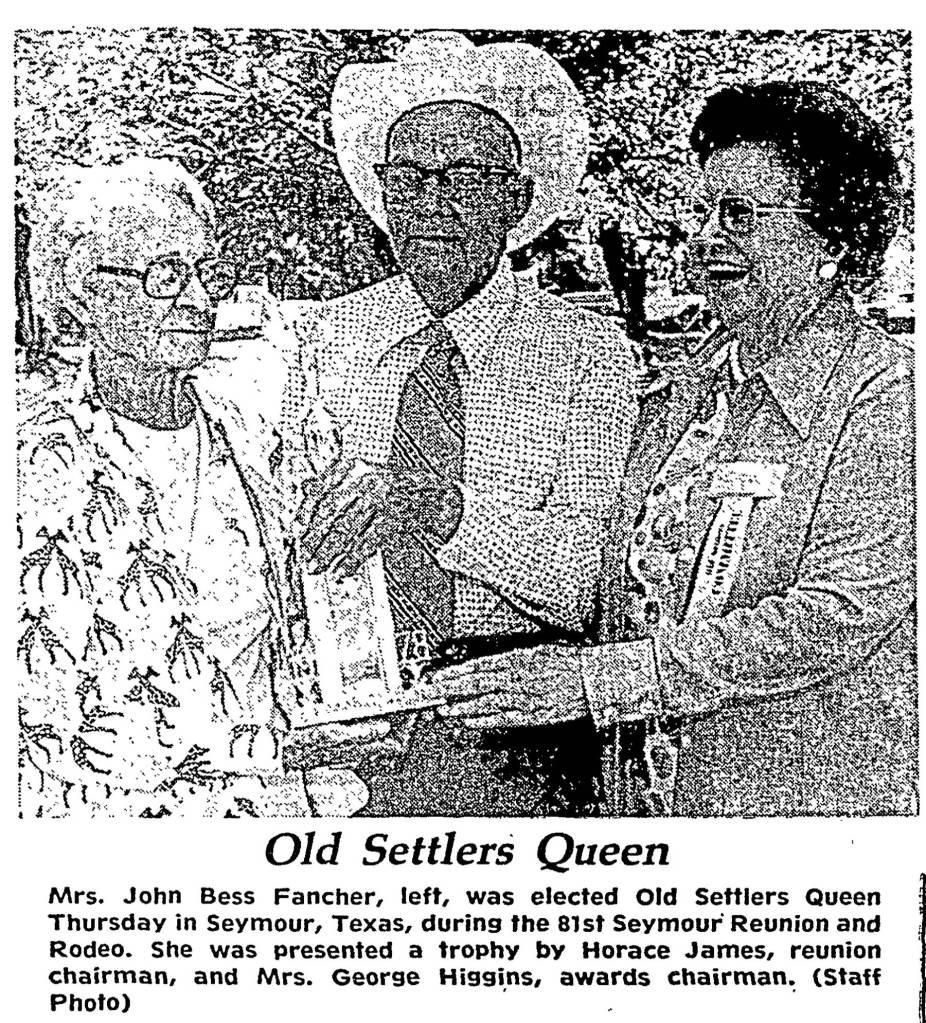
She was elected queen of the Old Settlers Reunion in Seymour, where her family had a history stretching back more than a hundred years.
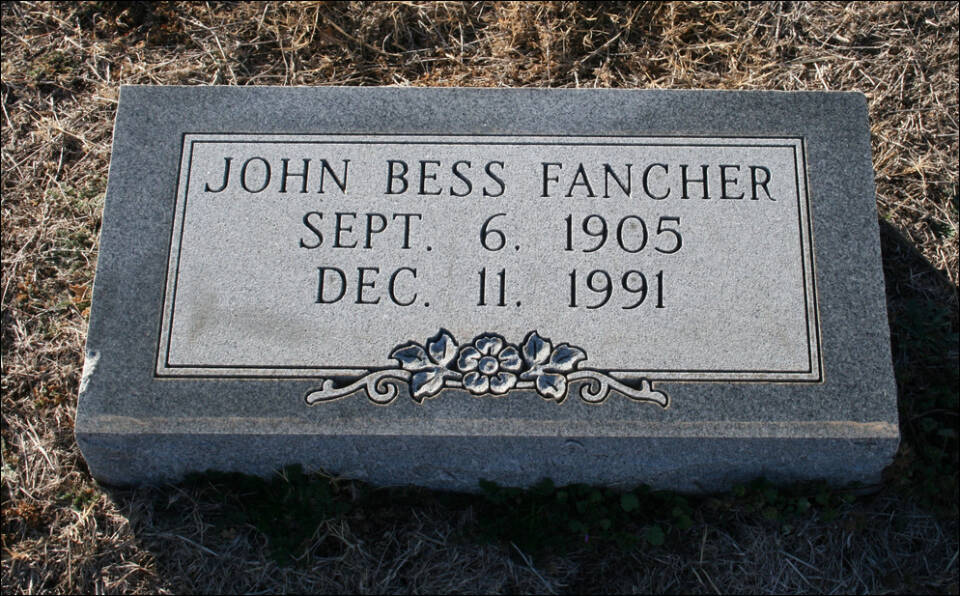
She died in a Seymour hospital, at the age of 86, on Dec. 11, 1991.
TO BE CONTINUED….