School board weighs budget reduction options
Published 1:30 am Thursday, March 5, 2026
The Kenai Peninsula Borough School District Board of Education held a series of work sessions and meetings over two days earlier this week to review, among regular business, proposed budget reduction scenarios for fiscal year 2027. The district is currently facing an $8.6 million deficit due in part to reductions in anticipated borough and state funding.
KPBSD is not the only district in the state facing overwhelming financial difficulty. Budget discussions over the last several months have highlighted rising operational costs amid a continued lack of sufficient state funding, despite the Legislature passing a $700 increase to per-student funding last year — the repercussions of which are being felt statewide.
District superintendent Clayton Holland noted during the KPBSD finance committee meeting on Monday that the Mat-Su Borough School District has proposed closing three elementary schools and eliminating over 100 full-time positions in the face of a $23 million shortfall. Last month, the Anchorage School Board, facing a $90 million deficit, voted to close three elementary schools and cut more than 500 staff.
“We are not going to be in that scenario,” he said. “We’re putting it all on the table here for what we have to do to make things happen.”
Budget scenarios
District administration presented to the board three budget scenarios for consideration. Scenario one, what Holland called the “worst case scenario” and the reality that the district is staring down, assumes that the district will receive the level of FY27 funding currently being proposed by the state and borough — approximately $141.7 million together.
All three scenarios assume $71.8 million in foundation funding from the state, which is the funding per the base student allocation, unless the Legislature makes changes to education funding or increases the BSA again. The district received over $76 million in state foundation funding last year; the reduction this year is largely due to a cost-shift from the state to the borough following property tax value increases, with the rest attributed to declining enrollment.
Under scenario one, KPB funding would be about $59 million between appropriations and in-kind services — approximately a 2.5% increase from the FY26 borough funding originally proposed before the KPB Assembly funded the district to the cap.
Scenario two counts on the district receiving the same level of borough funding in FY27 as they did in FY26, after the assembly voted to fund schools to the cap. Total revenue would equal approximately $145 million, with $62.3 million coming from the borough. Scenario three includes the maximum allowable FY27 funding from the borough — about $68.6 million — and puts total revenue at $151.3 million.
Before making any budget reductions, the district’s expenditures in the preliminary budget were estimated at $149.5 million.
During the board’s quarterly finance work session on Tuesday, board members gave consensus to move forward with scenario two as a starting point for balancing the budget. Some board members said that working off of this scenario, which includes an increase to current-level borough funding, would show a strong stance to the borough assembly of the district’s needs.
“I would like to believe it is a safe assumption that we will get at least status quo funding from the borough, and we can advocate for that very strongly,” board member Mica VanBuskirk said.
Board clerk Sarah Douthit said that scenario two was “something that is important to advocate for.”
“I think it would be ideal for our district, as long as we’re able to include consolidations in that,” she said.
The board also discussed during Monday’s school consolidations work session whether the budget deficit could be made up strictly through spending cuts and increasing the pupil-teacher ratio, or if consolidations were necessary to balance the budget. Holland said he didn’t see a way out without consolidating schools.
“Without consolidations, more reductions will occur across every school,” Holland said. “The primary impact will be increased pupil-teacher ratios, and higher PTR will reduce supports, programs and student opportunities in every building … without consolidation, reductions are spread across all students instead of managed through strategic planning.”
Holland added that the level of borough funding provided under scenario two would reduce the amount of immediate reductions required and would make possible a phased consolidation approach.
“Just like the board, there is nothing on this (budget scenario) that I want to do,” he said during Monday’s finance committee meeting. “There’s not a want on this. But we have to come up with a balanced budget by the end of the day.”
The latest numbers
Under the most recent version of the budget scenarios, following Tuesday’s work sessions, all PTR increases have been removed, a decision generally supported by members of the board of education. This also aligns with concerns expressed by respondents to the FY27 Balancing Act, a majority of whom requested no changes be made to high school, middle school, elementary school and small schools PTR. Public comments in the Balancing Act summary show a continued desire for small class sizes and retaining certified teachers, and say that middle and high schools have already faced major staffing cuts which have hurt students.
“We have to preserve our teachers in our classrooms and our staff … those positions that are working directly with our students,” VanBuskirk said.
Douthit said that PTR increases “are 100% staffing reductions.”
“If you spend any time in some of our larger elementary schools and high schools, they have a lot of kids in the classroom, and we can’t keep taking staff away from them,” she said.
In order to make up for the budget reductions lost by not increasing PTR, VanBuskirk suggested eliminating theater techs and managers, adding that doing so would help to prevent the elimination of library aides and certified librarians.
“In order to not have any library aides, librarians or teachers in this reduction, we have to seriously consider, in the same way that we’re closing pools, closing theaters and moving that to our communities,” she said. “I know it’s not an easy thing, and I know our kids need our theaters, but these are something that our communities can pick up easily.”
Holland reminded the board that the district did reduce one and a half theater positions last year.
“My concern with an elimination of this is that the liability for those theaters, no matter what we do … will still land back with the district,” he said. “Unless we’re just saying we’re shut down, if the theaters are no longer available to anybody, then it’s elimination. If we’re actually going to have people come in, we cannot eliminate that.”
Eric Soderquist, KPBSD Director of Information Services, added that when schools reach out for technical assistance with their theaters, trained theater techs are the ones who answer.
“It’s a specialty field … I don’t see much availability in my team to really, truly meet the level of caliber and fidelity that the theater techs do,” he said.
Cutting those positions would save the district $511,753. However, despite several board members stating support for eliminating theater techs and managers, that item is not currently included in scenario two on the latest budget sheet. Douthit also stated that district administration did not recommend cutting theater techs and managers in this presentation to the board.
Pool closures are included in all three scenarios — a potential $1.5 million savings for the district. Holland clarified during the finance committee meeting that that figure includes a reduction of in-kind services, “which is not something that we have knowledge that can be done yet or will be done at this time.”
“That amount is likely to be half of that, without a reduction in in-kind (services),” he said. “This was originally done with a complete closure and not a shift to people paying to offset cost.”
Assistant superintendent Kari Dendurent confirmed Wednesday that the school board recently approved ending district financing and operation of school pools. According to a Feb. 5 KPBSD press release, absent another viable solution such as a municipality, swim club or other organization assuming full operational responsibility; external partners or municipalities providing sufficient funding to fully offset pool operation costs; or the borough funding full pool operations outside of the district’s funding cap, district-operated pools will be closed effective June 30.
The elimination of certified librarians and library aides are currently included in the second budget scenario, a savings of $416,192 and $718,595 respectively. Board members held extensive discussion on reducing library staff positions instead of eliminating them, and other ways to address the proposed budget reduction. Several stated strong support for retaining library aides and finding ways to fund those positions.
Nate Crabtree, KPBSD Director of Human Resources, said that library aides currently work between 3 and 3.5 hours per day, and that he didn’t recommend cutting those positions in half.
“There’s no room to cut that in half,” he said. “Those types of positions are incredibly hard to fill, because it’s not worth the effort to get to your place of employment. So when we’re talking about reducing to half, the other option is to reduce half of the aides. Now you’re talking about which schools are going to get that half of an aide, or you’re splitting an aide starting at one school and then driving (to another).
“Logistically, from my perspective, it’s an all or nothing decision. Either they’re all reinstated or it is a cost-saving measure that’s incorporated for next year.”
Holland asked what would happen to librarians who have contracts with the district if they are not funded for FY27. Crabtree said they would be reassigned to a teaching position.
Scenario two also calls for eliminating certified distance education staff and certified middle school reading staff; reducing programmatic staffing by 50%; reducing custodians’ work days; reducing English Language Learners positions by 50%; and increasing middle school and high school extracurricular activity fees to cover the cost of stipends.
“Currently, activity fees stay at the site level. This would change it to where those fees come back to the district level, or at least a percentage of them come back to the district level,” Holland said during Monday’s finance committee meeting.
Under this scenario, the district is also looking at saving $145,000 by eliminating transportation funding for extra-curricular activities and athletics.
The budget scenario also includes funding cuts to the district office, including an elimination of the communications specialist position that administration opened a search for earlier this year — a 5% reduction to district office certified staff salary costs, or a savings of $139,407. The district office operating accounts would also be reduced by 10%, or $51,937.
Further, the budget scenario calls for a 50% reduction to the Kenai Peninsula Middle College, which Holland said was implemented last year, before state education funding was finalized and the board reversed some FY26 budget cuts. Also included are a 50% curriculum reduction, a 10% school sites supplies reduction and a transportation transfer elimination equalling $200,000.
“At this time I believe we would have to eliminate or reconfigure two routes,” Holland said. “I will hold some hope that at the state level … there’s talk of transportation fund changes that may help with that scenario, but that’s very uncertain at this time.”
Dendurent explained Wednesday that the state provides a certain amount of money to school districts to assist with transportation costs.
“Unfortunately, that is not enough money to cover our regular daily transportation routes. So what we do, as we have in the past, is we take money from the general fund to assist with covering transportation costs,” she said.
The $200,000 transportation funding eliminated from the budget would cancel the transfer from the district’s general fund to cover daily bussing operations.
Other cuts include a 50% reduction to districtwide travel and reductions to student support services by $500,000 and health services by $100,000.
The district also remains in ongoing negotiations with employee unions. Dendurent said Wednesday that the district’s latest offer, from Feb. 25 and 26, includes a 2% wage increase. According to the latest budget laydown, that would add over $2.9 million to the district’s expenditures.
“We have to always honor our last best offer,” she said. “It has not been settled, but it is on here as an expenditure.”
School closures and consolidations
School consolidations being considered at this time include Seward Middle School, Sterling Elementary and Tustumena Elementary. Both Sterling and Tustumena were included in the initial list of proposed school closures last year, but were eventually taken off. River City Academy is also being considered for closure in FY27.
Paul Banks Elementary in Homer and Nikiski Middle/High School are listed on the budget sheet on an informational basis, to reflect the savings that the district would see if either of those schools were closed. According to the laydown budget sheet, neither school is currently being considered for closure in FY27 under any of the three budget scenarios.
Under the current scenario, Seward Middle School’s sixth grade would be combined with Seward Elementary, with seventh and eighth graders being combined with Seward High School. Sterling Elementary would be combined with Soldotna Elementary, possibly for a year depending on progress with existing school bond projects, and Tustumena would be combined with Redoubt Elementary. According to previous reporting by the Clarion, the KPBSD board approved in August a plan to combine Soldotna and Redoubt elementary students into the vacant Soldotna Prep School.
River City Academy is a performance-based school located within Skyview Middle School, serving grades 7-12. The school is being considered for closure due to decreases in both enrollment and staffing.
“The concern is, are they able to provide adequate staffing in order to provide the program as they have it set forth?” Dendurent said on Wednesday.
Holland explained that closing RCA isn’t about saving on deferred maintenance, but rather “a straight staffing change,” where those staff members would be consolidated into a different school.
Dendurent also said Wednesday that because RCA is a program and classified differently than a typical brick-and-mortar school, if the school is closed, it would not fall under the seven-year moratorium before it would be allowed to reopen.
The school board is required to vote on any school closures or consolidations they decide to implement. Dendurent also confirmed Wednesday that, prior to a vote, the district would have all four schools currently under consideration go through the public process set forth by the Alaska Department of Education and Early Development.
If all of the current proposed cuts go through and the borough provides equal funding to FY26, budget scenario two shows that the district would end up with a $2 million excess of revenue over expenditures.
The proposed budget drafted following Tuesday’s work session will be presented again to the school board at the next meeting in April, with the intent that the board takes action on it at that time.
Public testimony
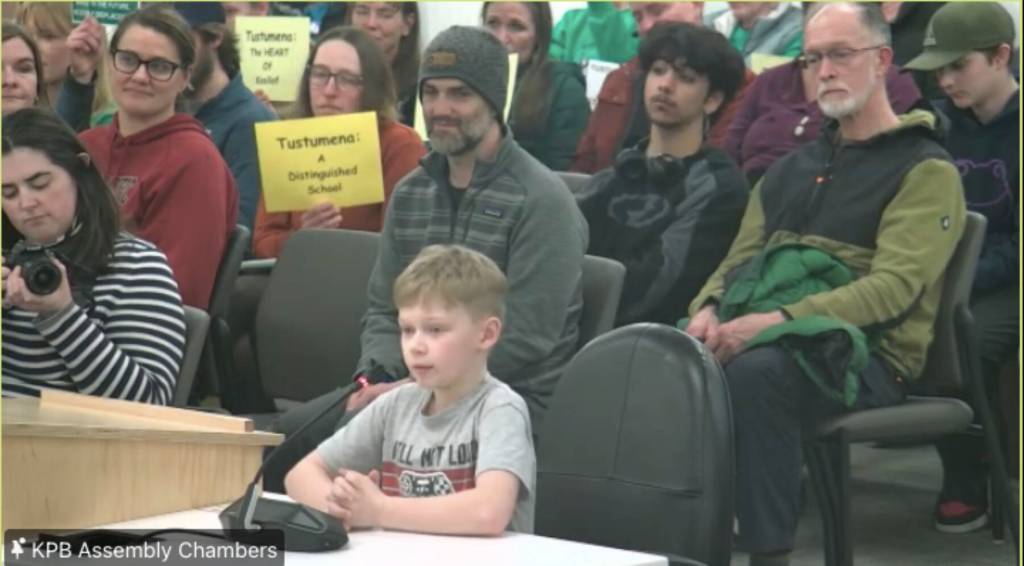
Nearly two dozen district parents, students and community members provided public testimony to the school board during their regular meeting on Monday, asking for the district to preserve their schools.
Talitha Wilcox, a student at River City Academy, said her fellow student body wanted their school to continue.
“We love where we are and we are succeeding, and we’re seen and we’re cared for,” she said. “Every other school I’ve gone to, I’ve felt really lonely and I haven’t been able to connect with people. But I’ve never had that problem at RCA. I’ve been there for two years and it is the place that I felt the most cared for throughout all of my schooling.”
Several young students advocated for keeping Tustumena open, saying that it’s an important part of the community and that school staff work well to meet the students’ individual needs.
Soldotna High School Tamra Wear spoke against the proposed elimination of library aides.
“I want to make sure that everyone knows that the title ‘library aide’ is a misnomer. In 17 out of 22 of our libraries, these individuals … work entirely by themselves. There is no librarian,” she said. “These employees actually give you the best value for your money. They are key to maintaining the productive infrastructure of these schools and their jobs are entirely focused on on of the district’s main priorities — student literacy.”
Amanda DeBoer, a parent at Tustumena Elementary, said that her family moved to Kasilof for the “small community feeling” and the community they’ve found is based around Tustumena.
“All of the people you’ve heard speak — our kids all go to school together, they come to each other’s birthday parties, they come for community events,” she said. “This is really hard for us to see that this might be closed, because it is a cornerstone of our community. We don’t want to be in the city. We don’t want the larger class sizes.”
Kylie Wilcox, Talitha’s mother, said that her children found the support they needed at RCA and were thriving there, when they had struggled elsewhere.
“Choosing to close a program like RCA will only serve to push more kids out of KPBSD and into private or home school options as parents and students are asking for more flexibility and individualized learning paths for their secondary education,” she said. “RCA is the perfect place for students like my kids. Please don’t make them move again.”
Rep. Louise Stutes, R-Kodiak, spoke up after several more parents and community members testified during the second public comment period at the end of the regular meeting.
“I’ve listened to this whole meeting — it’s just heart-wrenching,” she said. “I understand the dire straits that our education system as a whole is in … we’re aware of it, and our caucus in particular, as the (House) majority, has made education funding — to what degree at this point, we don’t know — but it is certainly a priority that we have.
“So there’s hope. We hear you, and I want you to know that I personally hear you, and I will do whatever I can within my power to support you as our educators.”
Find all budget materials and recordings of the March 2 and March 3 meetings on the KPBSD BoardDocs website.
The next regular KPBSD Board of Education meeting will be held April 6 in Homer.