Winter rescue: Saving the teacher’s life— Part 2
Published 1:30 am Thursday, June 18, 2026


AUTHOR’S NOTE: On Nov. 20, 1927, Ninilchik schoolteacher John Bess Howe accidentally shot herself in the abdomen while cleaning a gun. During a days-long storm, Walter Kotoff and Victor Kelly had walked to Kasilof to telegraph a distress call to both Seldovia and Anchorage. Kotoff had then made his way to Seldovia, via Homer, to make certain that his request for medical aid had gotten through. It had.
Help for the injured Ninilchik schoolteacher would soon be on the way.
After John Bess Howe had accidentally shot herself in the abdomen on Nov. 20, 1927, a request for medical assistance had been relayed by telegraph.
The weak radio signal had been received in both Seldovia and Anchorage, and rescue actions got under way.
It should be noted that in 1927, Seldovia had two resident physicians—Dr. Jens Jensen and Dr. Arthur Layne—both of them having spent more than a decade in Alaska, both of them considered older men but still effective doctors, and both of them, according to news reports, willing to assist in the emergency by venturing to Ninilchik by boat, despite a storm and rough seas.
They were dissuaded from making the attempt, however, because the Seldovia radio operator informed them that Anchorage would be sending a physician by airplane, and that many Seldovia locals considered a rescue attempt by sea to be borderline suicidal.
From Anchorage, the request for medical assistance for the Ninilchik teacher was relayed to one of the top pilots of the day, Russel Hyde Merrill, for whom Merrill Field is now named. Merrill, who was in Fairbanks at the time with Anchorage Air Transport’s only operating airplane, was instructed by the company president to attempt a rescue.
In his single-engine Travel Air Model 7000, Merrill flew back to Anchorage, where he picked up Dr. Arthur David Haverstock, an Army surgeon for the Alaska Railroad Hospital who, in 1930, would join the medical establishment in Seward.
The Travel Air was equipped with skis for winter, but the storm over Cook Inlet was not going to make for an easy trip. Driven by a 200-horsepower engine, Merrill’s plane featured an open cockpit, with a small windshield, for the pilot and, in front of him, an enclosed cabin that could hold up to four passengers.
According to Flying Cold: The Adventures of Russel Merrill, Pioneer Alaska Aviator, pilots like Merrill typically wore long sheepskin coats, heavy mittens, leather helmets, goggles and either boots or fur mukluks. The plane’s air-cooled engine was new to Alaska and difficult to warm up and start in extreme weather.
Another problem was that Ninilchik offered no nearby landing site for a plane on skis. Merrill, therefore, opted to land on a small frozen lake a few miles east of the village. They touched down successfully, and Merrill probably covered the plane engine with a protective canvas shroud before they began a trek of nearly six miles on foot to reach Ninilchik.
It is generally believed that Merrill and Haverstock arrived in the village sometime on Nov. 24, Thanksgiving Day.
In a Dec. 3, 1927, letter to his brother, Merrill wrote: “The girl was in bad shape—and had to be taken here (Anchorage) for an operation.”
It is unclear when Merrill returned to his airplane, but, knowing that he was going to have to warm up the engine prior to getting it started, he may have left Ninilchik well ahead of the doctor and his patient, who followed in a dogsled.
They arrived at about 1:30 in the afternoon and might have reached Anchorage before nightfall if not for an additional problem.
“After finally starting the ship,” Merrill wrote to his brother, “I taxied it over some overflow water on the lake that was completely covered with snow. This put a six-inch coating of slush ice on bottom of skis. We had to lift one side of ship at a time and scrape the ice off skis. The ship weighs about 3,000 pounds loaded, and there were about three of us (Merrill, Haverstock and whoever had driven the dog team) to do the lifting.
“Anyway,” he continued, “it was sundown (3 p.m.) when we finally got off. We landed here with the aid of auto headlights and some railroad (flares)—wasn’t half as hard as I’d expected.” Some sources say it was the first-ever nighttime landing in Anchorage, but it is safe to say that it was one of the first nighttime landings in the history of Alaska.
Regardless, an ambulance was waiting to collect Miss Howe and rush her to the Anchorage hospital and the care of the chief of surgery, Dr. Rex Swartz.
At least one source stated that Dr. Swartz removed a bullet from inside Howe while patching up her insides. If this is true, the speculation that she had been cleaning a shotgun is incorrect.
An Anchorage-based story on Nov. 26 stated that Howe was in “critical condition … with a fighting chance to recover from blood poisoning [a life-threatening condition now commonly referred to as sepsis] which had set it.”
Two days later, another Anchorage-based article reported that Howe was “improving” and expected to live.
The next stage
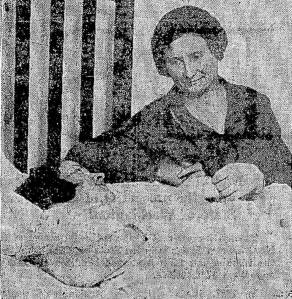
John Bess Howe, whom newspapers of the time frequently referred to as “plucky,” spent nearly a month in the Anchorage hospital before doctors deemed her strong enough to be transferred to the Lower 48.
Several news reports claimed that she had at least three more surgeries after the first one on the night of her arrival in Anchorage. The extent, dates or nature of those surgeries is not known.
During this period of convalescence, misinformation about Howe’s accidental shooting and her rescue was rampant.
On Dec. 5, the Times Record News of Wichita Falls, Texas—near her hometown of Seymour—reported that Howe’s parents had received a telegram informing them that their daughter was safely in a hospital in Ninilchik.
In late December, a few newspapers—despite all previous reportage—told readers that Howe had been shot on Dec. 18.
On Dec. 8, the Seward Daily Gateway offered an article of praise for one of her key rescuers, Ninilchik’s own Walter Kotoff, while misspelling his surname throughout the piece.
Several papers also reported erroneously that Kotoff had walked all the way to Seldovia. At least one paper said he mushed there with a team of sled dogs. The cumulative distance he traveled ranged widely, with some claiming that he had ventured nearly 180 miles.
It is most likely that his back-and-forth ground travel equaled at least 125 miles, in addition to the miles he covered by boat between Homer and Seldovia.
TO BE CONTINUED….