A taste of another culture
Published 1:30 am Thursday, March 19, 2026
I grew up in a diverse community, and I consider that an extreme privilege. It has always been normal in my life to see faces that didn’t look like mine, to hear languages I couldn’t understand, and to see people celebrating holidays and practicing religions I knew nothing about. I also grew up with a mother who looked at the others around us with curiosity and admiration, always pointing out the beauty she saw in things that were exotic to our lives, and through her example, I learned how to appreciate what was strange to me and find more things to love about life.
Then, we moved to another part of the country, a quintessential “Southern” town, and their culture truly disgusted me. These people could only find things to hate about unfamiliar others who were unfortunate enough to cross their paths, and, like the bullies they are, they pinched and shoved and berated until those others could squeeze themselves into a shape that satisfied their neighbors. These people even had the gall to call their way of life a rebellion against the status quo and referred to themselves as a righteous school of fish swimming against a wicked stream.
I never hid my distaste for these others, and I am not blind to my hypocrisy. How can I call myself a tolerant person who sees the beauty in our differences if I am so loathsome of this unfortunately common flavor of American? This dilemma is called the tolerance paradox, and for much of my life, grappling with it was morally challenging, but it isn’t anymore. I now know how far my tolerance goes and when it’s time to get angry and try to make those hateful fish see their swarm for what it is.
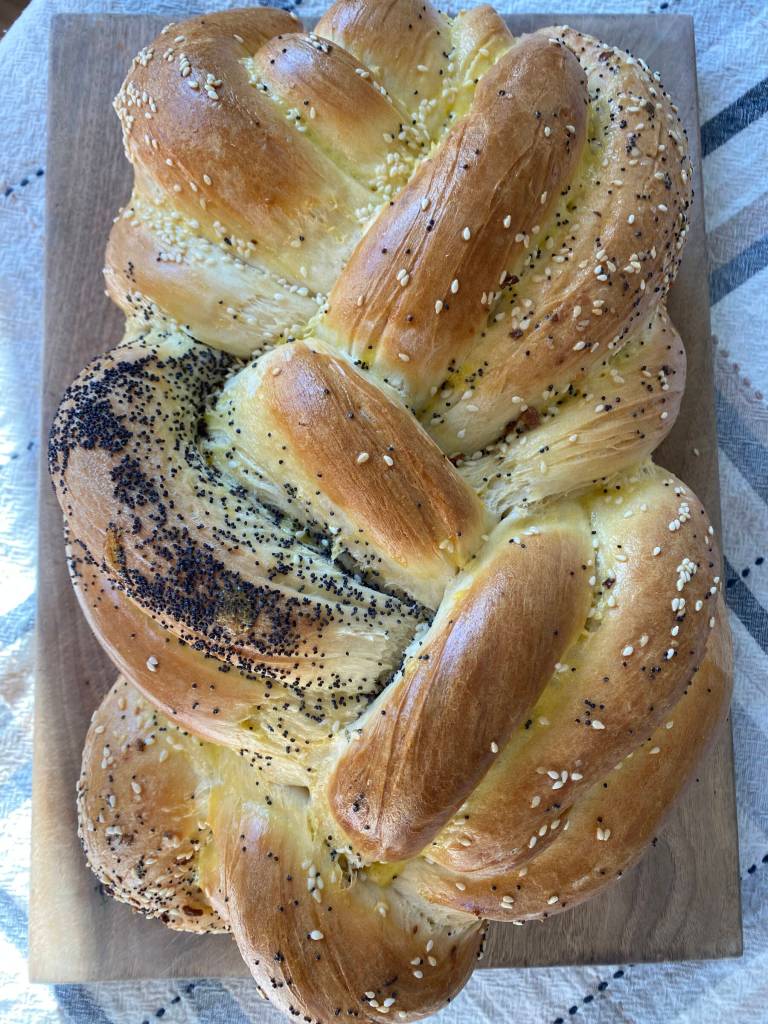
In the third grade, my friend invited me to dinner during Hanukkah, and I got to see some of their culture’s beauty and taste the memories of all her mothers. I was served golden braided challah sprinkled with sesame seeds, and I marveled at the impossibly lovely bread. This soft and rich bread is braided from nine strands, three of which are coated with seeds of different colors, making it more flavorful, more beautiful, and far more wholesome than plain white Wonder Bread.
Ingredients:
1 ½ cups warm water
2 teaspoons active dry yeast
2 tablespoons honey
3 eggs (plus 1 for egg wash)
3 ½ tablespoons neutral oil
6 cups all purpose flour
2 tablespoons salt
Seeds for coating — poppy, sesame, and everything but the bagel seasoning
Directions:
In the bowl of your mixer combine the warm water, honey and yeast, and let rest until bubbly.
In a separate bowl, whisk the eggs and oil together and set aside.
When the yeast mixture is frothy, add the flour and salt, then drop in the oil and eggs.
Mix briefly with the paddle attachment until the dough just comes together, then switch to the dough hook and knead for 5-8 minutes.
Transfer the dough to a greased bowl, brush with oil, cover, and let rise until doubled, which took about 2 hours in my chilly kitchen.
Punch down the dough and cut into 9 equal portions. Roll those portions into balls, cover, and rest for 10 minutes.
Roll each ball into a snake about 18 inches long.
Separate the 9 snakes into three sets of three, then take the snake from the middle of each group, and paint each one with egg wash before rolling in seeds to coat. You can do any combination of seeds, but poppy seeds and sesame seeds are common.
Return the seeded snakes to the center of their groups, pinch each group at the top to stick them together, then press the three big groups together at the top to connect them.
Keep the sets of three together as you braid them like a simple, three-strand braid, tucking the ends under the loaf at the top and bottom.
Brush the remaining egg wash onto the parts of the loaf that are not already seeded.
Bake at 350 degrees for 40-50 minutes, until the top is golden and you hear a hollow sound when you thump the top.