Our Sunday best: Early churches of the central Kenai Peninsula — Part 3
Published 1:30 am Thursday, June 4, 2026
AUTHOR’S NOTE: An earlier version of this story first appeared in May 2013 in the Redoubt Reporter. The focus of this series is churches of the central Kenai Peninsula; clearly, there is also a rich church history on the southern Kenai, in the Seward area and elsewhere, but those stories, and stories of non-Christian congregations, will be a topic for another time.
Both of the first two Methodist churches in Soldotna were hauled from the Kasilof area and brought whole across the Kenai River bridge. During both of these river crossings, adjustments had to be made because the smaller church stood a little too high, while the larger church sat a little too low.
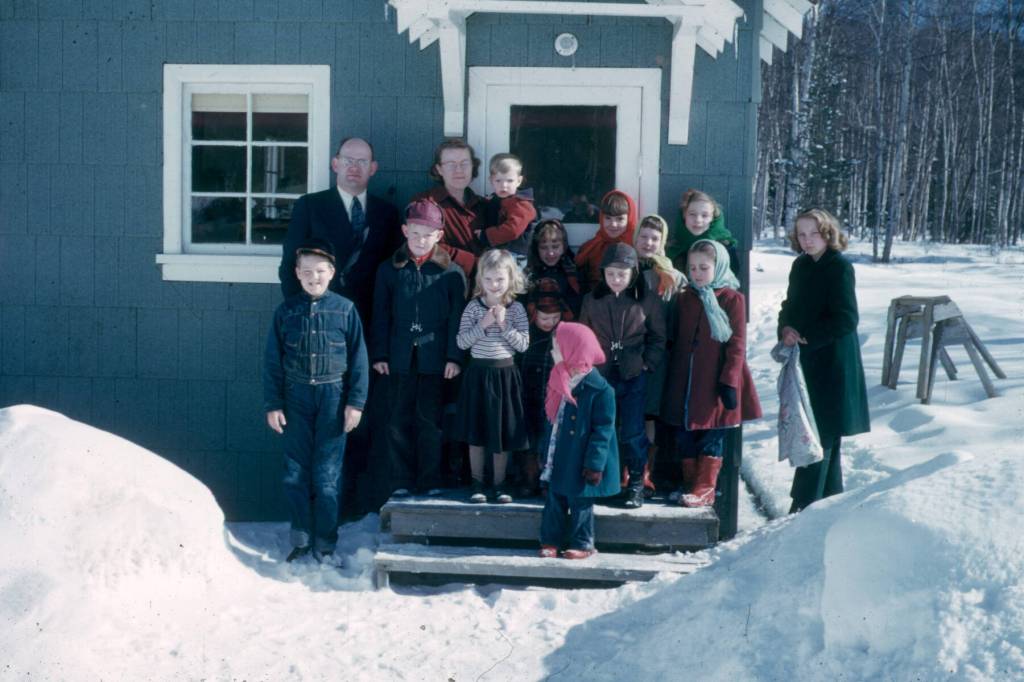
The earliest Methodist church on the central Kenai Peninsula was the first church structure in all of Soldotna. It was originally known as the Kasilof Methodist Church, and it pre-dated the now more established Methodist church in Kenai. According to information in the photo archive at Kenai Peninsula College, the one-story, one-room building—complete with greenish exterior walls, white-painted door and window trim, and a red roof—was moved out of Kasilof once a greater Methodist population grew in Soldotna.
Probably in late 1951, church members agreed to move onto property donated by homesteader Maxine Lee at Mile 0.5 of the Kenai Spur Highway, and they hired Homer Freight Lines to jack up and haul the structure. At the bridge, freight company employees realized that the top of the building would strike the overhead steel supports, so they had to partially deflate the tires on the trailer in order to create the proper clearance.
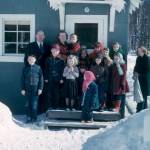
A photograph taken in April 1952 shows a small group of Methodist children posing with itinerant Moose Pass minister, Eugene Elliott, in front of the new church, which, with its small oil stove and thin walls, was difficult to heat in the winter months. Area Methodists used this church until the mid-1950s when a new, and much larger and more comfortable, church was built in Kenai.
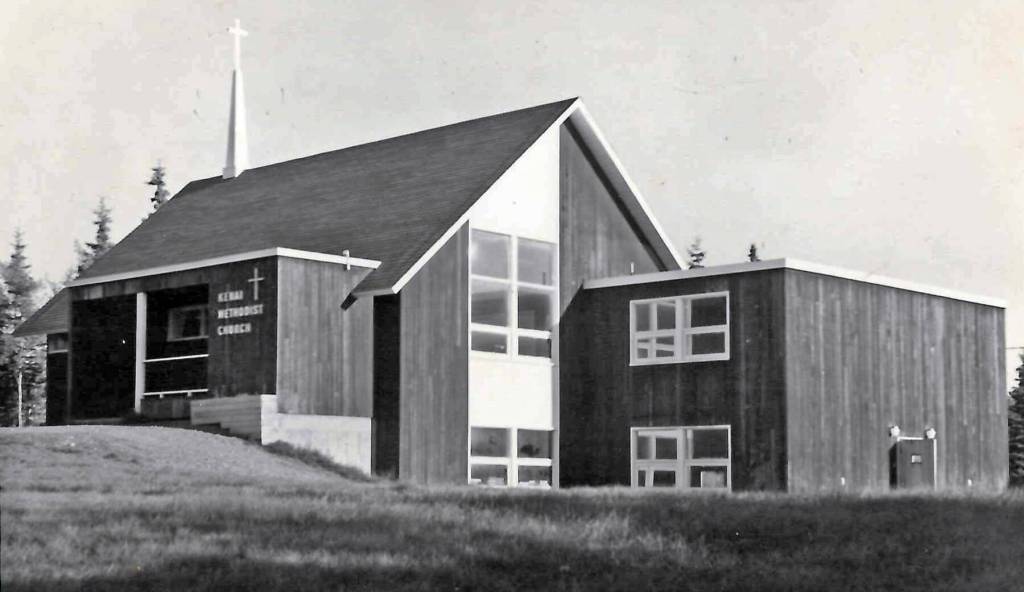
On Jan. 15, 1955, Pastor Quincy Murphree mailed two postcards to every boxholder in Kenai. The first card read: “Dear People: If you are interested in a Methodist Church in Kenai, fill in the attached postcard and return it to me at once. Do not fail to register your interest in one of the provided places.” The second card read: “I am interested in a Methodist Church in Kenai and will (A) become a member ____, (B) I do not care to become a member, but will attend regularly ____, (C) most of the time ____, (D) occasionally ____. My name is ____________________.”
Based on the results of this survey, the Kenai Methodist Church was born, with the first service being held on Feb. 13 in the Civic Center Building with 37 people in attendance while a blizzard blew outside. Although someone had tampered with the furnace, leaving the indoor temperature at 33 degrees, the faithful were not deterred. In fact, on Easter Sunday a few weeks later, 77 people showed up to worship.
The following week, 19 individuals joined the church on Charter Membership Day. Two years later, a large new church, constructed with nearly 2,000 hours of volunteer labor and located next to the Kenai School, was consecrated. The tiny Soldotna church was abandoned and transformed into an office building for the Coastal Drilling Company.
Kenai pastor Wayne Hull, in his 1959 report, acknowledged the difficulties involved in building and holding together his flock: “Because of the slowness of response by the majority of the people, the pastor must here, more than other places, be ‘all things to all men.’ He must be bigger than a church program. In Alaska there is a generous portion of skeptics and scorners. These cannot be won by simply an invitation to church services. They will not go there voluntarily and cannot be won by force. The churches need to come back with a better report than the moose hunter who was thrilled by his experience but recognized his difficulties and said, ‘Boy, I was right in among ’em, but they’re moving so fast you can’t hit ’em.”
By 1965, Soldotna Methodists, tired of the weekly commute to Kenai, wanted their little old building back. Coastal Drilling complied. The old church—now renamed Soldat Kriste (“Soldier of Christ”)—was picked up and hauled again, this time to a wooded lot just north of town, where it served the congregation until 1968, when a new two-story Methodist parsonage was built nearby, and services were held in the much more spacious parsonage basement.
Meanwhile, moves were afoot to create even more room and a real church. Property on Binkley Street was purchased, and a merger between the congregations of Soldotna and Kasilof was formed.
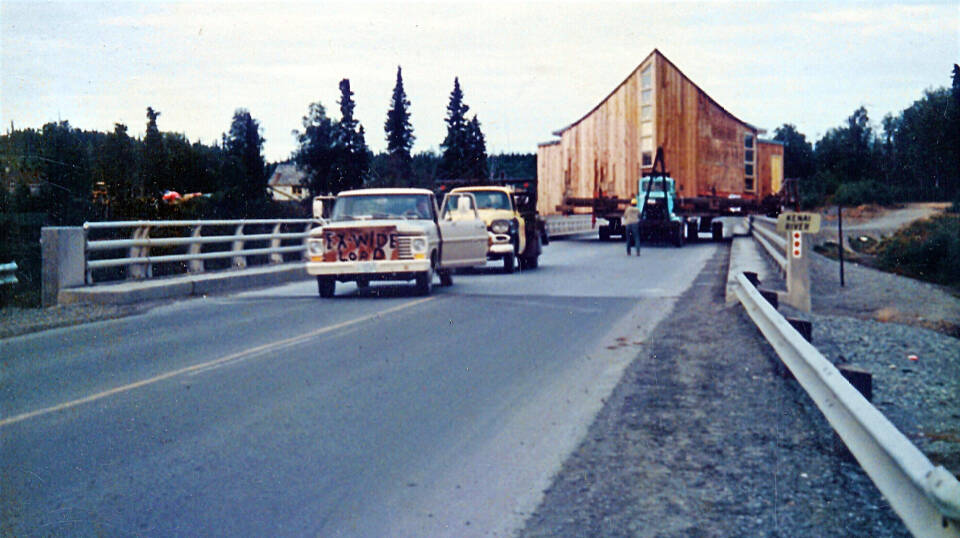
Built next to the Tustumena School in the mid-1960s under the direction of Pastor John Shaffer, the Tustumena Church of Christ the Victor, with its striking diamond shape and sky-piercing sanctuary, was jacked up on Aug. 2, 1968, placed on a flatbed freight hauler preceded by a truck bearing a sign, “EX-WIDE LOAD,” and aimed toward Soldotna.
The church was so wide that the movers decided to transport the building only between the hours of 4 and 6:30 a.m., a time they determined that traffic would be lightest. The 15-mile journey took two days and was slowed at the Kenai River because the entire structure had to be jacked up so that its bottom could pass over the top railings of the new bridge that had replaced the old steel-girder assembly.
The first worship service at the new location, now called Soldotna United Methodist Church, was held on Aug. 18.
Peninsula church miscellany
In the late 1950s and throughout the 1960s, several other area churches also got their starts, including the Kasilof Community Church (organized in parishioners’ homes starting in about 1947, in an official church building by 1958), Soldotna Baptist Church (1959), the First Baptist Church of Kenai (started in 1950 and disbanded, reorganized in 1965), and, in Soldotna, the Christ Lutheran Church (1962), the Church of the Nazarene (1962), the Church of God (1962), and the Church of Jesus Christ of Latter-Day Saints (1968).
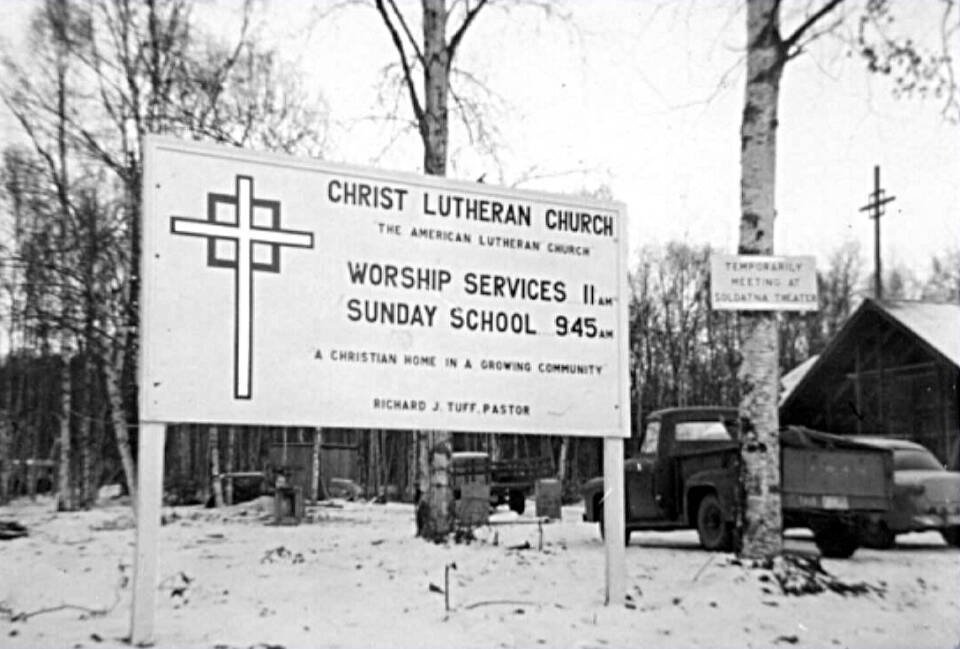
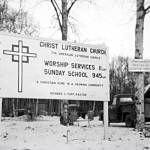
The first pastor of Soldotna’s Christ Lutheran Church was Richard J. Tuff. During the construction of the church, a small white sign nailed to a birch tree next to the main church sign announced in block letters: “TEMPORARILY MEETING IN SOLDATNA THEATER.” Built originally in the shape of a cross, the church has been known for decades for the fine acoustics in its sanctuary.
When the First Baptist Church of Kenai was reorganized in 1965, it began with 10 members who met initially in the National Guard Armory on Forest Drive. The Rev. Kelly Dickson became the first pastor, and soon thereafter a two-story church building was erected at the corner of 2nd and Birch streets.
The Rev. Ray Mainwaring, an early pastor for the Kasilof Community Church, was also a member of the Kenai Peninsula Fellowship, which started Solid Rock Bible Camp near Soldotna in 1958. He left his pastorate in 1966 to become the first manager of KRSM (K-Solid Rock Ministries) Radio.
It also must be acknowledged that the Soldotna Methodist Church, despite its start back in the early 1950s, was not even close to being the first Methodist church on the peninsula. That honor goes to the Seward Methodist Episcopal Church, which was constructed in 1907 by its first pastor, Louis H. Pedersen, who had arrived in town two years earlier.
Seward had a number of churches that began more than a century ago. Among them are: the Christian Science church (now defunct), which began in the community library in about 1915; the Sacred Heart Catholic Church, which was begun by Father Phillip Turnell after his arrival in June 1905; St. Peter’s Episcopal Church, in which the first services were held by the Rev. F.C. Taylor on June 12, 1904; and the Seward Lutheran Church, the members of which began meeting occasionally starting in 1917.
The church history in Seldovia, near Hope and Sunrise, and along the southern Kenai Peninsula is also long and colorful.
Currently, there are dozens of churches throughout the Kenai Peninsula, including perhaps two dozen each in both Kenai/Nikiski and Soldotna/Sterling.