Ben Swesey: More to the story — Part 1
Published 9:30 pm Wednesday, January 7, 2026
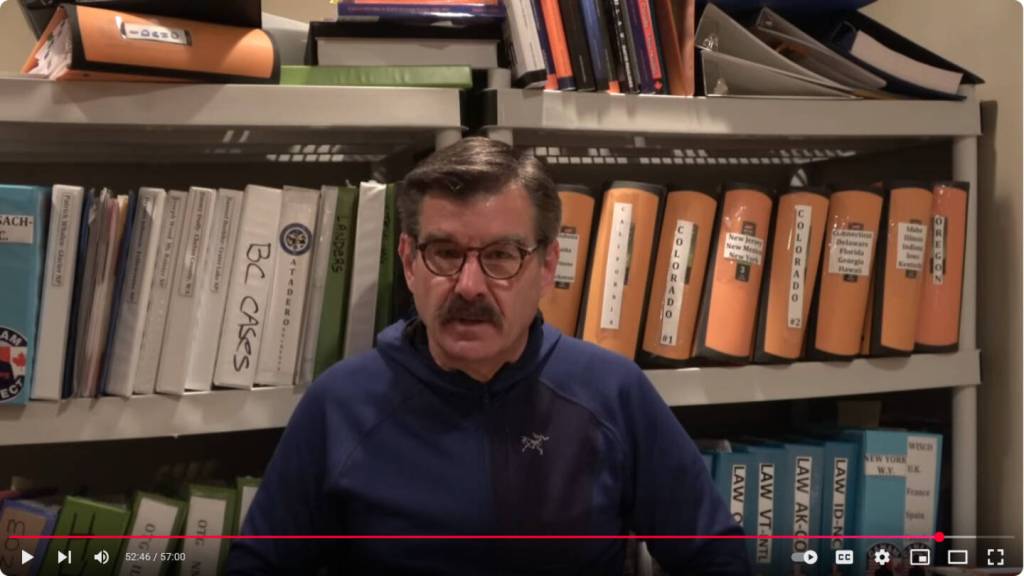

More than a hundred years after Ben Swesey and Bill Weaver steered an outboard-powered dory out of Resurrection Bay and were never seen again, an American video broadcaster included a segment about their disappearance on his YouTube channel.
David Paulides, whose Missing 411 series boasts nearly a half-million subscribers, sat before shelves of labeled three-ring binders, stared grimly and directly at the camera, and introduced the segment this way:
“The next case was a stunner. I doubt you’ve ever heard of this case. I doubt that anyone’s ever written about this case, but now … everyone will be talking about this case … [and they’ll be saying] ‘Dave broke the case.’”
Whatever his subscribers might have said after the segment aired on May 25, 2022, the truth is this: Paulides didn’t prove anything. In just over 12 minutes of screen time, he presented an assortment of facts, incorrect statements and outright speculation and offered only this in summation: The contemporaneous conclusions concerning the disappearance of Swesey and Weaver don’t add up. Those two men were too smart, too savvy about life and survival in the outdoors, for their story to have ended that way.
Paulides implied that there MUST be more to the narrative.
Maybe so. Maybe not.
There is just enough mystery in their story to create doubt. But doubts aren’t facts, and finding the full truth NOW is unlikely. Also, Paulides, who has authored two books on the search for Bigfoot and has been accused of being loose with the facts in order to fit his own narrative, offers his viewers very little that is concrete.
Even smart, savvy outdoorsmen can make fatal mistakes or simply suffer catastrophic bad luck.
Besides, as this narrative about Ben Swesey will attempt to demonstrate, it is difficult to draw accurate conclusions about character based on any single act, even a person’s final act. All lives are rife with determination, fate, coincidence, fortune and misfortune, good timing and bad.
The life of Ben Swesey was no exception.
Basoms and beyond
If misfortune had failed to strike the Basom family of Dalton, Muskegon County, Michigan, it is almost certain that Benjamin F. Swesey would never have been born. There would have been no 20-year Kenai Peninsula chapter in the story of his life. John Paulison Holman would have written about a different guide in his 1933 hunting memoir. Another musher would have helped haul the mail to the gold-mining town of Sunrise. Another man would have led writer, photographer and adventurer Helen Van Campen into the Kenai Mountains after trophy-sized bears and moose. And so on.
One spell of misfortune can produce wide-ranging domino-like effects. Such was the case with the Basom clan.
Swesey’s mother was born Eliza P. Staples, who in 1850 married a shoemaker named Daniel T. Basom, probably in Ohio. Between 1853 and 1861, the Basoms produced five children—one son and four daughters. Shortly the birth of the fifth child, Daniel Basom joined the Union Army in the Civil War—as a private, Company B, 19th U.S. Infantry—and in 1864 found himself in Georgia, embroiled in the Atlanta Campaign, famous for Gen. William Tecumseh Sherman’s “March to the Sea.”
In probably May 1864, Daniel Basom was either wounded or became ill and was sent to an infirmary in Kingston, Georgia, where he died on the Fourth of July. He was buried in a military cemetery in Marietta, Georgia, leaving Eliza a widow of four young children—her eldest daughter, Reena, having apparently already died.
Women of this time had few rights to property or citizenship and no right to vote. It was difficult for most women, let alone single mothers, to be more than caregivers and housekeepers. Eliza’s eldest living child, Henry, was nine; her youngest, Jennie, was three.
Seven months after the death of her first husband, she married her second, a Civil War veteran and farmer named Enoch Swesey. She also began dispersing her first batch of offspring. Henry and Mary (also known as May or Mae) were sent to live with Eliza’s parents, Henry and Mary Staples, in Muskegon.
Eva’s whereabouts in 1870 are unclear, but she was not living with her mother and step-father in Michigan. By age 15, she was married. Jennie was sent to live with the family of James and Amelia Benton in Kent County, Michigan.
Meanwhile, Eliza had begun producing a second brood—a daughter (Mildred/Millie, the youngest) and two sons (the eldest, Merrit—the spelling varies—and Benjamin). The 1870 U.S. Census for Oceana, in Muskegon County, shows all three Swesey children—Merrit, age 5; Ben, 3; and Millie, 1—living with both parents.
The Sweseys moved to Eldora, Iowa, in 1871 and then to Vermillion in the Dakota Territory in 1873. Then Eliza died in 1874, leaving Enoch a widower with three small children.
It appears that Enoch kept seven-year-old Ben with him and sent four-year-old Millie to live with his parents, Benjamin and Elizabeth Swesey, in Pennsylvania. Merrit shows up in the 1880 U.S. Census as a disabled 13-year-old boarder in the home of William H.H. Washburn in Vermillion; the extent of Merrit’s “disability” is unclear. His age also appears to be incorrect.
There are discrepancies, too, concerning Enoch’s fate, but the strongest evidence suggests that he died of pneumonia in the Seattle area in 1892. His son, Ben, then age 23 or 25, appears to also have been living in Washington at this time. Four years after his father’s death, Ben headed north to seek adventure and his fortune in Alaska.
Although few clues exist linking the Basom children to the Swesey children, it is clear that the members of each group were aware of their half-siblings and, in many cases, corresponded or otherwise kept in touch with them throughout their lives.
To assume, however, that the life of Ben Swesey was the only one—of Eliza’s seven surviving biological children—to include tragedy is to assume incorrectly.
Mary married at least three times, produced one stillborn daughter, and learned in 1921 that both of her adult sons, Blynn and Roland, had committed suicide together by drinking poison on a busy Lake Michigan beach. She may also have been institutionalized for a time due to mental-health problems.
Jennie’s son, Hiram Widoe, died of tuberculosis before his fourth birthday. Eva and her granddaughter Geraldine were killed instantly on Nov. 1, 1931, when the car in which they were riding was struck by a Michigan Central Railway passenger train traveling 60 miles per hour.
Millie’s son, Harold Lowell Jenks, died in 1928 when the car he was driving was struck by another vehicle traveling in the opposite direction and crossing over the center line. The other driver was believed to have been intoxicated.
Of Merrit and Reena’s fates, the evidence is thus far unclear. Henry, on the other hand, lived into his late seventies, although he did have to have at least one finger amputated after receiving blood poisoning from a nasty ax-wielding incident.
TO BE CONTINUED….