No Simple Matter: Finding the borough a home — Part 6
Published 10:30 pm Wednesday, September 24, 2025

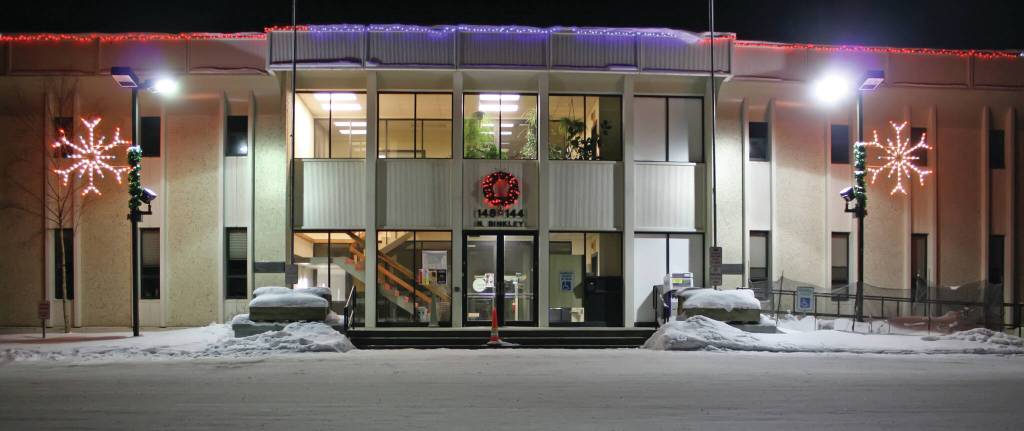
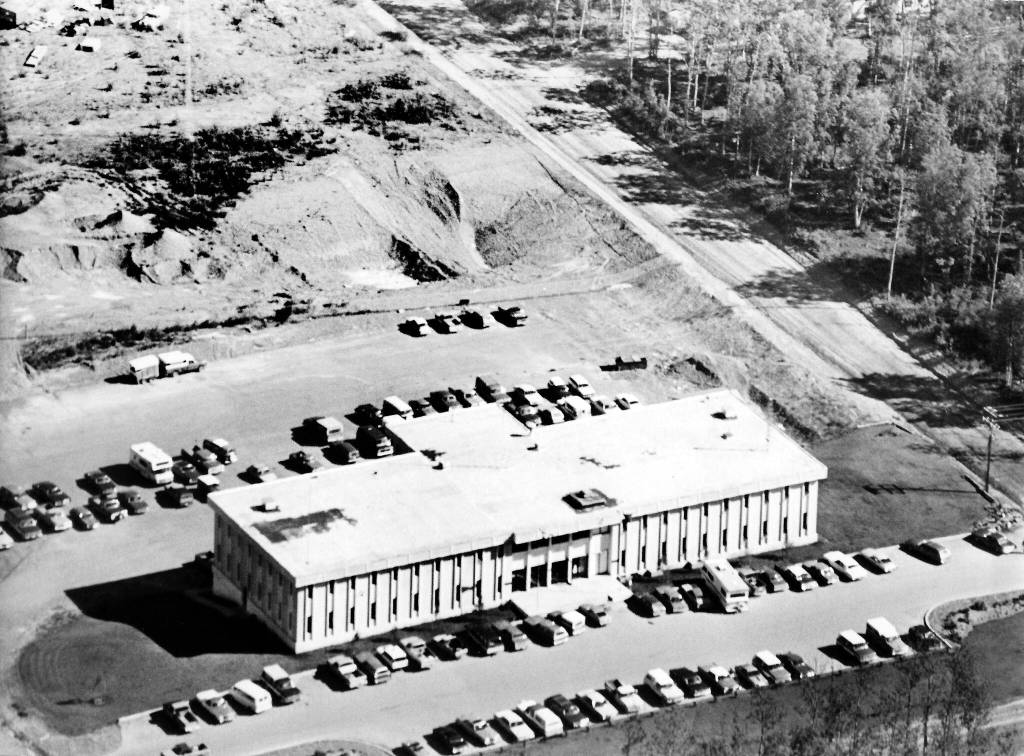


AUTHOR’S NOTE: Creating a borough government was no easy feat for the citizens and officials of the Kenai Peninsula, starting with incorporation in 1964, followed by battles over the location of the borough seat, massive governmental growth, the selection of a design for an administration building and a plan for funding. But even after all those things fell into line, completing the project was not as simple or as “cheap” as expected.
The Last Major Hurdle
The good start to the construction of the Borough Administration Building lasted only a few weeks. Then on Nov. 29, 1969—with the work estimated to be approximately 35 percent complete—a dire headline appeared on page one of the Cheechako News: “Borough Building Panels Lost in Storm at Sea.”
A few days earlier, according to the article, the tugboat Patricia Foss, owned by Seattle-based Foss Tug & Barge Company, had pulled into the dock at the Ketchikan Pulp Company after its barge, No. 250, had hit bad seas about 40 miles north of Ketchikan. Foss officials announced that two-thirds of a shipment of prefabricated concrete panels designated for the borough construction project had been on board, and that storm waters had cleared the decks of most of the cargo and damaged much of the remainder.
Borough construction coordinator Don Gallagher announced that the borough had “suffered a major setback in its building program.” Gallagher said each of the steel-reinforced concrete panels weighed eight to 12 tons and had been shipped out of Tacoma, Washington.
Originally the panels had been due on the Kenai Peninsula on Nov. 20, but bad weather had caused shipping delays. Now the delay would be more substantial: “I presume it will be necessary to contact the manufacturer of the panels and have the order repoured,” Gallagher said. “This will probably mean a delay of three to four months in our building schedule.”
Initial estimates by architect Mike Pendergrast and panel supplier Jack McCloud had called for a March 1, 1970, completion date. At a borough assembly meeting about three weeks after the storm, Borough Chairman George Navarre reported that he expected replacement panels to be shipped north on Feb. 15, and assembly members expressed hope that they might be able to move into the new facility by July 1, when the lease expired on their temporary quarters.
That optimism soon faded. At the assembly’s March 30 meeting, Pendergrast reported that the panels should be shipped by about April 15 and arrive in Kenai about two weeks later. He said he still hoped that the building could be completed by July 1.
But in early June the assembly learned that the panels—and only a partial shipment of them—had not been sent until May 29. The rest, it was hoped, would be sent on June 20.
Meanwhile, the school district’s administration was then operating out of classrooms in the new Kenai Junior High School. Navarre announced that he wanted the district out of the junior high by the first day of classes, Sept. 1, to free up more classroom space.
As summer began—and Navarre announced that he was hoping to be in the new building by Sept. 1—the economic politics surrounding the borough intensified. First, construction costs continued to rise for the Borough Building project and all of the borough’s school-construction projects. Second, Dolly Farnsworth, who leased space to the borough administration, was requesting a payment of $1,082 per month for that space if the lease were to continue on a monthly basis. Third, a small fire at the construction site scarred a portion of the building exterior.
Furthermore, the assembly learned at its June 28 meeting that the construction foreman believed that interior work on the Borough Building was progressing slowly because borough administration had not submitted to the architect plans for partitions and telephones, among other items. Navarre promised to have those items clarified later that week.
By early August, Navarre was forced to ask the assembly to approve a $42,201 change order to cover the cost of some of those interior alterations.
The exterior paneling was completed by mid-August, but more delays ensued during the pouring of the concrete second deck and because of vandalism at the job site in November.
There were also arguments over the cost and quality of furniture. Assemblyman Earl Cooper said the furnishings in the assembly room were “too elaborate.” Assemblyman James Hornaday (the future mayor of Homer) called the furnishings “too plush”; he said that the Borough Building should never have been built.
Deadlines came. Deadlines went. Costs accumulated.
In mid-November, school district superintendent Walter Hartenberger submitted to the school board a detailed but rough-draft plan recommending that the new building not be used for borough administration, but instead to fill a need he believed was much more pressing: a Soldotna High School.
Hartenberger’s plan went nowhere. Hartenberger himself lasted less than a year on the job. And a Soldotna high school did not open for another decade.
Finally—on Jan. 5, 1971—the Borough Administration Building had real signs of life not directly related to construction activity: On that night, the new assembly chambers were opened for the first time for a public meeting. Three weeks later, despite problems with the building’s 7,000-gallon septic tank, the borough and school district administrations and staffs moved in.
Frances Brymer, the first borough clerk, remembered her first impressions: “Once it was finished, it was beautiful, I thought. You looked around and it looked so huge, when you’re used to just a little bitty spot. You couldn’t even imagine! It was just overwhelming.”
Walter Ward, who had a long history as assistant superintendent of the school district, was also pleased with the final result: “It was the best buy they ever made. They would never have gotten it cheaper. It would have probably cost twice as much a year or two later. George Navarre did a good job negotiating and planning for the building.”
Stan Thompson, who was elected borough mayor in 1972, said that the Borough Building was “a heck of a good investment. I have to compliment Navarre for that. He’s the one that fought that through.”
The borough at last had space to spare—the entire upstairs was at first left vacant—and it owned its own administration building. No more leases. No more cramped quarters—at least not for many, many more years.
But there were a few other headaches, including two that many people (but not everyone) found fairly funny….
In the months after the building was finished and the moving-in was complete, a few little brown bats discovered a small gap where the roof beams met the top of the wall panels, and they decided to make themselves at home upstairs indoors.
When Ward’s college fencing class met upstairs in the big open space, he said, sometimes it was “just bats and us—that’s all that was up there.” He chuckled as he recalled that occasionally a bat would find its way downstairs to “give the secretaries a little problem.”
Brymer, whose office was downstairs, found less humor in the situation: “I had one come into my office. I was running around trying to hit it, and I couldn’t hit it. I think someone came in there and got it, probably one of the guys who was taller and could reach up there.”
Mayor Thompson, on the other hand, didn’t mind the bats: “I enjoyed them,” he said, adding that he didn’t even mind the jokes in the public about the borough having bats in its belfry. Because Thompson was in no hurry to eliminate the flying rodents, the bats were removed during a later administration, causing some controversy over their eradication.
Thompson also liked the presence of the other creatures living at the Borough Building—swallows, which nested in great numbers under the eaves. “I enjoyed having the swallows there,” he said. “I’m sorry we got rid of them. Most people didn’t give a hoot, but some people thought they should be cleaned out of there. Some felt as I did: ‘So what? It doesn’t really hurt anything.’”
But the swallows were a source of aggravation to many. Longtime school district secretary Barbara Jewell, for instance, wanted them gone. “The swallows would make me so darn mad because they would put their excretions on the cars. I had a silver car—not that it was a good car or anything like that—but all the droppings ruined the paint.”
Jewell also had an office with two windows, the sills of which the swallows used frequently as a toilet. “Oh sure, I can laugh about it now,” she said, “but you had to have your car repainted and everything else at the time. It was a pain in the neck.”
Eventually, the swallows’ nests were removed and the eaves were filled with a smooth, curved metal that prevented future habitation. “That’s human nature at work,” Thompson rued.
Epilogue
Today, the Kenai Peninsula Borough encompasses 16,075 square miles of land—roughly the area of Massachusetts and New Jersey combined—and 25,600 square miles (or the size of West Virginia) when ocean acreage is included. The borough and its school district serve approximately 60,000 residents and coordinate efforts with five first-class and/or home-rule cites and several other locally controlled communities. There are about 8,300 students in more than 40 schools across 29 communities, and each day school buses rack up more than 7,000 miles in delivering many of those students to those schools.
As a consequence of these numbers and the growth behind them, borough government has also grown.
These days, the value of the 42,269-square-foot Borough Administration Building is more than $20 million, according to borough assessors. For the 10.14 acres remaining from the original 15.11-acre parcel, the value is $422,800. And the borough and school district have filled to overflowing the many rooms of the Borough Building, forcing the relocation of several borough agencies—to Kalifornsky Beach Road, to Funny River Road, and elsewhere—and prompting occasional talk of adding on to the original building.
TIMELINE OF THE KENAI PENINSULA BOROUGH ADMINISTRATION BUILDING
1948—Howard and Maxine Lee homestead 160 acres in the heart of Soldotna.
1951—Howard and Maxine divorce. Howard’s share of the estate includes the current borough administration property.
1954—For the cost of a new car ($4,000), Howard Lee sells his property to Joe and Mickey Faa.
1956—The Alaska Road Commission is merged into the federal Bureau of Public Roads, an agency in charge of roads in Alaska.
A year or two later—Prior to the repaving/rebuilding of the Sterling Highway in 1958, the BPR acquires the gravel pit/source on the Faas’ property.
Jan. 3, 1959—Alaska statehood. Federal road building and maintenance responsibility and all BPR assets revert to the state’s Department of Highways (later renamed the Department of Transportation).
October 1961—Alaska State Legislature passes the Borough Act.
Jan. 27, 1962—The Kenai Peninsula Borough Study Group is formed.
March 31, 1962—The Kenai Peninsula Borough Study Group meets at the Riverside House in Soldotna to determine the parameters of a borough centered on the peninsula: (1) Legislative election districts 9 & 10 will comprise the borough. (2) They will form a first-class borough. (3) The borough seat will be established within a three-mile radius of Tustumena, although many other sites are suggested. (4) The entity will be known as the Kenai Peninsula Borough, although many other names are suggested.
May 1962—KPB Study Group recommends (by a 6-5 vote) the creation of second-class status for KPB.
April 1963—House Bill No. 90, signed by Gov. Bill Egan, directs that on Jan. 1, 1964, organized boroughs are to be incorporated.
Dec. 3, 1963—First election of the Kenai Peninsula Borough. Harold Pomeroy is elected the first chairman of the borough.
Jan. 1, 1964—Kenai Peninsula Borough is officially incorporated.
Jan. 4, 1964—First meeting of the KPB Assembly occurs in Elks Hall (now the VFW) in Soldotna. Jack Randall of Cooper Landing presides as first assembly president.
January 1964—Controversy ensues all month over whether Soldotna or Kenai will be the seat of borough government. Soldotna is selected as a temporary seat, and the headquarters of the borough become a small room in the Farnsworth Building. Controversy over permanent borough seat continues for more than a year.
Aug. 3, 1964—Frances Brymer becomes the first employee to be hired by the borough. (Chairman Pomeroy was elected.) Boro assessor, Gerald D. Heier, is hired next, only a few weeks later. Along with Heier come three appraisers.
April 6, 1965—Chairman Pomeroy reports that boro HQ now occupies 818 square feet of office space at 22 cents a square foot (including utilities), and that after July 1 the boro will need about 1,600 total feet to do its duties.
June 1, 1965—Borough assembly votes unanimously to lay the issue of a permanent borough seat to rest once and for all with an election on Oct. 5.
Sept. 3, 1965—Cheechako News announces that, with a week to go before the deadline, Seward, Soldotna and Kenai have filed applications to become the borough seat. Clam Gulch files one week later and then is dropped from ballot three weeks later.
Oct. 5, 1965—Soldotna wins easily with 1,499 votes (47.9%) and is now officially the seat of borough government.
1966—Assembly meetings for the next several years are held in numerous different venues, although most are located in Soldotna.
May 2, 1967—Chairman George Navarre reports: “The Soldotna Gravel Pit is an eyesore to the city, the site is in the middle of town and is not screened, and the land can be put to a better use as a borough office site or school site.” The City of Soldotna agrees. The state Department of Highway officials says that it may be possible to give the borough this land for public use.
Aug. 2, 1967—Assembly establishes Resolution 67-34, which provides that at the next general election—to be held on Oct. 3—KPB voters will decide whether to support a bond proposition for up to $10 million in school construction/remodeling and up to $300,000 to construct a boro administration building. Two months later, the KPB propositions for general-obligation bonding are defeated resoundingly. The administration building proposition fails, 981-419.
Nov. 7, 1967—Although there is no official site yet, planning on the actual structure of the new borough building goes ahead. Navarre requests that the assembly consider a prefabricated style of building.
April 16, 1968—Navarre says that architect Mike Pendergrast (who will later be tabbed as the project architect, and who is already at work on designing new peninsula schools) could create a “basic layout” for the borough building. He calls the new borough building “an urgent need.”
Aug. 6, 1968—The assembly unanimously approves the transfer of the gravel pit to the borough as a building site.
Aug. 20, 1968—Navarre presents a preliminary design for the proposed BAB.
Sept. 17, 1968—Pendergrast presents a schematic design for the BAB, which will cost about $20 per square foot. This building will be insulated with Styrofoam and covered with paneling on the interior. The outside walls will be prefabricated concrete panels, and most of the interior walls will be movable. Assembly approval of the design was unanimous.
Nov. 1, 1968—No funds are available to build the BAB at this time, according to Navarre.
Dec. 3, 1968—Pendergrast’s plans are approved. Plans call for 14,000 square feet for the basement, and the same for the main floor. Preliminary cost = $507,000 for full basement with concrete floor, concrete walls, two vaults, and a fallout shelter; a main floor with movable partitions. Pendergrast also shows a second floor as an alternative—adding $150,000 to the total cost, bringing the final total to $657,000.
June 20, 1969—Four bids are received and opened. Low bid is Firor-Janssen Contracting for $858,900.
July 15, 1969—Boro has allocated $800,000 for the BAB construction, but Navarre believes that $950,000 will be needed. He recommends pulling $75,000 from the Seward School contingency fund and another $75,000 from surplus revenue from the 1968-69 fiscal year budget to cover the difference, and he further recommends that the boro proceed with the construction. Pendergrast says he has tried to find cost-cutting means, but he believes now that this cost is a solid figure. He also believes that cutting the second floor would be a mistake, particularly since the boro will never be able to add a second floor later nearly so cheaply. Completion date is expected to be no later than March 1, 1970. Concrete panels are expected to be shipped from Tacoma Sept. 20. Assembly awards the bid to Firor-Janssen Contracting on a 12-1 vote.
Late November 1969—Two-thirds of a shipment of concrete panels for the boro building are lost in a storm at sea near Ketchikan. At this time, it is estimated that construction of the BAB is about 35% complete.
Dec. 16, 1969—For months, delays ensue. The borough’s lease on office property is running out. Space is tight for the borough and school district administration. Costs continue to rise.
Nov. 12, 1970—Superintendent Walter Hartenberger suggests abandoning the BAB as an administration building in favor of using it as a high school for Soldotna.
Jan. 5, 1971—At 7:30 p.m., the first-ever boro assembly meeting is held in new BAB.
Jan. 25-27, 1971—Borough administration and staff move in.
Jan. 27-29, 1971—School district administration and staff move in.
Feb. 2, 1971—Cheechako News announces that the final cost of the BAB is $1.36 million, not including SD furnishings.