Semester by the Bay students present at symposium
Published 8:30 am Thursday, November 20, 2025
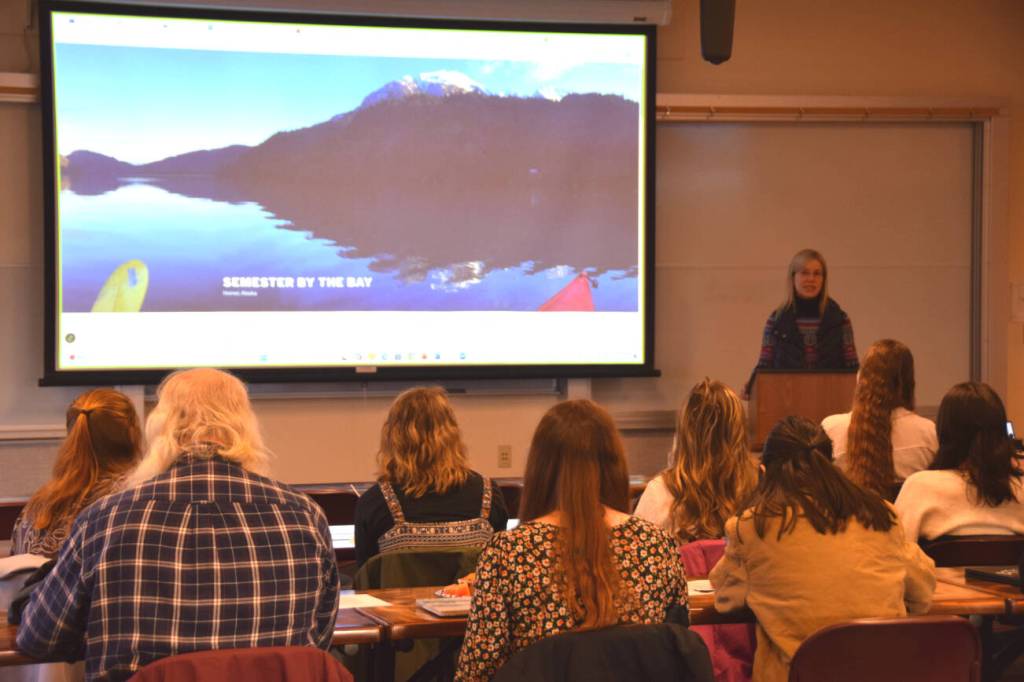
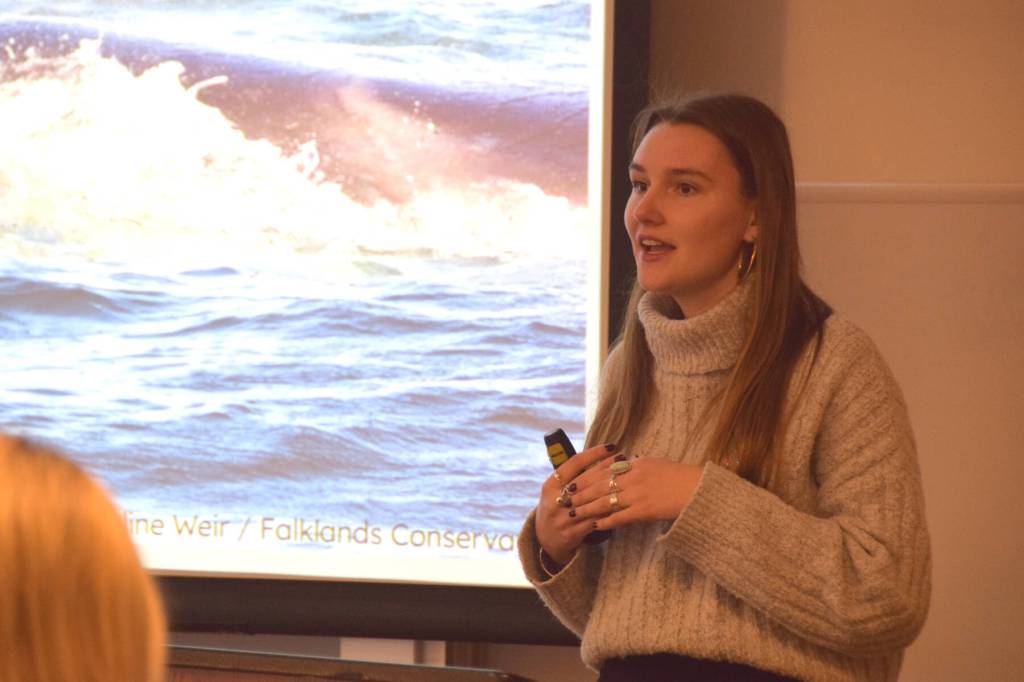


Students participating in Kachemak Bay Campus’ annual Semester By the Bay program gave presentations on their research conducted over the past months during a symposium hosted Friday at the college.
Now in its 15th year, Semester By the Bay offers undergraduate students across the U.S. pursuing biological sciences degrees the chance to gain hands-on academic experience and take part in coursework, internships and field excursions. Students are invited to apply for either the fall semester, which offers a marine mammals concentration, or the spring semester, which offers an environmental conservation concentration, or to apply for both and participate for the academic year.
Professor of Biology Dr. Debbie Tobin kicked off the symposium with an acknowledgement of the work that program students had done over the course of the semester.
“This is a culmination of a great deal of effort by all the students that you see here,” she said, gesturing to the group gathered in classroom P201 and P202 in Pioneer Hall. “Everybody is, throughout the semester, focusing on a specific ecosystem or topic or species, and then they have multiple assignments to do along those lines.”
The symposium offered SBB students a chance to experience conducting presentations and fielding questions about their work, and allowed the public to learn about trends in marine biology and what’s happening in Kachemak Bay.
“We try to make this as much as possible, similar to an actual scientific conference, to give the students a real life experience,” Tobin said.
For most SBB students, Friday’s symposium was their “second assignment,” according to Tobin. Earlier this fall, they participated in a seminar on the conservation of marine mammals, and at the end of the semester they will present research proposals on topics they would like to dive deeper into, based on their ongoing study subject.
During the course of the semester, SBB students also worked with many agency partners, Tobin said, including the Center for Alaskan Coastal Studies, the Alaska Maritime National Wildlife Refuge, the Kachemak Bay National Estuarine Research Reserve and more, to share data they had compiled and to identify individuals from multiple marine species.
“I can’t thank all of the community partners enough for all of their efforts to engage the students in internships, to engage them around town and in the community, and to provide a lot of the feedback on some of their efforts,” she said.
Tobin said that program students were able to share data with various agencies to not only help them expand their overall data sets and catalogs, but also to help the students learn from and engage with those agency partners and “see what it’s like to actually work a little bit in those fields and those types of agencies.”
Tobin also highlighted another effort by students taking part in a marine mammal skeleton articulation class taught by “The Boneman” Lee Post. Members of the fall cohort have been working on two articulated specimens — a sea otter and a harbor seal — that, once complete, will be permanently displayed at the AMNWR Visitor Center.
A poster session was also held later Friday afternoon, where SBB students presented their data acquired from various field excursions and showcased scientific posters on various topics including area marine mammals, the Alaska Beluga Monitoring Network, and more.
Marc Webber, an adjunct instructor in biology at KBC, said that the posters on display in Pioneer Hall included valuable information that is “increasingly important” to agency partners — including the rediscovery of a tagged sea lion that the Alaska Department of Fish and Game had “lost track of” because the transmitter had stopped working.
“We’re seeing things out there,” he said. “On our trip, (the students) found it and meticulously searched for images, and found (the sea lion) in those images. Fantastic work.”
To start off the symposium proper, Logan Hytten, who is majoring in biological sciences at the University of Vermont, gave a presentation on how sei whales’ feeding behaviors allow worldwide distribution of the species. Sei whales are listed as endangered under the Endangered Species Act following overharvesting in the whaling industry, where an estimated 300,000 whales were killed for their meat and oil. Today, there are only about 80,000 left in the world — which seems like a lot, Hytten said, but is nothing compared to their previous population, which included over 200,000 whales in the southern hemisphere alone. While some whaling of sei whales still occurs in Japan, today, sei whales are most at risk of harm from vessel strikes and entanglement.
“From 1974 to 1999, no studies were done on this species, so we lost a lot of data during that period. A lot of current studies are based on old whaling records,” Hytten said. “In 2015, similar to a lot of other species around the world, (sei whales) did experience a mass mortality event where over 300 whales washed upon the shores of Chile and Patagonia.”
According to Hytten, sei whales are found in essentially all of the world’s oceans, mostly in the open ocean, rarely ranging into the polar regions or the tropics.
“However, they do these wide-ranging movements throughout their hemisphere, so while their migratory patterns aren’t well defined, they will head toward the equator to breed and then back towards the polar regions to feed,” she said.
Because of their general migration patterns, sei whales eat several different prey species. Hytten also reviewed sei whales’ morphology and their feeding behaviors, which include three distinct methods — lunge feeding, subsurface lunging and skim feeding — and shares characteristics with other whales both within and outside of their family.
“This is due to the fact that they are not an evolutionary intermediate, but they are a functional and morphological intermediate,” she said. Evolutionary intermediates are organisms that exhibit traits found in both ancestral and descendant groups and serve as a bridge between them.
Reagan King, majoring in fisheries and wildlife biology at PennWest University Clarion, gave a presentation on the Rice’s whale — a whale initially thought to be a distinct population of Bryde’s whales but later determined to be a separate species.
In 1965, King said, naturalist Dale W. Rice found evidence of the presence of Bryde’s whales in the Gulf of Mexico. The National Oceanic and Atmospheric Administration discovered in 1999 that that whale population were year-round residents in the gulf. In 2014, NOAA discovered that the Gulf of Mexico “Bryde’s whales” were descended from an evolutionarily distinct lineage, and in 2021, following a necropsy and study of the bones of a member of the Gulf of Mexico population that was stranded on the Florida coast in 2019, the Rice’s whale was finally named as its own species.
“Within their genetics, (researchers) saw very little overlap between the Bryde’s whale and the Rice’s whale,” King said. “There was no genetic mixing, meaning that they aren’t breeding with one another. But that wasn’t enough to consider it its own species — you have to look into the morphology.”
According to King, among several specific differences, the Rice’s whale is a smaller whale overall than the Bryde’s whale. The two species also display distinct vocalizations.
Rice’s whales are a critically endangered species, with possibly only 51 individuals remaining in the population. King clarified that there are 31 identified individuals, and the total population count of 51 is an estimation. As residents of the Gulf of Mexico — a “highly trafficked area” between the tourism and oil and gas industries — they face threats from vessel strikes, entanglement, oil spills and climate change.
“Because these whales are so specialized in their habitat, any change in the water’s temperature or salinity can affect their food availability,” King said. “And because they are so specialized on one individual fish, this could be detrimental to the population.”
Other presentation topics included the effects of anthropogenic contaminants upon seal reproduction and pup health; the effects of contaminants on polar bear denning phenology — the study of the timing of cyclical natural events; the impact of endocrine-disrupting chemicals on cetaceans; the Antarctic ecotypes of orcas; climate change impacts on Pacific walrus movement and diet; methods of protecting New Zealand sea lions from pathogens; processes, management and limitations in marine mammal rescue and rehabilitation; behavioral impacts of deep-sea mining and drilling on sperm whales; and more.
Learn more about the Semester By the Bay program at semesterbythebay.org/.