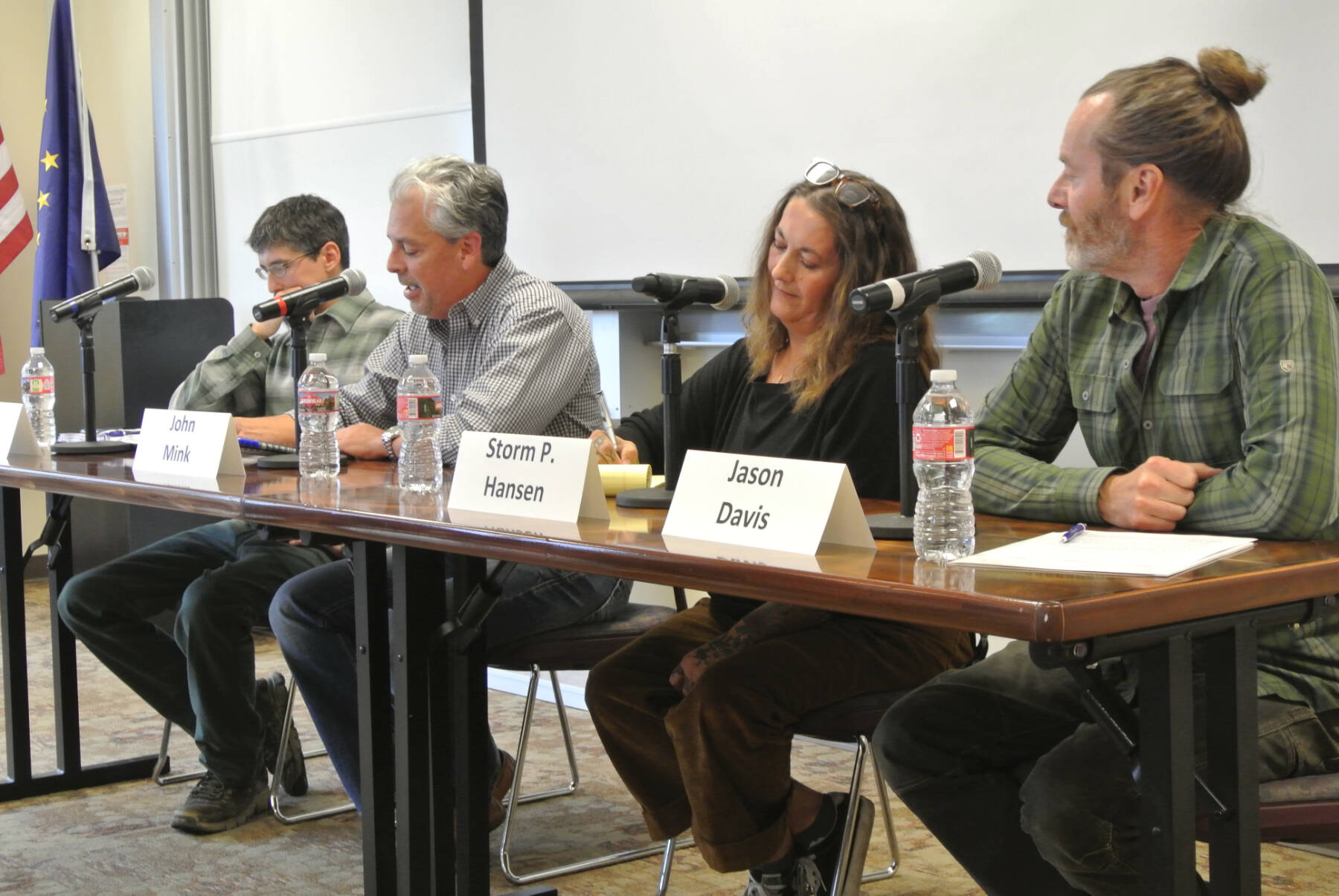
Homer City Council candidates vying for one-year and three-year terms answered questions in a forum hosted by the Homer Chamber of Commerce last Tuesday, Sept. 16, at Kachemak Bay Campus. Touching on topics including the ongoing comprehensive plan rewrite, the Homer Harbor Expansion, and residents’ quality of life, the candidates envisioned Homer’s future and discussed current plans for growth and development.
One-year term
Incumbent Bradley Parsons and challenger Michael Jones took the first round of questions from emcee and chamber director Brad Anderson.
In his opening statement, Parsons shared the story of how he moved with his family to Homer four years ago, after he fell in love with the area during their first visit in 2012.
“This is going to be our forever home,” he said. “I’m proud of Homer, and I’m proud to be a part of this community.”
Jones, who was born and raised in Washington and then spent several years in California, said he and his wife decided to retire in Homer after their son was assigned to a local Coast Guard posting.
“It’s a great opportunity to be here, and we just wanted to have an opportunity to contribute back to our community, so that’s why I’m running,” he said.
Anderson asked both candidates to share what they felt were the “most critical” issues, threats or opportunities facing Homer, as well as at least one workable solution to one of their concerns. Jones named the availability of affordable housing and year-round jobs as current challenges that “go hand-in-hand,” and said that having a good planning department to provide certainty to the rules for development can help residents build homes in a cost-effective way. Parsons echoed attainable housing as “a reality on everyone’s mind.”
“I think that is an issue that this community is going to have to deal with and try to figure out, especially if we want to see population growth that matches what outlying communities are seeing,” he said, referring to statistics from the Kenai Peninsula Economic Development District that show higher percentages of growth outside of Homer city limits than within. Regarding opportunities, he said that a “vibrant downtown” has been mentioned “numerous times” in the comprehensive plan process as a desire for the city and that he thinks Homer needs to move in that direction.
Further on the comp plan, Parsons said that the process to date has “captured a snapshot of what Homer desires are right now” and offers some “viable” opportunities to move forward with a plan. Jones said the plan isn’t perfect and that he thought there was still “opportunity for improvement” regarding land use and land management.
“City government cannot do everything to solve all of our challenges,” he said. “So I encourage you to participate as we go forward.”
Regarding the city’s financial position and whether each candidate favored revenue growth or spending control, Jones said he thought both were important and that the city doesn’t necessarily need to limit itself to one or the other. Parsons called the budget process for fiscal year 2026 an “eye opener” and said that while he isn’t interested in increasing taxes, he is interested in “making a larger pool” with more people within the city.
Anderson asked the candidates, following the U.S. Army Corps of Engineers’ recent introduction of draft alternatives for the Homer Harbor Expansion, which alternative they were each in support of. Both Jones and Parsons agreed that Alternative 2 seemed to offer the right balance and flexibility for the harbor’s current and future needs.
The candidates then took questions from local media representatives, including Michael Dukes, owner of Peninsula Radio Group. Dukes referred to both candidates’ discussions during the forum on housing and the proposed “vibrant downtown” and asked what they thought the city’s role was in dealing with those matters.
“Zoning codes,” Parsons answered. He referred to the City of Homer’s 2024 audit, in which the auditor included a comment that while the city’s finances were sound, the only worry lay with a “fundamental flaw” regarding the city’s water and sewer system, in which Homer has “too robust of a system with too little people using it and paying for it.”
“They used the word ‘infill,’” he said. “The other answer for this, I think, is infill within our neighborhoods. We need to make it easier to split lots … to build multiple structures, residential, within our neighborhoods. Right now it’s challenging if you want to go outside of what’s already in code because you trigger the conditional use permit.”
Jones agreed, and added that “you need to be excellent on executing that and creating certainty for developers.”
In his closing statement, Parsons said that the past 11 months serving on the council has brought him joy.
“This community continues to bring me joy. I want to continue serving this community on council, so I’d appreciate your vote,” he said.
Jones said that the city’s success will depend on engagement, and that he’s strived to “be a part of the overall process” as an outsider.
“I think I can help serve us better by being on the inside and being a member of the city council,” he said.
Three-year terms
Incumbents Jason Davis and Storm Hansen faced off against challengers Elias Garvey and John Mink in the next segment of the forum.
In his opening statement, Davis noted his four-year history on the council and said he looks forward to continuing to work.
“We’re in the middle of a lot of different projects that I’m really excited about, and I hope to be able to continue that work,” he said.
Hansen, running for her third term on the council, introduced herself as a “lifelong Homer-grown” resident and said that over the years she’s seen different dynamics and demographics in the community that she felt she was a good candidate to represent.
Mink introduced himself as a lifelong Alaskan, having grown up in Anchorage. He moved to Homer 10 years ago after spending “quite a while” in the Lower 48. He noted his involvement with several local nonprofits and said he “likes keeping the spirit up.”
Garvey also introduced himself as “practically a lifetime Homer resident” and said he focuses on policy surrounding limited government and prefers private/public partnerships or “simply private entities taking on most of the burdens facing the city.”
Anderson asked each candidate for their key takeaways from the comprehensive plan review process. Mink said he was “pretty OK” with the plan overall as long as the city council kept to core services and not And not “go terribly out of scope.” Garvey called the comp plan a “very good start and a continuing work,” but added that he supported action like that which former Homer Mayor Ken Castner took in 2023, when he vetoed spending for a comp plan rewrite to focus instead on a renovation of the 2018 plan.
“There are a lot of good projects projected in the plan. Some, I don’t think are necessarily the most worthwhile use of our times,” he said.
Davis said he thought the rewrite process has gone well, and that part of the reason to push for a comp plan rewrite instead of renovation was due to the community’s desire to create a more vibrant downtown — an idea which was hampered by what he called an outdated zoning code.
“We had a city manager (at the time) who felt very strongly that we couldn’t really have the legitimacy to go down that road if we didn’t redo the comprehensive plan,” he said. “Thankfully, the new comprehensive plan is very similar to the old one in the sense that it is very focused on the desire of this community for a more vibrant and a more walkable downtown with greater opportunities for attainable housing in that area in a mixed-use kind of setting.”
Hansen said she’d supported Castner’s comp plan budget at the time because she felt the city needed to be more restrictive on spending on things like studies.
“Although, this has been a great plan, and I really like the vision we have,” she said. “Next, I’m looking for the zoning. That will be just as important.”
On the city’s financial position, and revenue growth versus spending control, similar to what the one-year term candidates were asked, Garvey described the city budgetary process as “generally healthy” and reiterated that he would favor limiting spending over expanding revenue. He gave a comparative example of supporting core services, such as purchasing a new vehicle for the Public Works Department because it’s “essential to almost everything they do,” versus the proposed Diamond Creek underpass project, which he “would support cancelling such a project or repealing ordinances as necessary to avoid expenditures that we don’t need or that we’re not applying for adequately.”
Davis said that the council has been “very focused” on spending control, to the degree that the city nearly laid off some employees before finding a way forward without having to take such measures. He noted that in his experience on the council, sales tax has been the city’s main source of revenue, but that in the past few years the amount of sales tax brought in has been short of projections, while property tax revenue has been growing.
“I do think there’s a way to increase revenue and leave more money in people’s pockets that I’m really interested in exploring,” he said. Davis explained an idea, that if the city were to potentially raise sales tax by 0.5% or 1% in June, July and August, sales tax could then be reduced “by three times that amount for the other nine months of the year for the people who live here, and we would end up with more money in our coffers.”
Hansen said the city’s budget includes things that are necessary, things that aren’t necessary, and some things that are wants and wishes.
“Sometime those wants and wishes come first, because we know the cost of products and materials is going be a lot more … so we have to look ahead. We have to do the best we can,” she said.
Mink said he’s in favor of more revenue coming into the city so “we can do more things.”
Anderson asked the candidates their thoughts on the most critical issues, threats or opportunities facing Homer. Davis reiterated the opportunity to create a vibrant downtown, and listed erosion on Homer Spit Road as a threat that continues to need attention and a matter that the city continues to work on in partnership with state and federal legislative assistance to “make that a safer place, or a place that’s less likely to be damaged every time we have a storm.”
Both Hansen and Garvey spoke to the ongoing need for affordable housing. Mink said an opportunity lay with the Homer Harbor to deliver full-time winter jobs.
Dukes asked the candidates to speak further on how the city might work to create a vibrant downtown aside from updating zoning codes, and entice businesses to come build and invest in downtown Homer. Garvey said that he supported what Parsons said in the first forum segment about infill and would encourage pursuit of policy that would allow greater density in urban areas of Homer. He also reiterated support for public/private partnerships.
Davis, who owns Sweetgale Meadworks & Cider House, said that based on his experience opening a brick-and-mortar business, there’s a “pretty severe shortage” of commercial and retail space in Homer. If the city could open up more space for people to build modest-sized businesses, “ideally with some sort of housing attached it it,” he thought the demand would be there.
“It obviously would be a community discussion,” he said. “I think there’s almost limitless opportunity, if we could free up the space.”
Speaking to another point Davis made about how many kids growing up in Homer would love to return after college if they could find year-round housing, Hansen said that if there was a way to support a small district in downtown Homer that has an appealing atmosphere for kids to work at and start out small with affordable housing, she thought the city could do “really well.”
Other questions asked by Anderson or provided by media representatives and audience members touched on topics including regulation of short term rentals; establishing a city business license, which all candidates opposed; allowing non-city residents to vote in city elections; and public transportation.
In closing statements, Hansen said that she is “committed to Homer” and that it’s important to “remember the little people who have limited resources.”
Mink said that Homer has “given a lot to me over the years,” and he wants to continue giving back to it in the “more meaningful ways” he can.
Garvey reiterated that he opposes government spending “when it can be opposed” and is interested in finding ways to increase infill, or density.
Davis said that the forum was a “great opportunity to get out” and speak to people face to face.
“I am excited to be running. I feel like I have a lot left to contribute on these efforts that are already underway,” he said.
Find the forum recording in full on the Homer Chamber of Commerce Facebook page, or on their website at homeralaska.org/chamber.
Election day is Tuesday, Oct. 7. Early absentee voting opened Monday, Sept. 22 at Homer City Hall. Find more information on how to vote in this year’s municipal election at www.cityofhomer-ak.gov/cityclerk/early-absentee-voting.
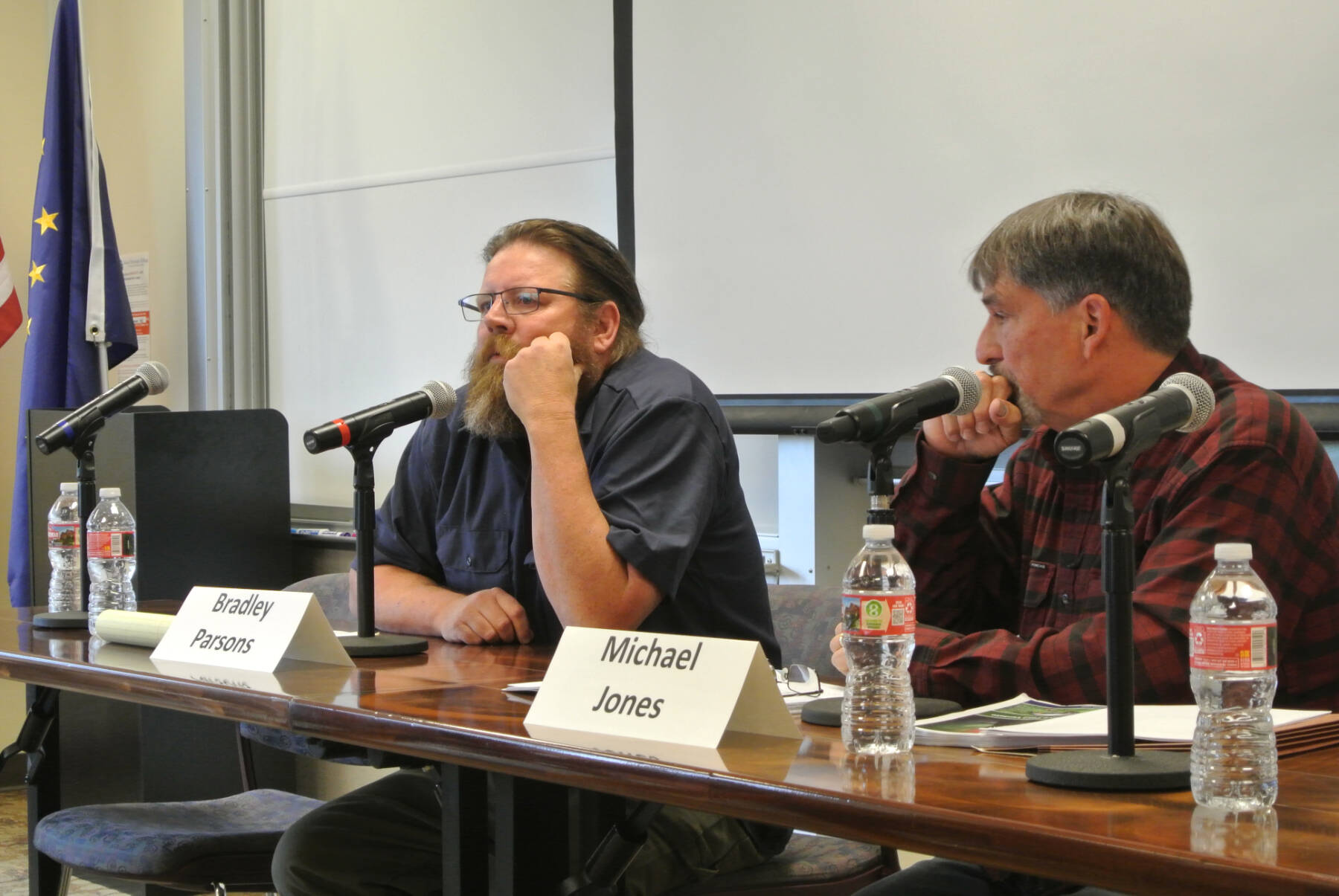
Bradley Parsons (left) and Michael Jones answer questions during the Homer City Council candidate forum hosted by the Homer Chamber of Commerce on Tuesday, Sept. 16, 2025, at Kachemak Bay Campus in Homer, Alaska. (Delcenia Cosman/Homer News)