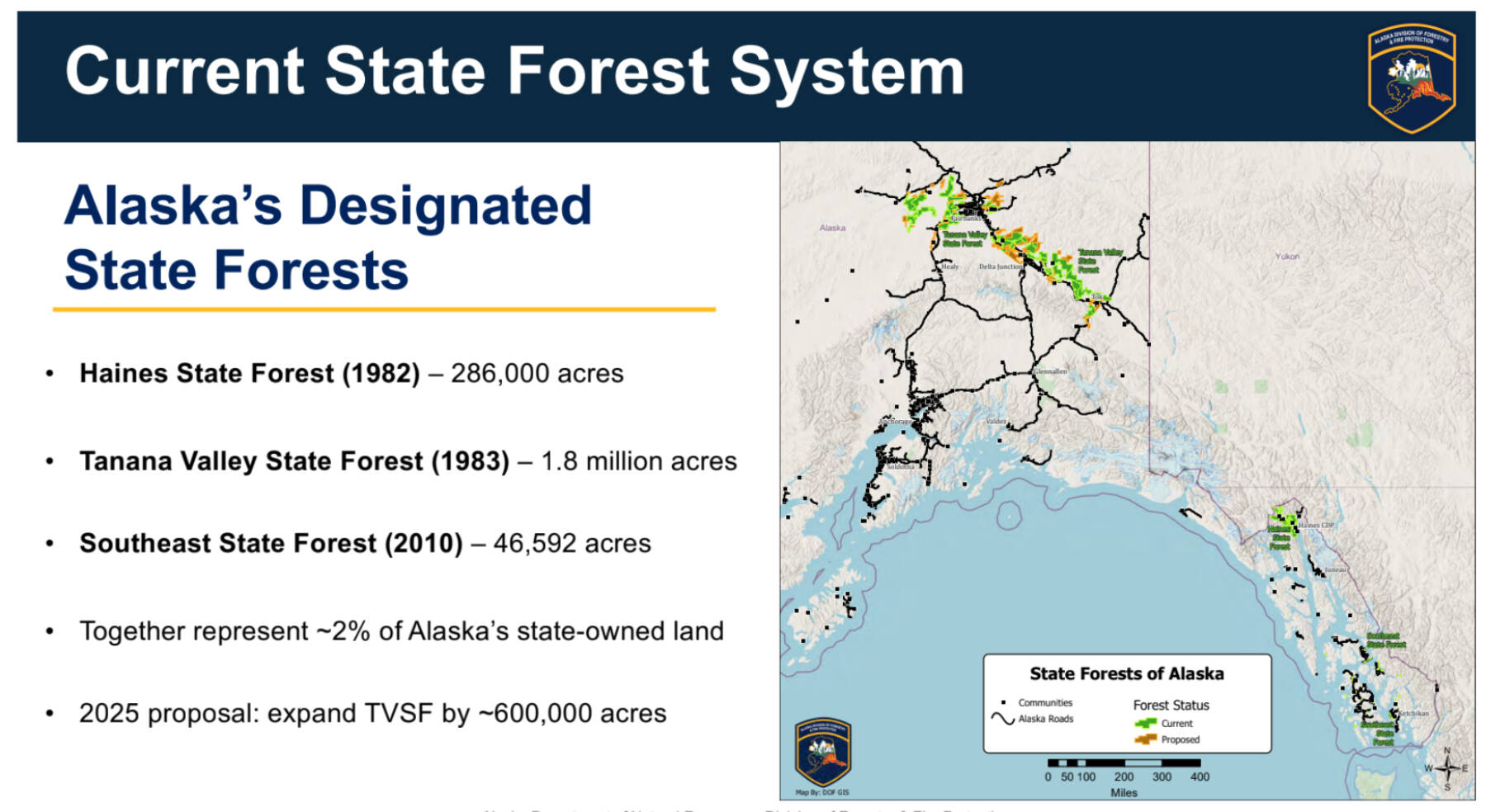
Over a dozen people attended a virtual meeting the Alaska Department of Natural Resources hosted last Thursday evening, Dec. 11. DNR is asking for the community’s input on the potential establishment of a Kenai Peninsula State Forest, and Thursday’s meeting was the last of four held throughout the Kenai Peninsula.
Area forester Diane Campbell began the meeting by clarifying that there’s no written proposal for a Kenai Peninsula State Forest.
“This is strictly an outreach to get community interest and to inform the community of what we’re thinking, what a forest is, how it operates and why we think it would be important for the Kenai,” she said.
State law says only the Alaska Legislature can designate a state forest. Public input will go to the department commissioner, and if there’s enough positive feedback, the commissioner will forward the proposal to state lawmakers. Campbell reiterated that because there’s no proposal for a new state forest, there’s no definitive map outlining the areas that would potentially become the state forest.
Division of Forestry and Fire Protection Director and State Forester Jeremy Douse told the Clarion in a Dec. 5 email that DNR has identified areas affected by spruce beetle mortality as providing strong opportunities for reforestation and regeneration. DNR already owns those areas, but the Division of Mining, Land and Water has oversight. If the state forest were created, management responsibilities would be transferred to DFFP.
One of the biggest questions so far has been whether Caribou Hills would be included in the potential proposal. DFFP Special Projects Coordinator Lily Coyle said the Caribou Hills area is already classified as recreational use, meaning that even if DNR received overwhelmingly positive input from the public and moved forward with the proposal process, it “wouldn’t make sense” to include Caribou Hills in the areas that would become the state forest.
“It’s classified as best use recreation, there’s already an existing management plan and we’ve heard loud and clear from the public that there would be no interest in having that be part of a state forest proposal,” Coyle said.
State forests currently represent around 2% of state-owned land in Alaska. The Tanana Valley, Haines and Southeast state forests cover over two million cumulative acres. The creation of a Kenai Peninsula State Forest would expand the Tanana Valley State Forest by 600,000 acres.
Campbell said that although long-term timber management remains the foundational purpose of a state forest, DFFP will maintain opportunities for recreation and work with other environmental organizations to ensure areas used for hunting, fishing and other subsistence practices remain unpolluted.
“Once a forest is established, management occurs under a forest management plan developed through public, stakeholder and interagency engagement,” she said. “The Forest Resource and Practices Act is there to protect the fish habitat and the water quality through coordination with the Division of Forestry and Fire Protection, the Alaska Department of Fish and Game and the Department of Environmental Conservation. We all work together to keep those habitats clean and clear.”
Environmental advocacy organizations such as the Susitna Water Coalition and the Kachemak Bay Conservation Society say the proposed actions threaten ecosystems and signal an expansion in industrial timber production.
“We’re still learning about the role of forests and upland habitat in the health of our watershed and the ways that watershed supports our communities,” said Katie Gavenus, secretary of the KBCS board of directors and lifelong Homer resident. “Any major changes to that could have some really significant ripple impacts that we can’t even predict yet.”
According to the Kenai Watershed Forum, the Kenai Peninsula Borough contains over 4,800 miles of anadromous salmon habitat. Anadromous habitat — freshwater areas where eggs hatch, young salmon migrate from when they make their way to sea and return to as adults when they’re ready to spawn — is crucial to salmon in all stages of life. The forum estimates only 40% of anadromous waterways in the Kenai Peninsula Borough are documented, leaving thousands of miles to be explored.
Gavenus said putting in roads to support timber production would impact the hydrology in sensitive areas by depleting the flow of nutrients. Additionally, the removal of trees would open salmon habitat to increased erosion and flooding.
“Realistically, there’s not a lot of high quality timber in the areas that are potentially up within this proposal,” Gavenus said. “That raises other questions as well, of the cost benefit here. If this is really about harvesting trees that are really high quality in terms of habitat and ecosystem services, but aren’t of high quality in terms of the products that can be made out of them once they’re harvested, why are we even considering this? It just doesn’t make economic sense, and it really doesn’t make ecological sense.”
Matt Beauregard, a carpenter and hunter who lives in Anchor Point, said he doesn’t want the changes to occur, saying he values the way things are now.
“I’m from California, where there’s logging galore,” he said. “Sierra Pacific Industries owns every other lot, and it’s a network of road hunters at all times. You are not going to find a deer right off the road, and even if you go in deep, they’re all hunted out. I just don’t want to see our future become anything like some of these Lower 48 states, where logging interests take hold and all of a sudden you’ve got access, but you also don’t have the resources anymore.”
Coyle said during the meeting that public comment has been “mixed” so far. She added that DNR has received 150 public comments to date, but she hasn’t yet reviewed them.
The meeting was recorded and is available to watch on the Alaska DNR Youtube channel.
Public comments are due by 5 p.m. on Jan. 16. Comments can be emailed to stateforests@alaska.gov or mailed to the Alaska Division of Forestry & Fire Protection at 550 W. 7th Ave. Ste. 1450 in Anchorage.