
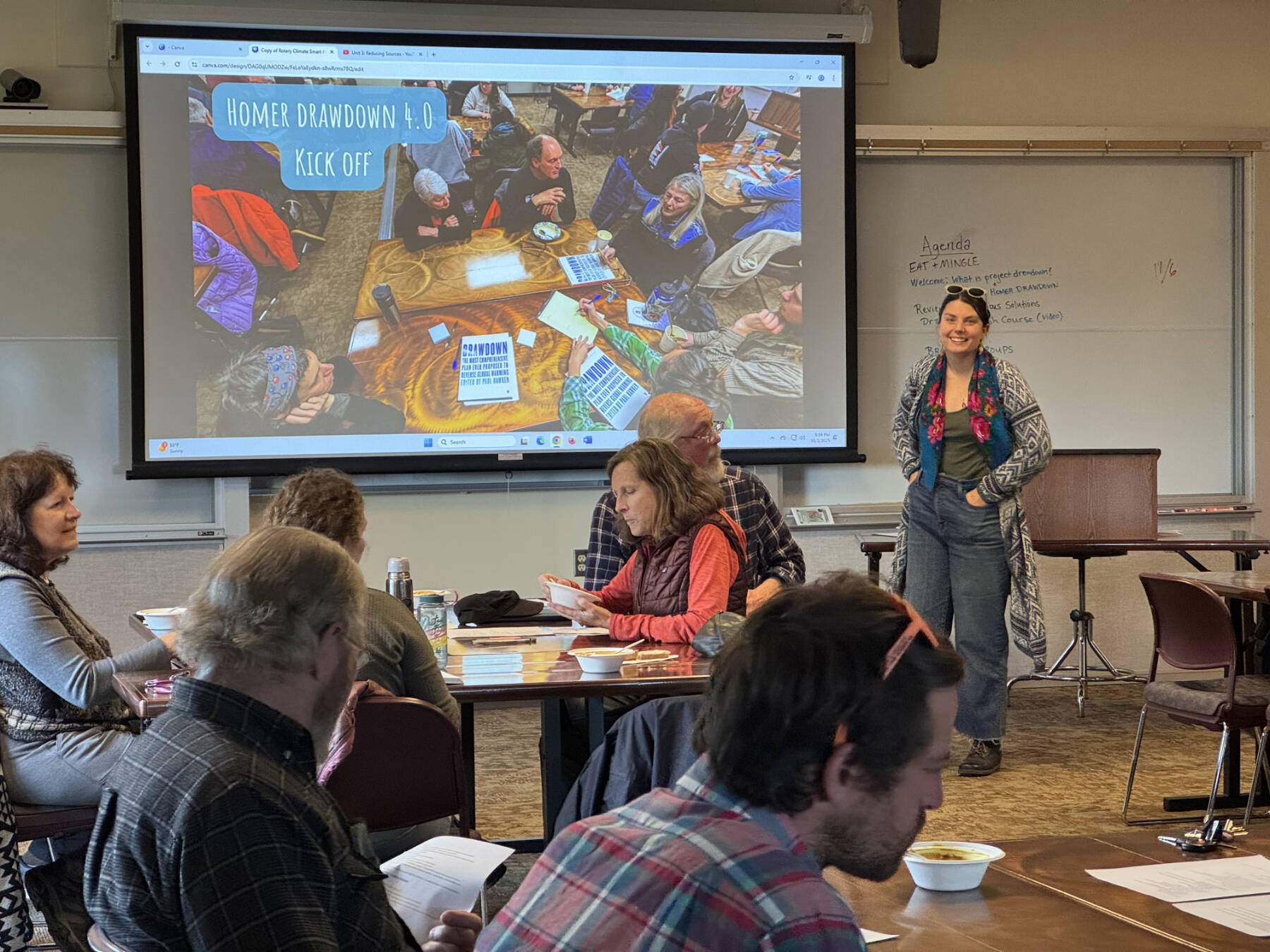
Homer Drawdown, the grassroots program built around community-driven efforts to mitigate the climate crisis at the local level, recently voted to tackle waste streams for their next project.
Largely headed up by the nonprofit environmental protection organization Cook Inletkeeper and based on the book, “Drawdown: The Most Comprehensive Plan Ever Proposed to Reverse Global Warming,” Homer Drawdown was begun in 2020, just before the COVID-19 pandemic arrived. The program’s website describes it as a “de-centralized community effort to … identify meaningful and well-researched solutions that stabilize levels of greenhouse gasses in the atmosphere. Homer Drawdown is grounded in the belief that community-led, middle-out solutions are the most influential solution we can enact.”
There have been three Drawdown projects completed to date, and community members are embarking on the fourth. Thus far, the program has focused on local peatlands, non-motorized transportation and climate smart homes. Inletkeeper Clean Water Lead Satchel Pondolfino said in an interview Monday that while the program doesn’t stick to a specific timeline for how long each project will take, they typically have lasted for one to two years.
“I think Homer Drawdown has sustained itself all the way into the fourth project because it is very fulfilling and hopeful work that feels good to be part of,” she said. “The climate solutions are certainly the heart of it, but we’ve learned from every chapter of this project that there’s so many other co-benefits and reasons to do this work. Beyond becoming a more climate-conscious community, it also often makes the community more affordable to live in, more safe or more healthy.”
On the question of “why waste streams,” Pondolfino pointed back to Homer Drawdown’s originating goal that the community can use its collective power and skill sets to do something locally about climate change.
“For waste streams, every single product that we use has a life cycle, and that life cycle has energy associated with it, and it often has land use and water associated with it,” she said. “So the more that we can extend the life cycle or think of things in a more circular way, the more efficient we’re being with those resources, and the more we can reduce emissions associated with that entire life cycle.”
She said that while the most impactful way to address climate concerns within waste streams is to consume less overall, and while she hopes that the new Drawdown project will help promote that value, the community’s efforts are focusing more on the back end of product use because that’s where they have the most influence.
“What we are hoping to contribute is a cultural shift that thinks about everything we use and waste in general not as an end point, but like an opportunity for a new economy or another use,” she said.
Volunteers involved with the program met in November to hear various pitches for the fourth Drawdown solution and vote on where the coalition would next direct their energy. Two solutions in particular — one focused on municipal recycling and composting, and the other focused on reducing food waste — resonated so strongly with the group that they tied the vote.
“(That) was a first one for us,” Pondolfino said. “People who participated in that meeting were really compelled by each solution … and the votes came in at an exact tie, so that was both befuddling and fun.”
Because both solutions fell under the umbrella of improving local waste streams, program members decided to combine them into Homer Drawdown 4.0: No Scrap Wasted.
The group met again on Dec. 9 to fine-tune proposed projects that Drawdown might accomplish as part of the fourth solution.
“We didn’t whittle it down as much as I think we probably will need to eventually do, but we definitely have some strong ideas that feel feasible and exciting to pursue,” Pondolfino said. “One place that we know we want to start is we’d like to get representatives from the borough and the city (of Homer) together to host a forum that would help share information about the state of the landfill, state of recycling, composting and waste-reduction goals, and share what we’re trying to accomplish as well.”
Other goals, she said, include working with the borough and potential contractors to explore what it would take to implement municipal composting and “make moves in that direction.”
“Whether that could get off the ground in two years is a question mark still, but it’s definitely something we intend to put some focused energy towards and build some partnerships and collaboration,” she said.
Drawdown 4.0 also envisions increasing local recycling rates and helping local businesses and institutions improve their recycling practices. Pondolfino said one potential avenue for that goal that Drawdown participants have brainstormed is helping to subsidize glass crushers for restaurants.
“That can really help the restaurants — it saves space, essentially, (and) it can make it a lot more convenient to recycle,” she said.
Some Drawdown members are interested in working with local schools to expand recycling programs and education there, while others have expressed willingness to work with the borough to help sort recyclable materials and possibly volunteer in-person on the weekends, to “have that interaction between individuals dropping off recycling to help make sure that best practices are taking place.”
Pondolfino said the group also “definitely wants” to work with local artists to create new signage “that is more encouraging” and offers better information about recycling. She also described an ongoing effort in the Matanuska-Susitna Borough where plastic film or shrink wrap, such as is used to wrap boats in the off-season, is shipped to companies like Trex or Alaska Plastic Recovery, the Alaska creators of Grizzly Wood, that turn that plastic into lumber.
“In the Mat-Su Borough, they send big sacks of that shrink wrap to Trex and get paid for it,” Pondolfino said. “We’d like to try to specifically intervene in the boat yards … so in the spring, we’d like to set up some recycling opportunities for that there and hopefully divert all of that to either the Mat-Su to combine with theirs or directly work with their partner.”
Additional goals shift the focus on reducing food waste streams, including hosting workshops to help community members build tangible skills that will enable them to reduce their own food waste at home. Pondolfino noted that Project Drawdown identifies food waste as a “really high priority climate action” because one-third of food is wasted globally.
“That would be things like canning, pickling and fermenting, utilizing the whole fish, how to store food properly so it doesn’t go bad in your fridge, gathering and preserving wild foods, composting at home,” Pondolfino said. “We’ve already gotten a thumbs-up from the (Homer United) Methodist Church to do a lot of those workshops in their commercial kitchen, which is awesome.”
Also related to better utilizing whole fish, Pondolfino said program members are considering working with a local artist to create and establish signage at self-use fish processing tables on the Homer Spit that include recipes, resources and tips such as scraping fish carcasses for meat to use in fish patties, how to use fish heads or how to pickle fish eggs, so anglers can utilize more of their catch.
Drawdown members are also interested in creating a directory to connect organic and food waste producers with individuals who can utilize it.
“So if people are doing at-home compost or if they have chickens or other farm animals, they can use this resource to connect, to rescue food that more than likely would be thrown away from restaurants and institutions,” she said.
Similarly in that line, she added, another Drawdown 4.0 goal is to work with restaurants directly to rescue leftover food that is “still good and could be nourishing for people in our community” and divert it to the Free Fridge hosted by the Methodist church and Homer Community Food Pantry.
There’s still more work to do before “No Scrap Wasted” projects are officially underway, but Pondolfino said that Drawdown 4.0 could potentially be implemented over the next two years.
“Because we combined two solutions right off the bat, we have a pretty long list of ambitions that we’d like to accomplish,” she said. “I think that the two-year time frame gives us more room to breathe.”
The next Homer Drawdown meeting will be held at Kachemak Bay Campus in January. Pondolfino said that participants will be forming working groups “to start divvying out tasks to get some of these off the ground.”
“A lot of our early work is often just research and calling people up and understanding how systems are currently operating and what it would take to get some of this going in our community,” she said. “Hopefully by summer, there’ll be some more hands-on opportunities, and certainly some educational opportunities that we’ll host, things like that.”
Homer Drawdown is open to all members of the community, no sign-up or registration required. Pondolfino noted that because the group is currently starting a new project from scratch, now is a “really apt time for people who haven’t worked with us before to come check it out.”
Those interested can find more information on the Homer Drawdown website or Facebook group, or contact Satchel Pondolfino at satchel@inletkeeper.org.
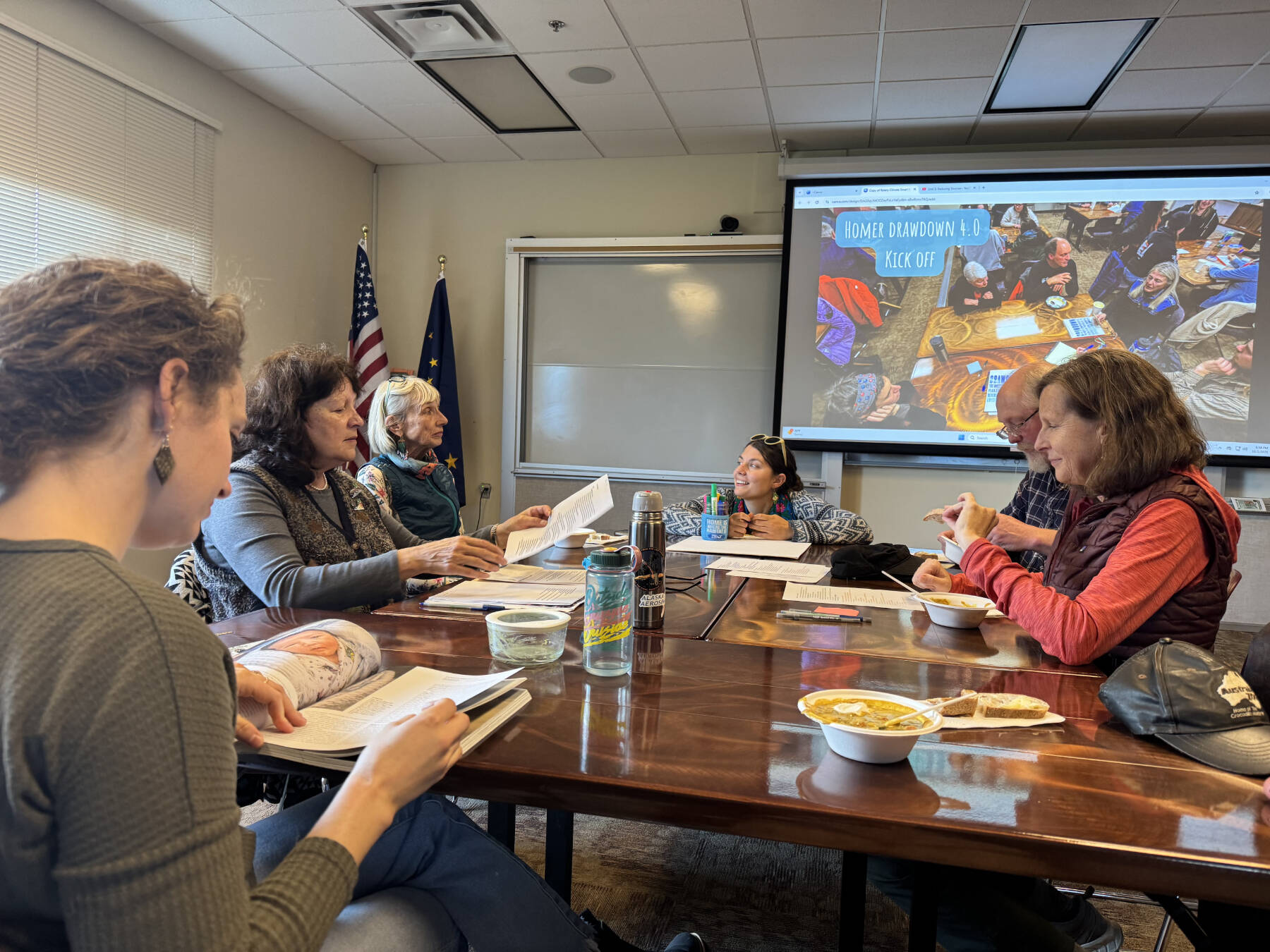
Community members participate in the Homer Drawdown 4.0 kick-off on Oct. 2, 2025, at Kachemak Bay Campus in Homer, Alaska. Photo courtesy Jamie Currie