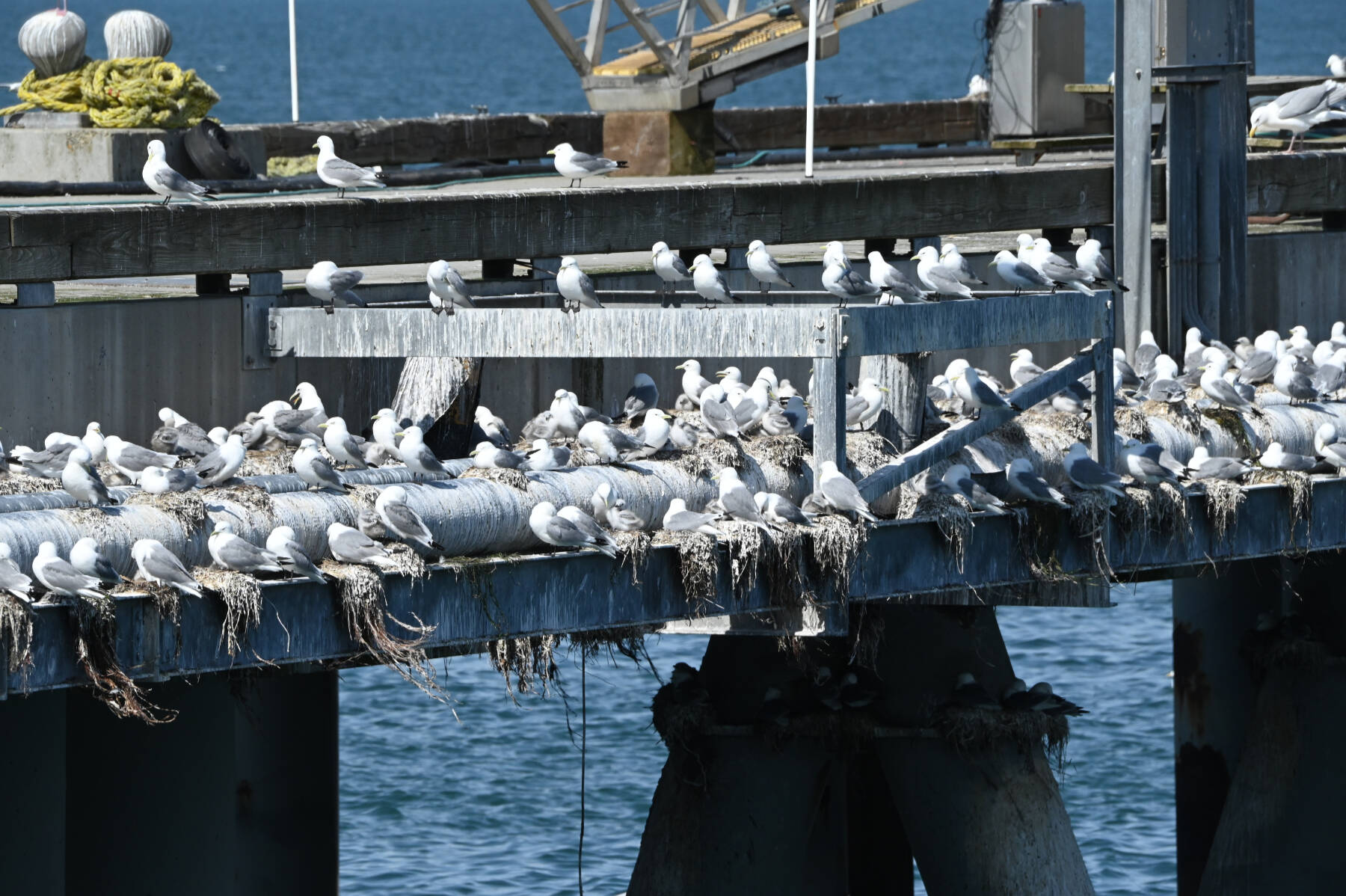
A research program begun in May by an undergraduate intern hosted by the Kachemak Bay National Estuarine Research Reserve invites citizen science efforts to monitor three local kittiwake colonies and track their reproductive success and disturbances to each colony.
Kittiwakes include two closely related seabird species — the black-legged kittiwake and red-legged kittiwake — in the gull family, with the black-legged kittiwakes being those most commonly found near Homer. The program, created by NOAA Hollings Scholar Claire Labuda as part of her internship this summer with KBNERR, focuses on the kittiwake colonies at the Deep Water Dock and Homer Ferry Terminal on the Homer Spit and Gull Island in Kachemak Bay.
“They’re very different in management styles and human usage,” Labuda said of the three colony sites. “So I was looking at disturbance levels between all the sites — human impact and eagle predation — (and) seeing if there’s any differences between the colonies and how that’s impacting their reproductive success and the timing of when they lay their eggs.”
Part of Labuda’s interest in the seabirds, she said, lay in their classification as a vulnerable species and their declining populations, as well as their function as an indicator species.
“They’re really valuable to study, because kittiwakes are only feeding on surface-level fish and plankton,” she said. “These fish and plankton are super important for the food web and the economies of these coastal communities that rely on them — so because the kittiwakes are only feeding on this, they serve as an indicator for how the ecosystem health is doing.”
Monitoring the kittiwake colonies can also inform researchers on matters including the effects of industrialization on the ecosystem, she said, noting for example future hotel development and the anticipated Homer Harbor expansion.
Labuda also gave as an example the major die-off event that occurred at the end of July, which affected a number of marine mammals and happened concurrently with the algal bloom in Kachemak Bay that researchers are still studying to determine its toxicity. It has not yet been determined whether the algal bloom was the reason for the die-off event.
“But the first species to be affected were the kittiwakes,” she said. “They’re the first species that’s going to be impacted (by) any changes that are happening in the environment, so by studying them, we can then better monitor how the overall ecosystem health is doing.”
Data derived from the monitoring program will also help with management plans, Labuda said. In her studies this summer, she found that the Homer Spit colonies are situated in more favorable habitat than the Gull Island colony — the opposite of what might be expected.
“You might think this area on the Spit, there’s all these cars and people around so it’s not good habitat, but it actually is showing it is really good habitat because all the humans around scare the bald eagles away,” she said. “So all the bald eagles are actually out at Gull Island, and there’s really heavy predation going on there.
“Our two colonies on the Spit are actually very successful and very healthy, which is good to know if we’re going to increase (development) — it shows that these species can still find suitable habitat here.”
Labuda said that due to eagle predation, the Gull Island kittiwakes are “constantly” being scared off their nests and the population is seeing “very low” reproductive success. Additionally, glaucous-winged gulls are preying on kittiwake eggs after the birds have been scared off their nests by bald eagles.
“Each of the colonies have a few thousand individuals there, so they’re about equal in number. So what we’re looking at is their reproductive success rate and how many eggs turn into a fledged chick that leaves,” Labuda said. “A good rate would be over a 50% success rate, usually. At Gull Island right now, it’s very low. Out of the thousands of birds, we’ve only seen two or three nests with chicks.”
Meanwhile at the Deep Water Dock and Ferry Terminal, which the researchers have divided into different plots, success rates range from 30-70%, which Labuda said was “really good.”
She said that kittiwakes can live more than 20 years and will usually return to the same sites every year.
“But we’re also seeing more and more birds are starting to nest here on the Spit, so it’ll be interesting to see going forward,” she said.
Though Labuda’s internship with KBNERR has ended, she set up the kittiwake monitoring program to continue in her absence. Next year, she hopes there will be another intern that will “keep momentum going.” She also hopes the project will garner additional involvement from the local community.
“I think it’d be really valuable to have community monitoring, so instead of just the researchers going out, we could have the community going out and then we’d have a more collaborative dataset and more eyes on the colonies to see what’s going on,” she said.
Homer has a successful history with citizen science and community monitoring, including Kachemak Crane Watch, a project associated with the Center for Alaskan Coastal Studies, and KBNERR’s ongoing monitoring for phytoplankton and invasive species including pike and European green crabs.
Labuda expects the kittiwake monitoring program to largely be a summertime effort since the birds only come to land in the summer to breed before returning to the ocean for the remainder of the year.
The kittiwake monitoring report is available via QR code on the KBNERR website. Community members are invited to submit their observations of disturbances to any of the three colonies to the dataset.
Labuda said that a disturbance is quantified as any time more than 1% of the colony is scared off of their nest. When submitting an observation to the online form, community members should note what they thought the cause of the disturbance was — for example, human interference or eagle predation — how many birds were seen flying off of their nests, how long the disturbance lasted, the date and time of the disturbance, and the weather at the time the disturbance occurred. The form also includes an option to submit photos of recorded disturbances.
“That way we can better understand how many disturbances there really are at all these sites, because we only go out once a week to monitor, so we don’t fully know what’s going on every day,” she said.
Learn more and get involved with kittiwake disturbance monitoring at kachemakbayreserve.org/kittiwake-disturbance-monitoring/.