
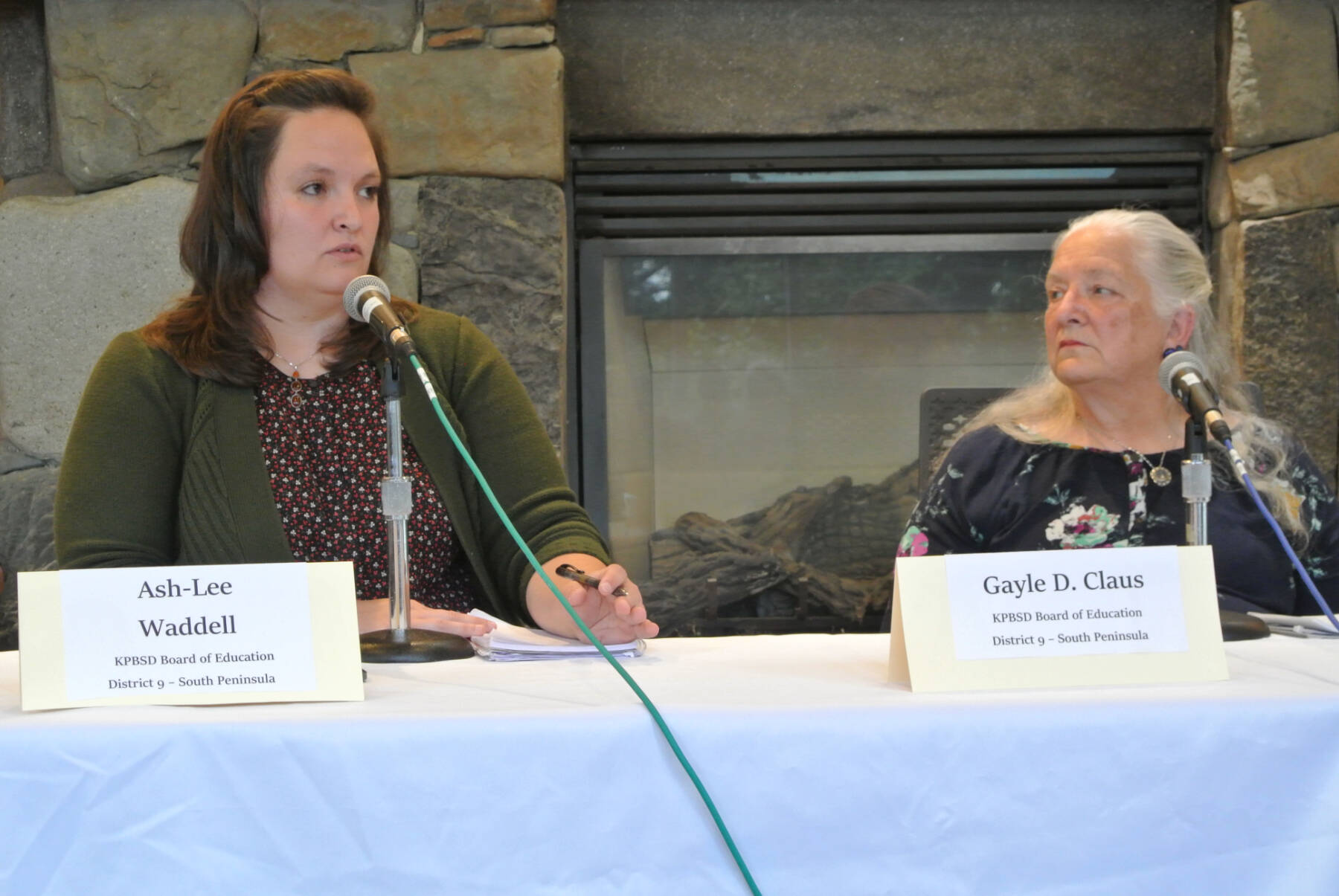
Many large questions loom over the Kenai Peninsula Borough School District as it grapples with ongoing funding issues, student retention, and sustainability. Last Thursday, District 9 candidates Ash-Lee Waddell and Gayle Claus took on some of those questions in an election forum hosted by the Peninsula Clarion and KBBI AM 890 at the Homer Public Library.
District 9 covers the southern Kenai Peninsula, excluding Homer. The candidate elected to the seat would serve students in communities including Anchor Point, Fritz Creek, Kachemak Selo, Voznesenka, Razdolna, Fox River, Seldovia, Nanwalek and Port Graham.
Waddell said in her opening statement that she is running for election to the KPBSD Board of Education because “my strongest allegiance is to our kids.” She noted her history of volunteering in the district’s schools and attending school board meetings as part of her belief that the community “deserves an active voice and eyes on what’s happening in our schools.”
“Education is a public trust that needs to serve every student,” she said. “I believe in leadership that adapts, does the hard work and listens to everybody that has a voice at the table. Essentially, I’m running because I want to make sure that every student, every school and every voice is heard.”
Claus, a Homer resident for more than 40 years, said she’s running for election to the school board out of concern over the quality of education in the district.
“I’m concerned about test scores … across the board, our schools are not doing very well,” she said. “Looking at our local schools and our small rural schools, they really are struggling with reading, writing and arithmetic, and people who don’t have those skills are handicapped in our society.”
Moderators’ first question reflected the district’s annual budget process and asked the candidates if they thought there were areas where the district was spending either too much money or not enough.
“I think that’s a hard question to quantify, because if we really looked at it, we would see that we’re not spending enough where we should be, and that’s not always because the funds are going elsewhere. It’s because we don’t have enough to go around,” Waddell said. She added that the three biggest cost drivers for the district are health care, transportation and salaries, and said that the district couldn’t cut any of those funds without direct cuts to staff retention or students’ ability to get to school.
“I think that we can be spending more money is the classrooms or in ways that directly affect the student’s day-to-day experiences … and professional development for the teachers,” she said.
Claus said that although, in looking at the budget, she “can’t quite make heads or tails of where all the money goes,” she had a sense that more money is spent on administration than on direct services to the students.
“I think that needs to be explored,” she said. “I’m definitely not in favor of an ‘off with your head’ sort of approach. But … I do think that’s probably where you start looking at cutting money, is administration versus direct services.”
Following the initial budget question, the candidates were then asked to explain their strategies for handling major budget shortfalls. Claus said that she didn’t understand the justification for or the legality of deficit spending.
“I think that, as stewards of public money, the school district needs to be looking at that. And I know that’s not an easy problem to address … so it would take some creative budgeting,” she said. “I think that you have to come back to, we have to at least try not to spend more money than we have.”
Waddell said that the real issue is that Alaska hasn’t modernized the base student allocation, and that one-time funding boosts are neither predictable nor “something you can effectively balance a budget on.”
“That aside, we should always focus on human impact first — which cuts ripple out to the most students, and those cuts should be last,” she said. “Like a household, you don’t cut your electricity first. In schools, we shouldn’t make cuts that affect the classroom first. Efficiencies must be balanced with equity and access.”
Prior to the start of the current school year, the board held numerous discussions about potential school closures, and have again restarted that conversation ahead of the next fiscal year. Both candidates were asked which factors they would consider as the district continues reviewing schools for possible closures.
Waddell said that student impact would always be the first factor she considered, with related factors including bus ride lengths, whether another school was reasonably close, and whether the alternative building is safe and healthy.
“If we’re keeping schools open that are not safe and habitable, I think that it’s important that we prioritize getting those students to better schools first,” she said.
Claus agreed, and added that the district might also look at the strengths of different schools, or “what is the most bang for your buck, as far as which building to use.”
When asked about the ongoing discussion about whether to shift the cost burden for school pools to the borough, both agreed that it seemed reasonable that, since pools often serve as a community resource in addition to a student facility, the cost should be supported by the communities using them.
Returning to discussion of the BSA, Waddell said she supported further increases to state funding for K-12 schools.
“The Alaska Constitution requires the state to fund public education, and by not keeping up with inflation, they’re falling short of their duty to appropriately fund,” she said. “I believe that the state must keep increasing funding until it aligns with today’s cost. Partial measures are inadequate.”
Claus reiterated her point on deficit spending.
“What is the point at which we realize and we admit that we don’t have the money in the state to fund further increases in education — and especially when increases in education funding are not accompanied by any measure to address performance?” she said. “I am fiercely in favor of good education, but it has to be paid for, and we’re on a slippery slope. There does have to be an effort on the part of the school district to economize.”
Both candidates were asked their thoughts on what the school district should prioritize when brainstorming new ways to recruit and retain quality employees. Waddell said that she believes that retention starts with respect.
“When teachers are consistently faced with the rhetoric that our schools are failing, they’re the worst, our kids aren’t learning or growing their skills like they’re supposed to — that’s a direct disrespect to the teachers,” she said. “That goes for everybody involved, as far as teachers, custodians, nutrition staff, and aides.
“I think that all of those deserve adequate pay and respect, and until we are collectively aligned with that, I don’t know that we’ll see the retention that we’re looking for.”
Claus countered that addressing the issue of low scores and poor performance isn’t an insult to anybody.
“It is actually just a statement of the truth. It doesn’t have to be an emotional assault,” she said. “I believe in merit-based evaluation and hiring, and I think that when we hire teachers, we need to be looking for people who perform well, whose students perform well.”
On deferred maintenance, Claus said that the school board and district administration “needs to look at how to get the most out of tax dollars.”
“To me, that includes maintaining things, not waiting until they’re dead and then having to replace them,” she said.
Waddell said that the district should first address safety and health impacts to students while avoiding sinking money into buildings that are “far gone.”
“Consolidation decisions also come back to this when we consider whether resources can be shifted into safer, healthier spaces,” she said.
Moderators noted that standardized testing data published by the state the week prior to the forum showed that while Kenai Peninsula students “consistently” score higher than Alaska as a whole, most students are not proficient in math and reading. Both candidates were asked what they viewed as the school board’s role in boosting student achievement.
“I would want to explore the choices of curriculum … and looking at transitioning back to phonics to teach kids to read,” Claus said. “I know that in some circles that’s a really terrible word, but there’s quite a lot of research to show that whole word reading is just memorization, and they don’t actually learn how to read.
She added that she would make sure that the curriculum committee is populated by current teachers, rather than retired teachers, and examine the curriculum purchasing practices.
Waddell said she is of the opinion that achievement is tied to basic needs.
“Students can’t succeed when they’re hungry, unsafe or unsupported,” she said. “Focusing on teacher and student wellness first, I believe, will lead the test scores to follow when the roots are healthy.”
Looking next at the uniqueness of the Kenai Peninsula school district, each candidate was asked how the district could ensure equal educational opportunities for all students, regardless of where they live.
Claus answered that the district should first ensure that there’s adequate student-teacher ratio for the basics — reading, writing, mathematics, history and science — and then extracurricular activities would be provided on the basis of the individual school’s ability to pay for them.
“I think if you go back to making sure that you have enough teachers and the right curriculum so that kids can be successful, I think we’d be really surprised at how not complicated education has to be for someone to become a lifelong learner,” she said.
Waddell’s answer was for the district to visit the schools and communities and to talk with parents, students and teachers in each community.
“I think the only way to ensure equal access is to know what equal access looks like where we’re trying to deliver it,” she said.
Other questions fielded to the candidates asked about weighing community feedback when considering controversial topics; where each candidate would like to see the district in the next 10-15 years; the greatest challenges facing the school district; the district’s greatest asset — which both candidates agreed was diversity among the district’s students, teachers and communities; the proposed four-day school week; and what each candidate saw as their responsibility to represent people from across the peninsula, including those outside District 9.
Find the forum recording in full on the Peninsula Clarion Facebook page. Election day is Tuesday, Oct. 7.
^
This story has been updated to clarify a comment by candidate Ash-Lee Waddell on school district employee retention. Waddell initially said the district may not see the desired retention until employees receive equal pay; she later clarified that the comment should have been the district may not see desired retention until employees receive adequate pay.