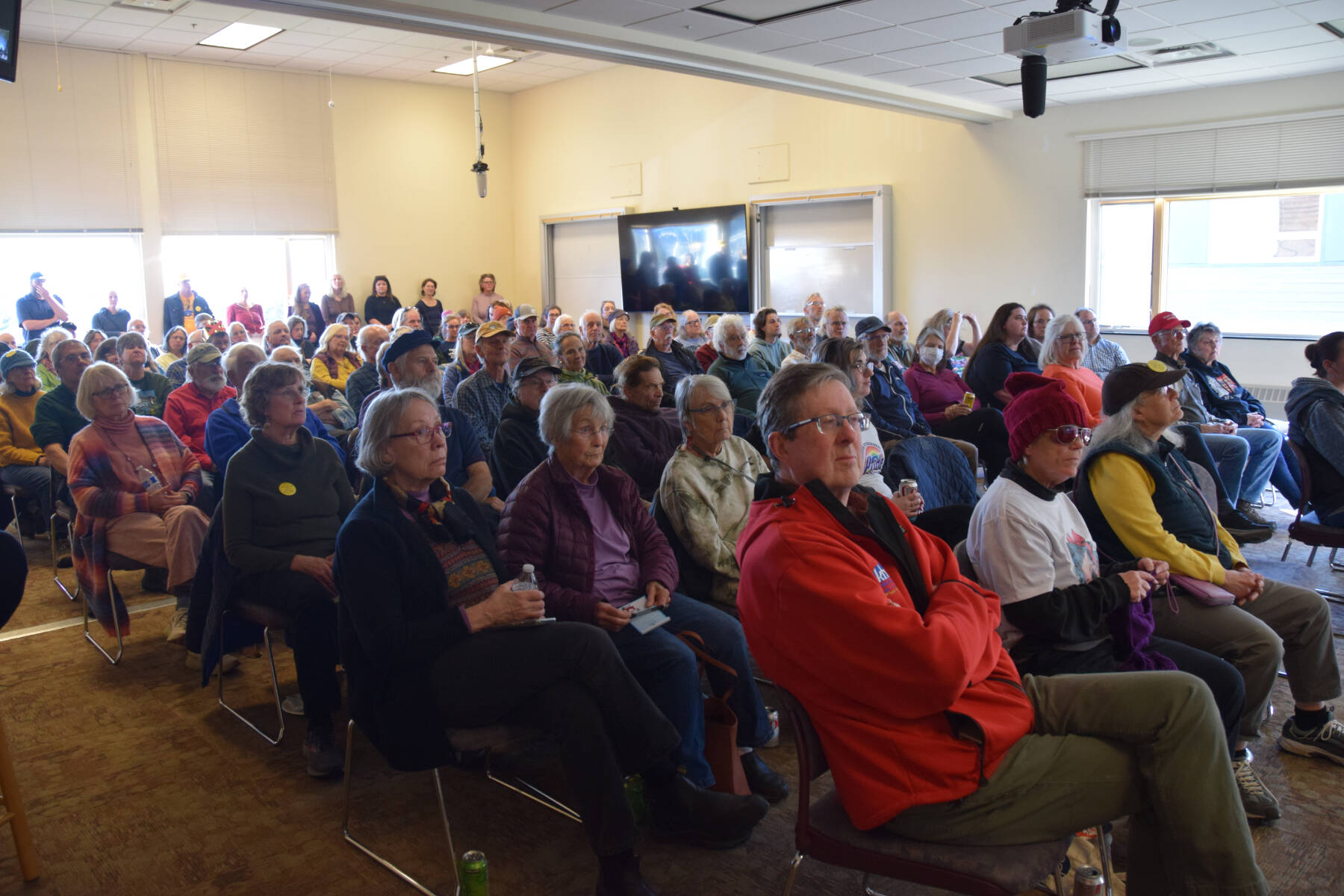
More than 100 people packed into Kachemak Bay Campus’s Pioneer Hall for a citizen’s town hall meeting following the “No Kings” demonstration on Saturday, Oct. 18. Panel member discussion and audience questions focused on rights established in the First Amendment to the U.S. Constitution and on the separation of church and state.
The event was sponsored by the House District 6 Accountability Project, a group that was formally created in approximately late August in order to establish more effective advocacy for the local community. Alaska State House District 6 covers the lower Kenai Peninsula, from Kasilof to the head of Kachemak Bay.
“A few months ago, at the end of the last legislative session, some friends, some neighbors and some people I had met for the first time got together, and we were sharing frustration on how divisive and polarized our community seem to be becoming,” Carly Wier, a volunteer board member for the HD6 Accountability Project, said at the start of Saturday’s town hall. “We were frustrated by the fact that we had felt our voices weren’t heard and represented by all of our elected officials. We were frustrated that sometimes we couldn’t get a response, or we felt unwelcome when we went to Juneau. So we decided to get together and create a new organization.
“What we came together to do was to advocate for our local community, for the things that matter to us that help create a healthy, thriving place for our families, for our children, for our grandchildren, for our elders, for our small and large business owners, for our workers, our people who work so many jobs to be able to live in this incredible community.”
Wier said that the group hoped the topics discussed Saturday would serve as the start of a series, with broader community topics including education, roads and more to be covered in future events.
The three-person panel included former Homer News editor Michael Armstrong, Homer United Methodist Church Reverend Blake Langston and City of Homer Library Advisory Board member Marcia Kuszmaul. Longtime Kenai Peninsula resident and local business owner Jason Davis, who also has over 20 years’ diplomatic experience, moderated the discussion. Davis also serves on the Homer City Council, but clarified Saturday that he attended the town hall meeting as a private citizen.
“We’re going to have this space today in a manner that, I hope, reminds us all that we are neighbors,” Wier said. “We are community members in a small town.”
Freedom of speech and freedom of the press
Davis started off the panel discussion with a series of questions for Armstrong relating to the First Amendment rights to freedom of speech and freedom of the press. The other panel members were also welcomed to comment on any questions directed toward a specific panelist.
Armstrong spoke on the implications for journalism, particularly local journalism in small communities, when people’s rights to free speech and a free press are suppressed and voices are silenced. He said that “news deserts” are one of the challenges seen across the country, especially in small towns, where weekly newspapers with decades or even centuries of publication are closed and disappear from the community.
“What you lose with that is not just the breaking news, but the daily in-and-out of covering a community,” he said. “We can talk about the silencing of voices in terms of big stories, controversial stories, but also I think as great a danger is the silencing of all those community connections.”
Davis next asked what role, if any, a sitting legislator holds in influencing what a newspaper publishes.
Armstrong said that he would expand that from influencing to informing.
“Informing is influencing, in the sense of if there are issues in Juneau, for example, things that are happening that we may not be aware of, it’s important for a legislator to keep us informed,” he said. “People in general want to influence the news in the sense that they want their perspective, their institution, to get coverage.”
Armstrong was also asked to share about organizations that are available to support a free and independent press. The Alaska Press Club is the statewide advocacy organization for journalism and represents all media types in Alaska. At the national level is the Society of Professional Journalists and the American Civil Liberties Union. Locally, Armstrong said the best way for community members to support journalism is to support public media.
“Be involved with what is being reported in your community and support it by subscriptions, by advertising, and by buying the paper,” he said, adding that for those who can’t afford a subscription, free copies of several newspapers are available at the public library. “We’ve had a decline in readership, unfortunately — changing media is something that every print newspaper has to deal with, and that’s a challenge. But as new media develops, I would say, seek those out and support those as well.”
The next question pertained to a letter sent by Rep. Sarah Vance, R-Homer, to Homer News’ publisher in response to a Sept. 25 article about a memorial held in Homer for Turning Point USA founder Charlie Kirk. In the letter, Vance alleged that there was a “growing movement” to boycott Homer News advertising and called for “corrective action” to avoid “financial as well as reputational” consequences. Davis asked Armstrong whether, in his opinion, Vance’s use of official Alaska State Legislature letterhead was a violation of the First Amendment, and whether his answer would be different if official letterhead had not been used.
“I support a wide latitude of the First Amendment,” Armstrong said. “I would say that Rep. Vance did have a First Amendment right to express her opinions on her letterhead, or not on her letterhead. Alaska law is interesting — a sitting legislator in legislative session … can say a lot without many limitations, which I think is as it should be. A legislator should be free to speak on the floor.”
The real question in this context, Armstrong said, was whether a legislator should intimidate the press or make veiled threats.
“I don’t think they should do that,” he said. “I think that’s what’s happened, and this is why we’re here now. There are some limitations there, and some accountability.”
Book bans, censorship and ‘the right to know’
The conversation turned to book bans and libraries’ responses to book challenges. The Homer Public Library saw policy turned into action in 2022 and 2023, when a citizen’s group challenged more than 50 titles in the children’s section, and the Library Advisory Board reviewed each book before voting on whether or not to keep the title on the shelf. The library found that there was no reason to remove any of the contested titles and chose to keep all 55 books in circulation.
Davis asked Kuszmaul what it was like to respond to the attempted book ban.
“The outcome was very positive, and in all aspects, it was a very healthy and very good exercise for the community to go through,” she said. “We were very fortunate that our library was well-prepared to address the complaints, in that we have a very strong collection development policy that’s in place that details how our books are selected, and we had a very strong reconsideration process in place.”
Kuszmaul emphasized that library policies are not just made up on their own, and that libraries have a “long history” of having established guidelines and professional ethics — including the Library Bill of Rights, originally adopted by the American Library Association in 1939, which states that all libraries serve all people in the community and that books and other materials should not be prohibited or removed because of partisanal or doctrinal disapproval.
Davis asked Kuszmaul to outline current trends with regard to book challenges, and what people can do to respond to calls for banning books. Kuszmaul said that book challenges have “increased dramatically” in the last three years, and noted that the data collected annually on book bans — some of which she shared during the meeting — is available online through organizations including the ALA.
“About 72% of book bans are coming from pressure groups, or from boards or elected officials who are being influenced by those groups. Interestingly, only 16% of the bans are coming from parents,” she said. “So it is definitely more of an organized effort than an individual effort by individual people.”
Kuszmaul said that the nature of book bans over the decades tends to follow current issues or topics that people are focused on.
“It’s gone from racial issues to sexual issues. Now it’s about LGBTQ+ issues,” she said.
One change the Homer Public Library made to their policy in response to the 2022 book challenge, which focused on alleged LGBTQ+ titles in the children’s section, was to require people submitting a challenge to note specific issues they had with a book and the location of the issue within the book. During the Library Advisory Board’s review of each challenged title following several hours of public testimony from both sides, multiple board members found that several of the books didn’t relate to or contain LGBTQ+ themes at all.
“Prior to the book ban challenge, we didn’t ask people to verify that they had actually read the material. So now, on our challenge form that’s posted online, if you have an objection to a book or a program, you need to be specific about what it is about that book (and) where in the book,” Kuszmaul said. “The things that are important for people to do is know that your library has a strong policy and has a strong procedure for how to address challenges to materials or programs, because that’s critical to be in place.”
Davis asked the full panel to weigh in on what a community loses if library books or local news is censored.
Armstrong said that the government can’t censor news due to the First Amendment, though it may try.
“Interestingly, although the government cannot say to a newspaper, ‘You can’t do this, you can’t publish this,’ often the government just doesn’t release the news or makes it hard to get. So in that sense, there is some censorship” he said. “What you lose is, first of all, the information that we as citizens need to understand what’s happening in our community — good (or) bad. When you have censorship, particularly when people are compliant with it, you lose trust in your news source.”
Armstrong also noted that it is a journalist’s duty to seek out as many opinions, ideas and facts as possible.
“The Bible of journalists, the Associated Press Stylebook, distinctly says, ‘Seek out diversity of voices,’” he said. “When I was at the newspaper, I saw myself as a storyteller, and my job was to tell the stories of all the people of Homer. But if you censor that, you lose trust and you lose voices.”
Kuszmaul added that through censorship, people also lose their right to form their own opinions.
“That’s a key thing about the notion of freedom to read and the right to know,” she said. “Those are two concepts that I think are really important, that everyone has the freedom to explore any topic from any perspective and come to their own conclusions.”
Langston said that censorship becomes a “pendulum” and causes loss of diversity and the ability to build trust in communities.
“If you censor something now (and) someone else censors something later, it becomes this very precarious ledge upon which we perch, and it leads to more and more censorship,” he said. “I see it funneling down, so we lose this beautiful thing that we call the celebration of our plurality and our diversity in our communities.
“When we censor, all of a sudden we’re worried about what we can and can’t read, what we can and can’t say, and we don’t get to be our truest person in front of the other. So we lose our ability to be these amazing things that we are and shape these amazing communities that we can.”
Religious liberty and the separation of church and state
The discussion moved on to the concept of separation of church and state, the concept’s background and what it looks like in practice.
Davis asked Langston to explain the meaning of the term “Christian nationalism,” a term that has been used often lately in the media and elsewhere. Langston said that the term referred to the idea that a national identity and a religious identity would be fused.
“This is not the informing of one of the other, which is, by the way, the right of every person who expresses any sort of faith or religion, or those who express no faith or religion whatsoever,” he said. “Christian nationalism is specifically that fusing of values … merging those two things into one thing.
“From the Christian perspective, Jesus said that no one can serve two masters. You’re going to love one and hate the other. I think that’s part of the big conflict, is that in this sense, faith is being used as a lever to mobilize and pull people into different spaces. This is not new … (but) Christian nationalism becomes pernicious because it uses faith as a way to leverage people, and in that way, you’re not really serving the faith or the nation.”
Kuszmaul added that she thought, in the fusing of Christianity and the American national identity, there was an expectation that to be a “true American,” one must also be a Christian, and vice versa.
“Nationalism, I think, is very different from patriotism, and I think most people appreciate the difference,” she said. “I think that is something that we’ve seen evolve.”
The next question referred more closely to the concept of separation of church and state. Panelists were asked how politicians might justify basing their political decision-making on their religion when the Constitution calls for separating church and state.
Armstrong said that America has a long history of people of faith serving in government and in political action, and specifically named Martin Luther King, Jr. as an example of the latter.
“It’s a good idea to have people of faith in our government. If you’re raised in a religion, the presumption is that most religions have a central tenet of doing unto others as you would have them do unto you. That’s a good moral basis for anybody to serve anywhere, particularly in government,” he said. “But I think the limit is, if by practicing your faith you suppress others’ beliefs, or even their non-beliefs, I think that’s the separation.”
Langston said he didn’t think there was, nor should there be, a broad expectation that any politician would put their values off to the side when they legislate.
“The line comes when activities become tantamount to a state-sponsored religion, which for us it’s important not to have that, because it does then become a type of coercion,” he said. “To represent what you truly believe, I think, is a high calling. To represent those who trusted you with their votes is a true and a high calling. Where you balance that out is in the establishment clause of the First Amendment.”
The final question asked panelists why separation of church and state is important for both the church and the state, and how the establishment clause — or the clause in the First Amendment which prohibits Congress from establishing a state religion — protects individual and collective religious liberty.
Langston referred to the Acts of Supremacy, or two acts passed by the English Parliament in the 16th century which established English monarchs — starting with Henry VIII — as the head of the Church of England in addition to being the head of state.
“That’s the backdrop — so what happened after Henry, was Mary came along. She was Catholic, so you have the Reformation, then the Counter-Reformation, a lot of murders … a lot of persecution occurred in the name of the church on both sides of the argument,” he said. “This is the historical backdrop, which our Founding Fathers would have known and were concerned that there would be sectarian divides in a fledgling government that really required the consent of the governed. ‘We the people’ is the statement that came out of that.
“The history is that trouble followed when (religion) became state-sanctioned, so if you were not that religion, then you were by definition an enemy of the state and a traitor.”
Langston said that the First Amendment’s establishment clause “was not any kind of indictment on religious freedoms at all,” but rather enshrined individual and collective religious freedom by establishing law against imposing one religion or belief system to the exclusion of all others.
The second half of the town hall allowed panelists to answer questions from the audience. Audience members continued the discussion with further comments and questions relating to religious freedom and separation of church and state, censorship in public media, and the liberties enshrined in the First Amendment to the U.S. Constitution.
One audience member asked the panel their thoughts on, when mainstream media fails or is corrupted, what makes an effective alternative media. Panelists also discussed who the media should reach and how, and what needs to be communicated to the people most urgently.
Armstrong said that the wonders of technology in the world means that there are many alternative forms of communication today that allow other voices and media to be heard.
“What needs to be communicated is the community,” he said. “We need those community platforms to share our stories, share our successes, share our failures, share our sadness. I think that’s what unites us as a community, is that we come to know each other.”
Watch the town hall discussion, titled “Citizens Town Hall on the First Amendment,” in full through the House District 6 Accountability Project YouTube page at www.youtube.com/@HD6Accountability.
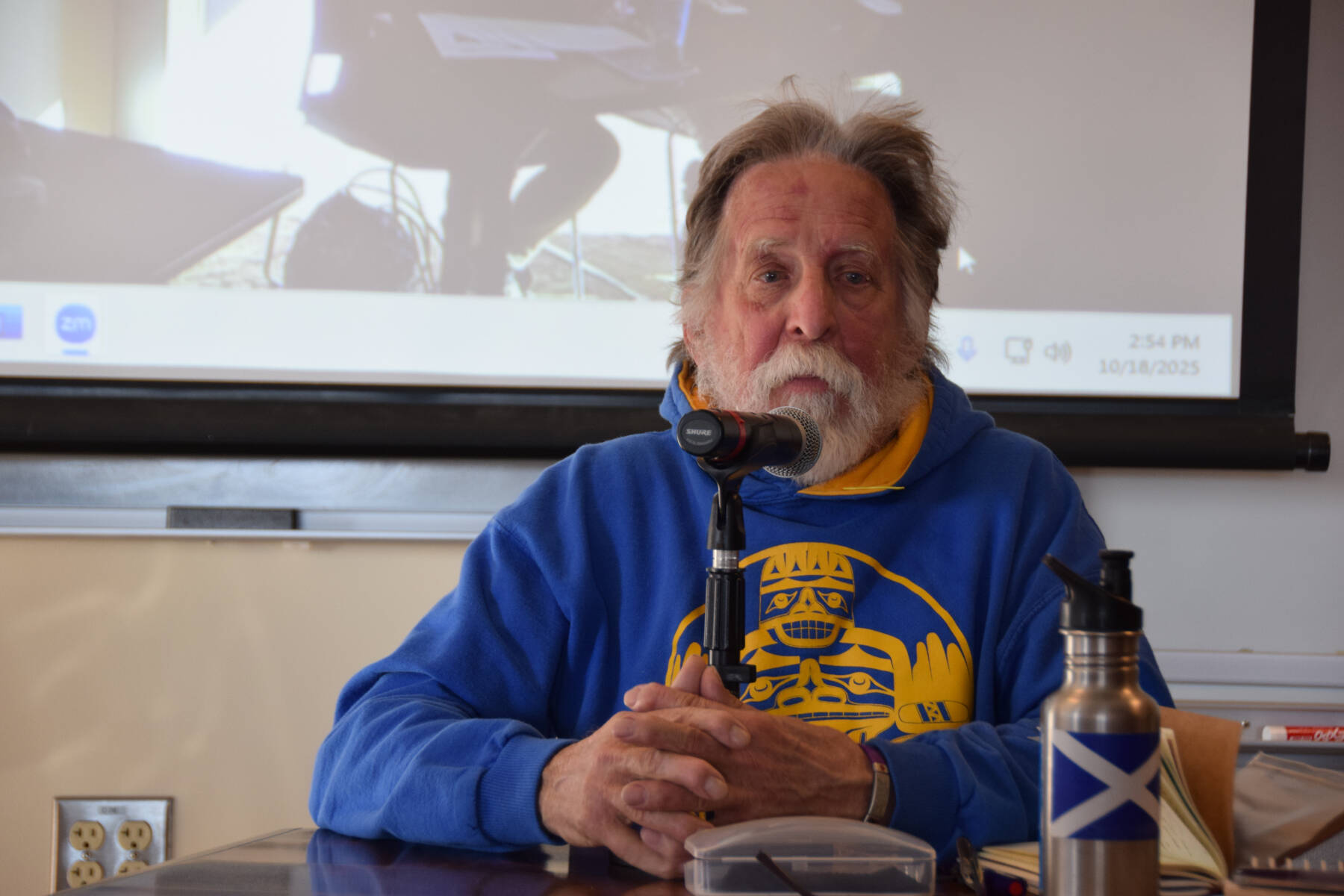
Former Homer News editor Michael Armstrong answers a question during the Citizen’s Town Hall meeting on Saturday, Oct. 18, 2025, at Kachemak Bay Campus in Homer, Alaska. (Delcenia Cosman/Homer News)
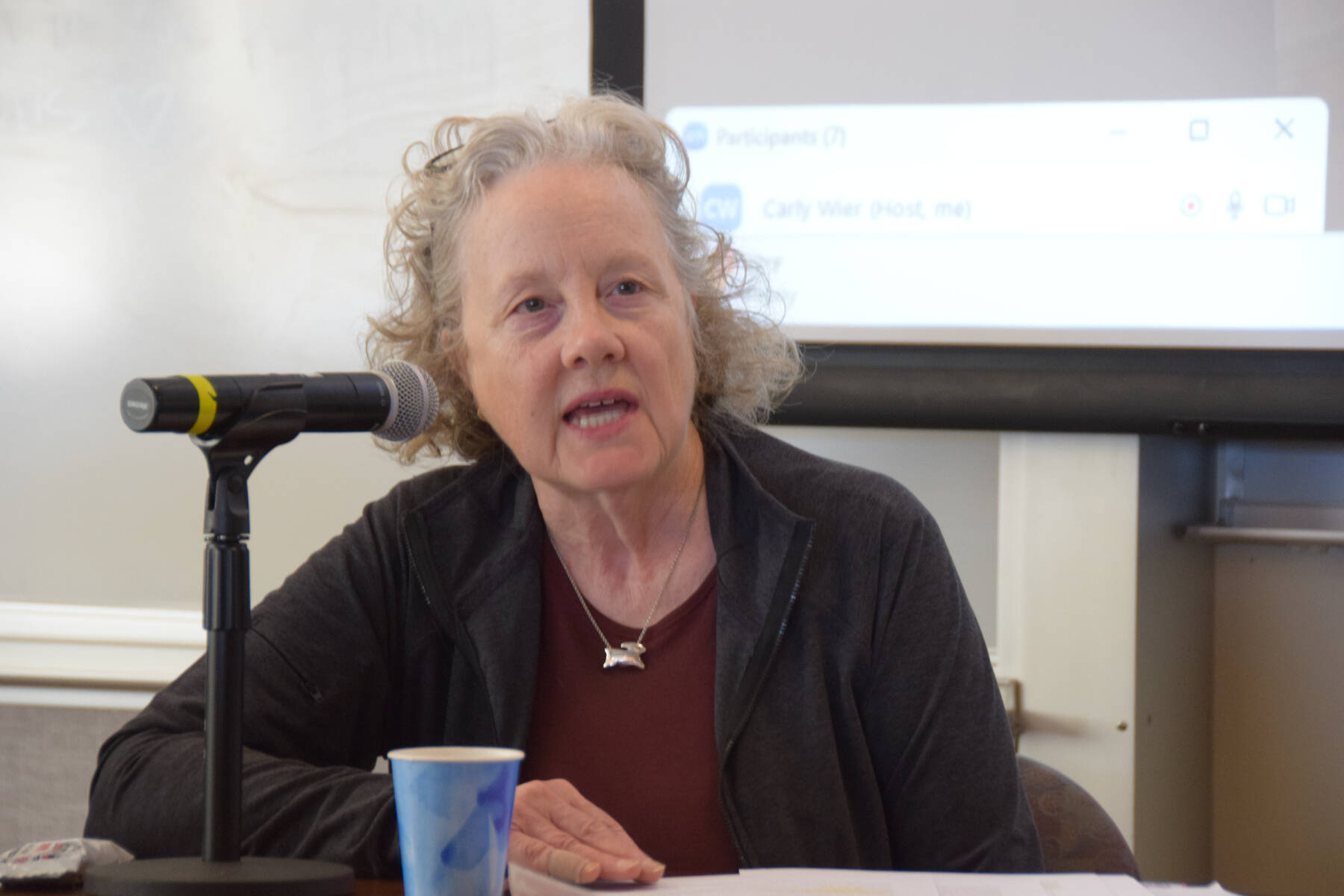
Homer Library Advisory Board member Marcia Kuszmaul answers a question during the Citizen’s Town Hall meeting on Saturday, Oct. 18, 2025, at Kachemak Bay Campus in Homer, Alaska. (Delcenia Cosman/Homer News)
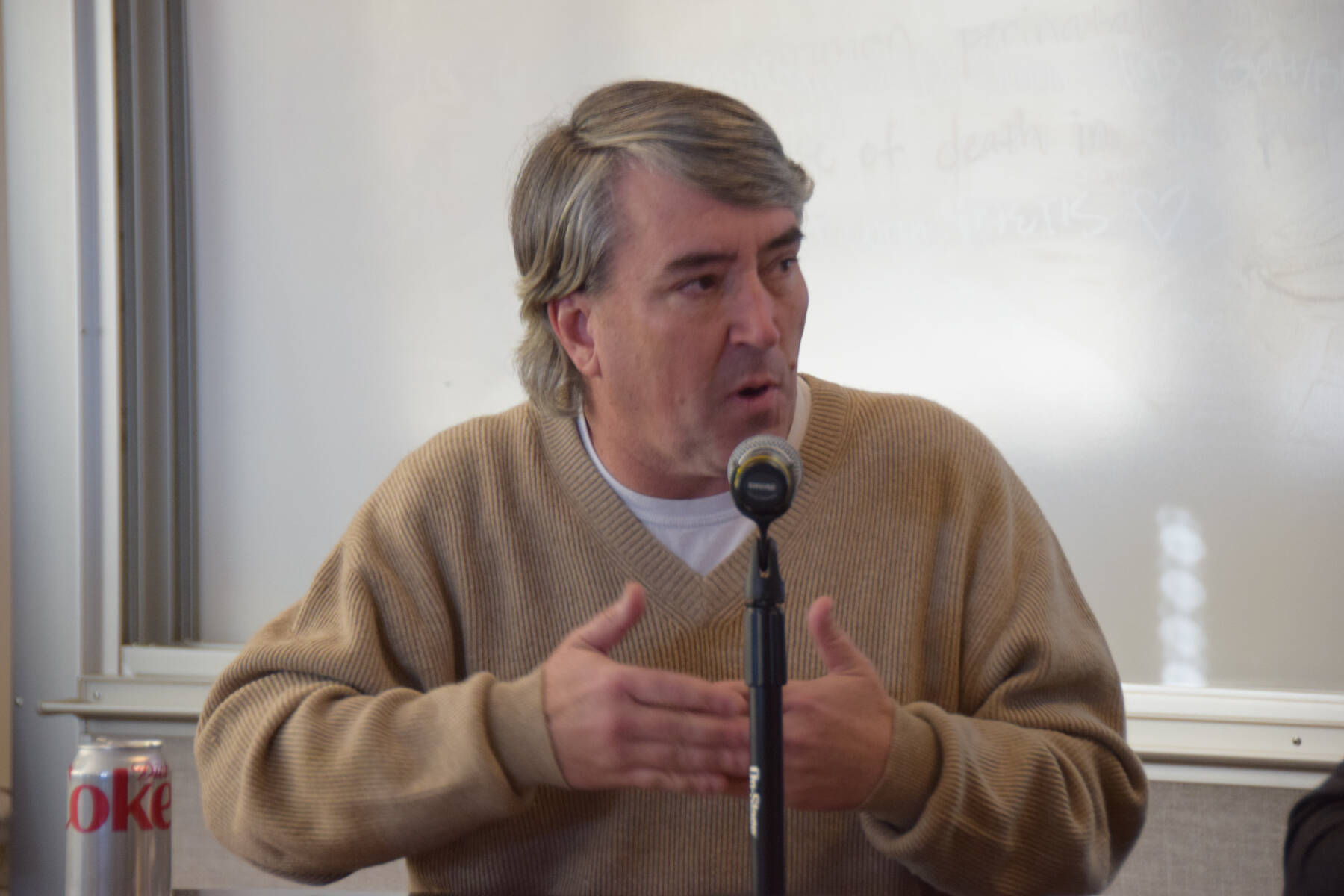
Homer United Methodist Church Reverend Blake Langston answers a question asked during the Citizen’s Town Hall meeting on Saturday, Oct. 18, 2025, at Kachemak Bay Campus in Homer, Alaska. (Delcenia Cosman/Homer News)

Jason Davis moderates the panel discussion and audience questions during the Citizen’s Town Hall meeting on Saturday, Oct. 18, 2025, at Kachemak Bay Campus in Homer, Alaska. (Delcenia Cosman/Homer News)
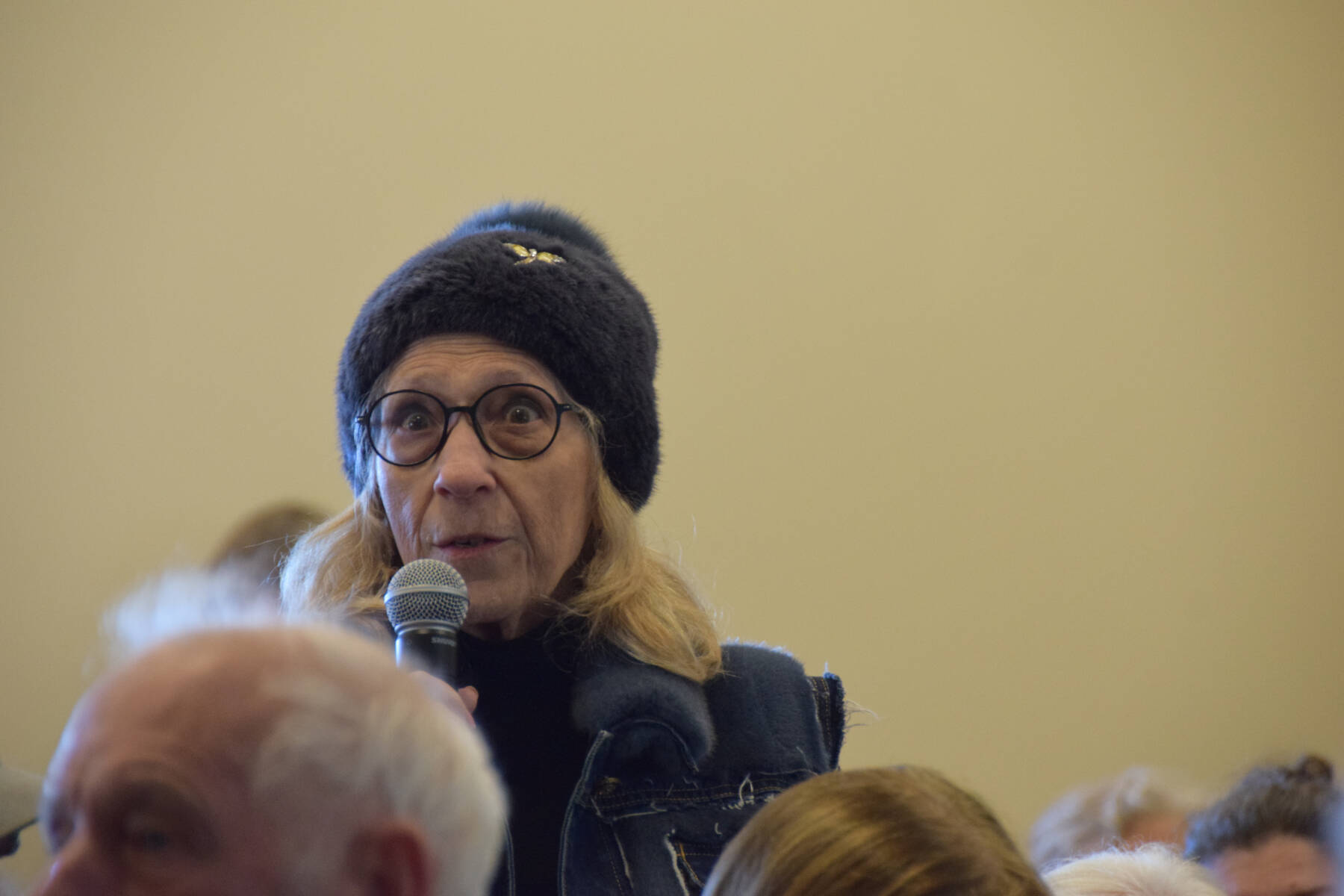
Local resident and audience member Nona Safra asks a question for the panel during the Citizen’s Town Hall meeting on Saturday, Oct. 18, 2025, at Kachemak Bay Campus in Homer, Alaska. (Delcenia Cosman/Homer News)