
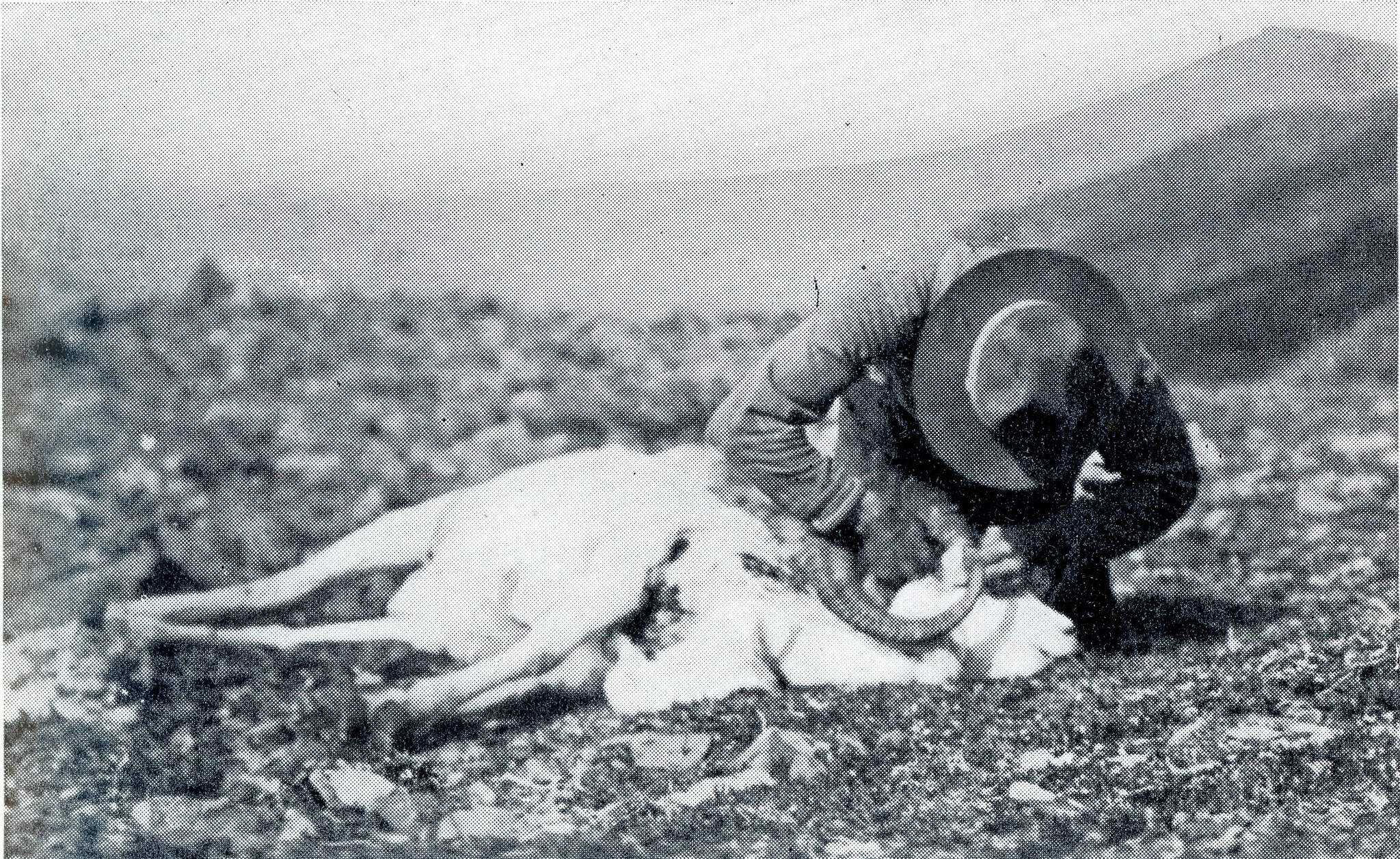
AUTHOR’S NOTE: Danger was inherent in the job. Although his fellow hunting guide, William Weaver, had narrowly escaped drowning in Kenai Lake in October 1910, Ben Swesey was undeterred. Swesey, by 1911, had been a licensed guide for only a year, but he was already developing a sterling reputation for his knowledge, his expertise and his warm personality.
After Baron von Loehneysen, the German consul at Seattle, returned to Seward from a September 1911 moose hunt in the Stetson Creek area on the central Kenai Peninsula, Alaska’s territorial governor asked him to provide a written impression of the guiding services he had received.
The baron’s guide had been Ben Swesey, who had assisted the hunter in killing two large bulls. According to the Seward Gateway, one set of antlers was attached to an “exceptionally large and splendidly shaped head,” and von Loehneysen provided glowing praise of the guide who helped him procure his trophies.
“Mr. Benjamin Sweasey [sic] is not only a very able hunter and guide who knows where to find the game and how to get it,” wrote von Loehneysen, “but he is also a most congenial companion and a fine man physically as well as mentally. He never disappoints his employer by taking a shot when he is not supposed to, nor does he run after money by trying to keep his employer busy in finding the game.
“[He] is more ambitious to see his employer get the game than sometimes even the hunter himself,” the baron continued. “His character is the most honest one that I ever found among men of his class. In short, I cannot imagine anyone [a] better guide than he is.”
Such praise was typical of the hunters who hired Seward resident Ben Swesey to guide them to big game on the Kenai.
In pursuit of trophy animals, Swesey led hunters from throughout the Lower 48 and much of northern Europe. Most clients on such hunts expected to be out in the wilderness for two to six weeks.
The year before, Swesey, fellow guide William Weaver and three packers had led a former major in the U.S. Army and a Wyoming businessman into the Kenai Mountains above Skilak Lake for about a month. They returned in mid-October, according to the Seward Gateway, elated and “laden with trophies of [the] chase.”
Guiding work was seasonal, but it was also steady and dependable. Although the work was rigorous, it also paid well.
When hunting seasons were closed, Swesey prospected for gold (usually on a claim he shared on Stetson Creek). He also worked as a winter watchman for a mining company and sometimes assisted the explorations and investigations of area game warden John A. Baughman.
In addition to his cabin in town, Swesey kept a mining cabin a short distance up Cooper Creek, into which Stetson Creek flowed. When he wasn’t guiding, he could usually be found in one of these two locations.
In the summer of 1911, before he guided Baron von Loehneysen after moose in the mountains, he also joined with miner Jerome Hatchey and fellow guide Henry E. Revell to build and test a motorized launch on Kenai Lake.
News reports at the time spoke of a “tryout day,” in which the launch sped along the waters “like a racer.” The trio of men hoped that the craft would provide passenger service and possibly freight transport up and down Kenai Lake, which, at the time, was the main avenue connecting Seward to Cooper Landing.
In 1913, Swesey was one of a quartet of guides hired in Seward by “the Kleinschmidt party,” a well-heeled group with two missions: First, the group planned, according to the local newspaper, to “take out moving picture machines and get pictures of all animal life on the Kenai Peninsula, more especially brown bear and moose.” Second, after a sojourn in western Alaska, group members planned to return to Seward in the fall and “spend about six weeks [hunting] moose and bear and mountain sheep.”
Part of the group’s work was intended to benefit the Carnegie Museum in Pittsburgh, and two taxidermists—one from the San Francisco Academy of Science, the other from the State University of Iowa—had been hired to join the Kleinschmidt team and help preserve specimens.
After that eventful fall and summer, Swesey managed to squeeze in one more hunt before winter fully set in. A portion of that final trip was more eventful than either the guide or his client, a New York surgeon named Dr. A.W. Elting, had anticipated.
As evening approached, Swesey and Elting were following a moose trail back toward their camp when Swesey spotted a huge brown bear standing in the brush only about 40 feet away, according to the Seward Gateway. Swesey was unarmed, as his two packers, Elgin Vaughn and Ike Hergard, had borrowed Swesey’s rifle as protection against a large bear they had seen on the previous day.
“Shoot it in the neck!” instructed Swesey, as the bear dropped to charge. Elting held his ground and fired. The bear, struck in the shoulder, collapsed immediately to the ground—and then, said the newspaper, “instantly arose and made for the brush and was soon lost to view.”
The two men attempted to track the wounded animal, but waning light hampered their efforts. They instead headed to camp, determined to search again the next morning. That night, however, two inches of snow fell, obscuring all signs of the fleeing bear.
Over the next few years, Swesey continued to mine during the summers and guide hunters in the fall, usually working with George Cotter as his packer. William Weaver, meanwhile, apparently took time off from guiding. He worked a variety of jobs, including trail-breaking, road-clearing, and occasionally assisting Seward’s deputy U.S. marshal, Isaac Evans.
Swesey and Weaver do not appear together in contemporaneous news coverage until their fateful trip out of Resurrection Bay in mid-October 1917.
Just before their disappearance, Swesey served as guide on one final hunting trip. Both of his clients, who were sportsmen from New York, later wrote hunting memoirs that included their adventure on the Kenai Peninsula. Both of those books praised the efforts and character of Ben Swesey, and one of them provided possible clues concerning the disappearance.
TO BE CONTINUED….