
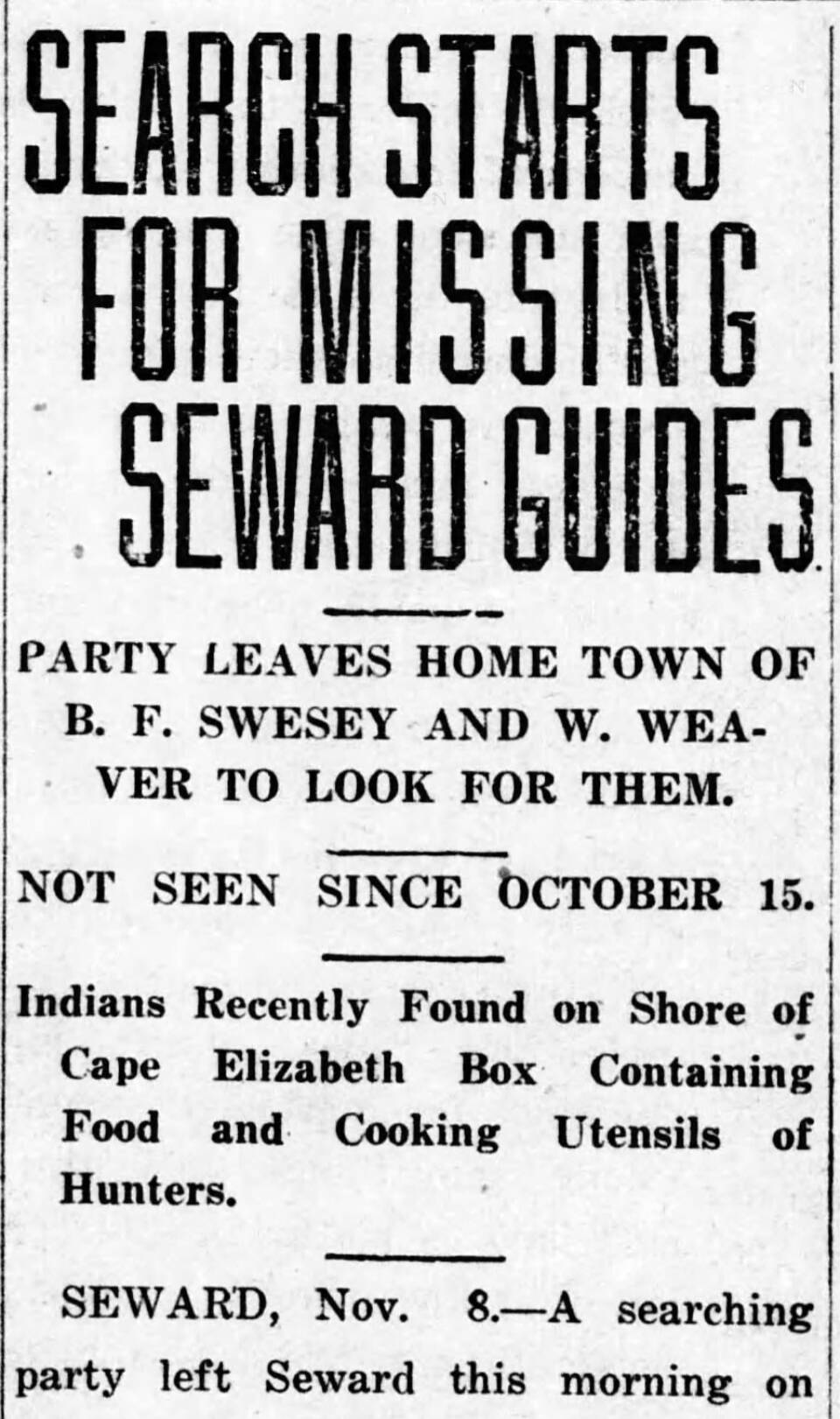
AUTHOR’S NOTE: Seasoned Seward outdoorsmen Ben Swesey and William Weaver left home on Oct. 15, 1917 in Swesey’s boat on what was reportedly a two-week hunting trip. They were never seen again. Searches for the men produced only speculation.
Explanations vary concerning what happened after Oct. 15, 1917, when seasoned outdoorsmen Ben Swesey and William Weaver left Seward on what newspapers of the day called a two-week hunting trip.
Most agree that the two men headed out of Resurrection Bay in Ben Swesey’s dory, powered by Swesey’s Evinrude outboard. According to a memoir written by one of Swesey’s last hunting clients, the Evinrude was the same outboard that had malfunctioned in a storm about a month earlier while the hunting party was attempting to motor the length of Kenai Lake.
Contemporaneous accounts stated that Swesey and Weaver were planning to hunt in nearby Aialik Bay. John P. Holman, the last man guided personally by Swesey, stated in his memoir that Swesey and Weaver were actually “fulfilling a dangerous duty for the sheriff of Seward … [by attempting to] run down some boot-leggers who were supposed to be in hiding along the bleak and barren coast to the westward.”
While no evidence has yet come to light that Swesey was ever deputized for such a duty, Weaver, at least, had previously cooperated with Seward’s U.S. deputy marshal, Isaac Evans, and had been deputized. When Evans had taken a five-week leave of absence in October-November 1915, Weaver had been named acting deputy marshal. The following year, he had taken part in a marshal’s posse and also helped Evans destroy 218 cases of bootleg alcohol.
Neither man, however—despite the assertions of modern YouTube missing-persons guru and former San Jose police detective, David Paulides—had previously been U.S. marshals stationed for years in Anchorage.
The city of Anchorage had not existed during the time Paulides refers to. Both men, in fact, had grown up in the States and had come to Alaska to mine for gold—Swesey in 1896, Weaver in 1900. Since at least 1910, several years before Anchorage was founded, both men had been residents of Seward.
Other details are less open to debate: Sometime between Oct. 23 and Oct. 28, a group of Native hunters found a food box on a beach of Elizabeth Island, at the mouth of Cook Inlet. The box, measuring 24 inches long, 18 inches wide and 12 inches high, was taken to Seldovia, where it was examined by U.S. Deputy Marshal C.W. Harrington.
In a letter after this inspection, Harrington described the contents: “[It] contained about a week’s grub, consisting of small slab bacon, a little flour, tea, sugar, salt, syrup, potatoes, two case knives and forks, spoons, nearly worn-out butcher knife, candles and two Marvel hunting knives. One knife was marked B.F.S. on the scabbard….”
It was determined later that the initials stood for Benjamin F. Swesey. This determination prompted the transmission of a wire from Seldovia to Seward, inquiring whether Swesey was in town. A Nov. 8 article in the Anchorage Weekly Times and Alaska Labor News claimed that “many persons [were] anxious to ascertain his whereabouts.”
About a week later, a search party was dispatched from Seward, with the searchers planning to focus on Aialik Bay. When the search party came up empty—and after Marshal Evans heard that a steamship returning from Seldovia also had found nothing—a second team was sent out to look.
The second search was scheduled to last 10 days to two weeks, and the searchers were given a greater area to scour and more latitude to exercise the law. According to the Seward Gateway, they were “given authority to make a thorough investigation, make arrests, if this should be required, and also empowered to summon witnesses.” The language used here seems to imply at least a suspicion of foul play, hardly what might be expected in a case involving two missing hunters.
The second group of searchers, like the first, planned to begin searching in Aialik Bay, then to sweep along the outer coast on the way to Seldovia and out to the Barren Islands. On Dec. 4, the Gateway offered only disappointing results: “The second party sent to search for Ben Sweasy [sic] and Bill Weaver returned last night, efforts fruitless…. Nothing new was learned … [and it is] now the belief that the missing men were blown out to sea and lost.”
By late January 1918, no one seemed to believe the two men could have survived. “All hope has been abandoned,” declared the Juneau Empire. Meanwhile, the Seward Gateway began running “Notice to Creditors” alerts for the estates of both Swesey and Weaver.
Then in late summer 1918—10 months after Swesey and Weaver had left Seward—came news that, to many, was confirmation of the deaths: A hunting party had found Swesey’s boat, upside-down, on a beach near Bear Glacier in Resurrection Bay. The boat, said one newspaper, “showed signs of being severely buffeted by wind and wave.”
Although the initiation of a final search for the men’s bodies was contemplated, no evidence has yet been found to prove that such a search occurred.
On his YouTube channel, “Missing 411,” David Paulides concluded his discussion of the disappearance this way: “What bothers me about this is, there were no easy answers…. Do I believe that [Swesey and Weaver] ran into a storm and then sunk out in the middle of the bay? Uh, no. Here’s why: Because anyone who’s smart knows that when it gets really rough, what do you do? You head for land, and you ride it out on the land, which is what Swesey would’ve done.
“They wouldn’t have pushed forward,” he continued. “They wouldn’t have risked their lives. They would’ve done the smart thing. And my heart tells me that that’s what they did…. And it would’ve been so easy to miss a camp on the amount of landfall that they had to search that I don’t blame searchers for not finding it.”
Maybe so. Maybe not. Mistakes happen to even the well-prepared.
Besides, despite Paulides’ nearly half-million followers, his views have produced skeptics. YouTuber Aiden Mattis, for instance, in a 2025 episode entitled “David Paulides Is Lying about Missing 411,” took Paulides to task for his methodology and tactics.
Mattis—who said he had been a Paulides devotee until he began doing his own research—asserted that Paulides’ claims often relied on obfuscation, the creation of material to support his ideas, and the deliberate omission of material that might contradict his own conclusions.
New researchers, therefore, will have to determine the truth for themselves.
John Holman, who spent a month in the wilderness with Swesey before the disappearance, offered this purple prose in remembrance of his former guide and his companion: “The heaving waters of the great Pacific moan a solemn requiem among the rocks and shoals of that pitiless coast, and the relentless mountains rear their snow-crowned heads above the mighty sepulchre of two of nature’s noblemen.”
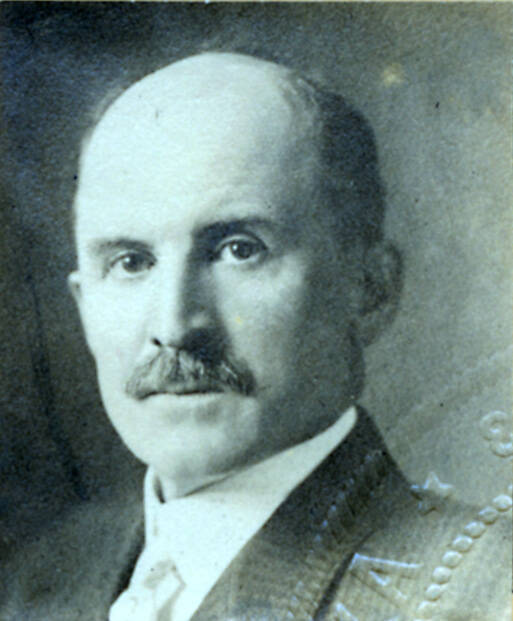
image courtesy of the Resurrection Bay Historical Society U.S. Deputy Marshal Isaac Evans, who worked out of Seward and was murdered in 1919, hired William Weaver on occasion to help him with law enforcement. In October and November of 1915, Weaver filled in as marshal while Evans was on vacation. (Photo from Evans’s Water-Front Pass, which gave him legal access to the Port of Seward.