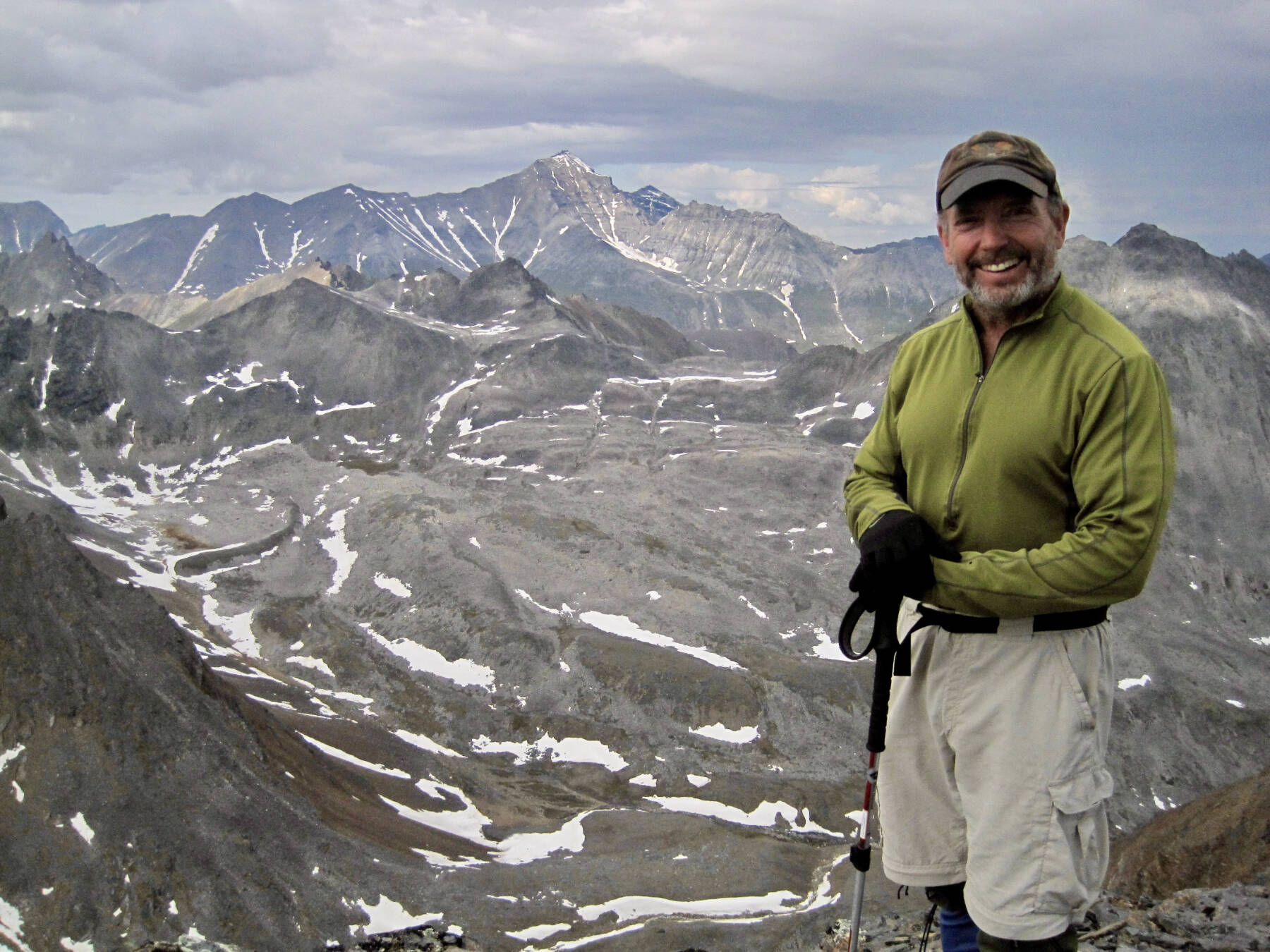
A geologist, outdoor enthusiast, author and photographer, Taz Tally has been photographing the world around him for nearly the past 65 years.
“Throughout the decades, I’ve used my photographic skills to capture and illustrate geologic and other natural history subjects, as well as to document my life,” he said. “Capturing my way through life encourages me to slow down and really enjoy what I’m doing and to be fully present in all the moments.”
Well known in the community for his black and white landscape images, Tally’s definition of landscape images varies from large mountain range panoramas to texture and fabric macros. While he prefers to photograph spontaneously scenes and compositions that grab his attention, he has on a few occasions set out to capture specific images, including photographing the solar eclipse from central Oregon in 2017 and the solar eclipse from the Texas Hill Country in 2024.
“I prepared for both of those for over a year each, scouting shooting locations and studying maps and weather patterns,” he said. “The eclipses themselves were a denouement extreme with the entire sky and landscape dark for a few minutes and everything quiet and eerily lit.”
A landscape that has especially captured Tally’s creativity is the Brooks Range, the only mountain range entirely north of the Arctic Circle in North America, stretching 700 miles from the Yukon border west to the Chukchi Sea.
“The Brooks is one of the largest and wildest landscapes remaining on the planet, with the southern portion featuring boreal forest covered soaring glacier carved peaks, the northern slopes draped with the subtle tapestry of Arctic tundra and no trails, only wide-open landscape to wander through,” he said.
His favorite times to photograph this area are mid- to late August when he hikes, backpacks and pack rafts through the height of the Arctic autumn, and during late winter and early spring when he traverses the snow-white landscape on backcountry skis and Nordic ice skates, setting his sights on capturing the abstract snow and ice sculpted features.
Tally also regularly ventures to shoot the ever-changing light and textures of the Great Sand Dunes National Park and Preserve in South Central Colorado, including in 2022 when he was an Artist in Residence and taught a nighttime smart phone photography class as part of his residency.
“The mesmerizing combinations of dune structures, sand textures and cast shadows of the early morning and late afternoon light against the backdrop of the snow-covered Sangre de Christo mountains offer unending, sensual and photographic delights,” he said.
Tally’s photographic adventures are not just limited to being on land. For the past several decades, he and a group of friends have traveled the world diving in locations including the Caribbean, Central America, Indonesia, Australia, Hawaii and California.
“My favorite underwater marine landscape is the great Astrolabe Reef that rims the southern Fijian island of Kadavu,” he said. “The third largest reef in the world, it is one of the healthies,t and supports coral-covered landscapes, enormous schools of fish and the ability to swim alongside 1,500-pound manta rays with 20-foot wingspans. Marine landscape provides a vast array of fascinating life, colors, textures, structures and topographies unlike anything you can experience on land, and are a delight to witness and photograph.”
While Tally enjoys being spontaneous and unintentional about the subjects he shoots, he is extremely deliberate about his compositions.
“Whether I’m setting up to press the shutter release or critiquing and editing an image later on, I’m very deliberate and very explicit about evaluating compositions in the order of simplicity, asymmetry, eye line and point of view,” he said. “These are the four essential elements I use to create and edit all of my compositions. This deliberateness and explicitness force me to focus on and create the very best compositions that I can capture and edit.”
While Tally may be out shooting for an hour on a local beach, a couple of days on an across-the-bay or up-the-road adventure, or for weeks on a cross-country trip,
his post-shoot workflow often finds him devoting more than 100 hours to any given image, working in post-shooting image production and processing using Lightroom and Photoshop software.
“I begin thinking about my post-processing while I’m initially composing the image,” he said. “Working in post is as much of my creative process as the original image composition and camera settings.”
Tally got his first camera was he was nine years old, a Zeiss Icon Coniflex, gifted to him by his father as they were boarding a plane from Massachusetts to Florida. During the flight, his dad explained the fundamentals of shutter speed, F stop and ASA, today referred to as ISO.
“I loved learning all the technical aspects of the camera because I could immediately imagine the creative adjustments I would be able to make,” Tally said.
As a teenager, he began his photographic journey in analog, building his own analog photographic wet lab and developing his own black and white film and papers as well as color positive film. As technology evolved, Tally enthusiastically made the transition from analog to digital.
“I was very familiar with the possibilities and the limitations of film and chemistry-based photography, so when I picked up the first consumer-level digital camera in the early 1980s, I remember being thrilled at capturing and viewing my first digital image,” he said. “It only contained something like 460 x 320 pixels and eight bits per pixel and 72 PPI, but it became immediately obvious to me how my creative world had just exploded. Many photographers came kicking and screaming into the digital world, but I sprinted in and have been running through it ever since.”
While the young photographer captured images in both color and black and white, he became entranced by the variety of nuances that black and white could showcase over color.
“I realized that there were layers of fascinating structures, fabrics and textures that were largely hidden by and overwhelmed by color,” he said. “This is one of the primary reasons I dove headlong into the digital world, because of how it allowed me to manipulate various grayscale channels of color images in order to render black and white the way I wanted it and with endless variations.”
Today, Tally internally reinterprets the color scenes in front of him into black and white while out shooting.
“I look for initial differences in tone and color and pre-imagine how I’ll convert these into tonal variations in the black and white versions,” he said. “Sometimes I’ll create both color and black and white versions of the same image, showcasing images that have not only a very different compositional emphases, but a very different look and feel.”
Mostly self-taught, Tally has through the years kept up with the ever-changing photographic technology through books and online education. He has himself published numerous books and videos on photography, Photoshop, Lightroom, scanning, Acrobat, color correction, page layout and print file prep. In the 1980s and 1990s, he developed a nationwide digital imaging seminar series, traveling the country and teaching digital imaging and graphic arts to professionals who were making the transition from the analog to the digital world. Over the past decade, he has also published several adventure books that feature his photography, including “50 Hikes on Alaska’s Kenai Peninsula”, editions 1 and 2, as well as “Backroads & Byways of Alaska.”
In addition to sharing his passion for photography through publishing, Tally has for more than 20 years taught classes to students of all ages, both locally and online. He currently teaches a dozen different photography classes online through Sessions.edu, as well as a variety of face-to-face photography courses through the University of Alaska Anchorage Kenai Peninsula College’s Kachemak Bay Campus.
Since the late 2000s, Tally has exhibited his photography in Homer at the Art Shop Gallery, the first photographer to show his work at the gallery thanks to the support of Karin Marks, founder and former longtime owner of the gallery, and current gallery owner Joell Restad.
While most of Tally’s gallery images are his high-contrast black and white images, he is slowly introducing more color photographs into his exhibits. As the Art Shop Gallery’s featured artist for the month of November, four of his full-color images are currently on display, including “Pratt Forest Autumn Bouquet” and “Pratt Forest Autumn Bouquet Mini.” Both images showcase the summer-to-fall transition in the woods behind the Pratt Museum.
“The important elements here are the beautiful, highly saturated autumn colors, as well as the texture and fabrics of the devil’s club and their companion ferns which have contrasting color and very strongly contrasting textures and shapes,” Tally said.
“Let There Be Light” was shot during a geology field trip on the south side of Kachemak Bay and features a burst of sunlight diffracted around the top of a spruce tree.
“In this image, the eye lines of the sunburst are central to the image and, unlike the forest bouquets, the color here is subtle, but still essential to the overall composition,” he said.
“Small Kelp with Hold Fast” is a macro scale texture and fabric image of a small kelp frond holding onto a miniature blue rock with a small hold fast.
“Texture and fabric are front and center here and, like the sunburst image, the color is subtle, but essential,” he said.
Whether using his DSLR camera, his iPhone or his newly acquired photographic drone, Tally finds immense joy in capturing the world around him, spontaneously, intentionally and in both large and small scale.
Tally’s work can be found year-round at the Art Shop Gallery. He will be teaching a two-day class, Capturing Great Images with Your Smartphone, at Kachemak Bay Campus on Friday, Nov. 14 from 5:30 to 8:30 p.m. and Saturday, Nov. 15 from 9 a.m. to noon. Register online at continuingstudies.alaska.edu/registration or stop by the college campus at 533 E. Pioneer Avenue.
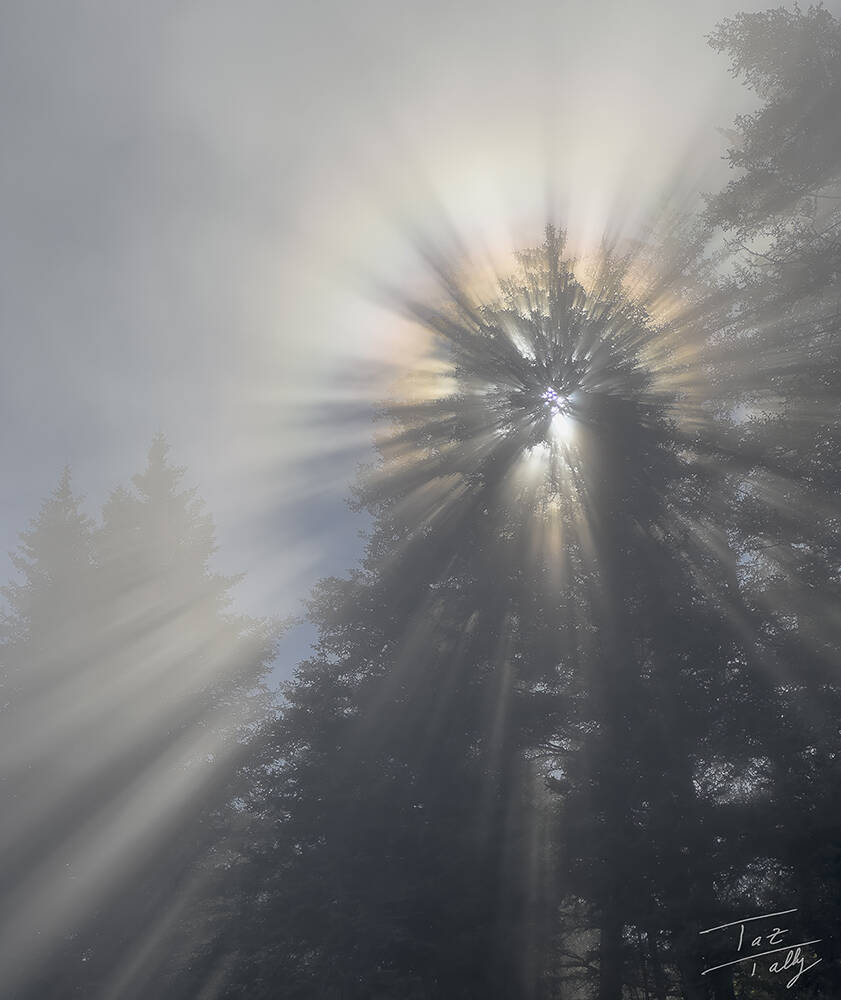
“Let There Be Light,” a photograph taken by Taz Tally in the southern Kenai Peninsula in the spring of 2025, is on display through November in Tally’s solo exhibit at the Art Shop Gallery in Homer, Alaska. Photo provided by Taz Tally
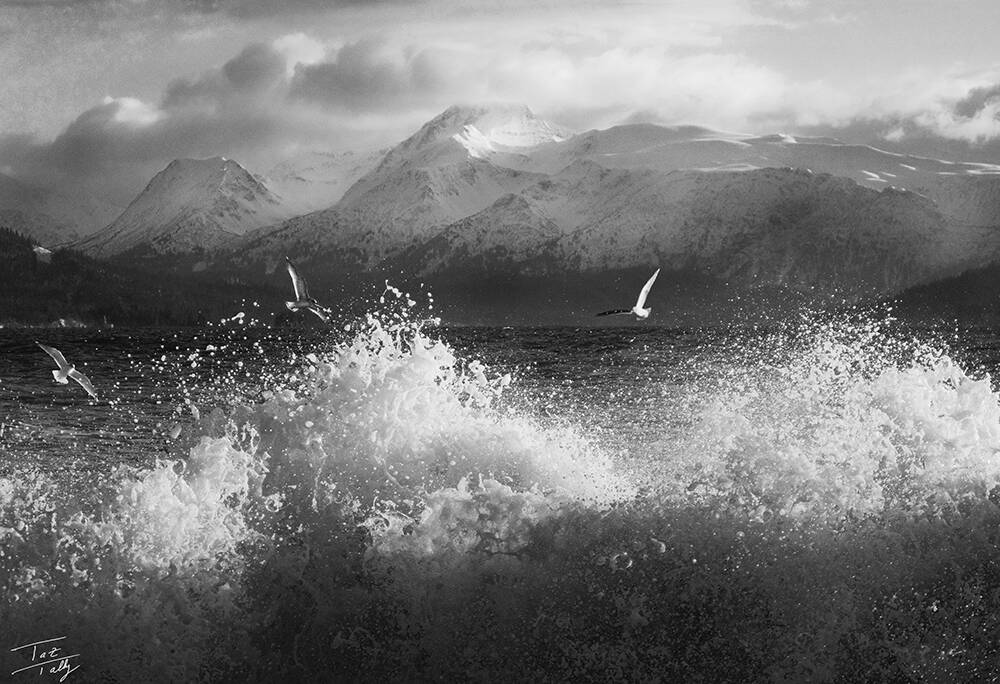
“Tern Tern Tern,” a photograph captured by Taz Tally in 2019, is one of several images on display through November in his solo exhibit at the Art Shop Gallery in Homer, Alaska. Photo provided by Taz Tally
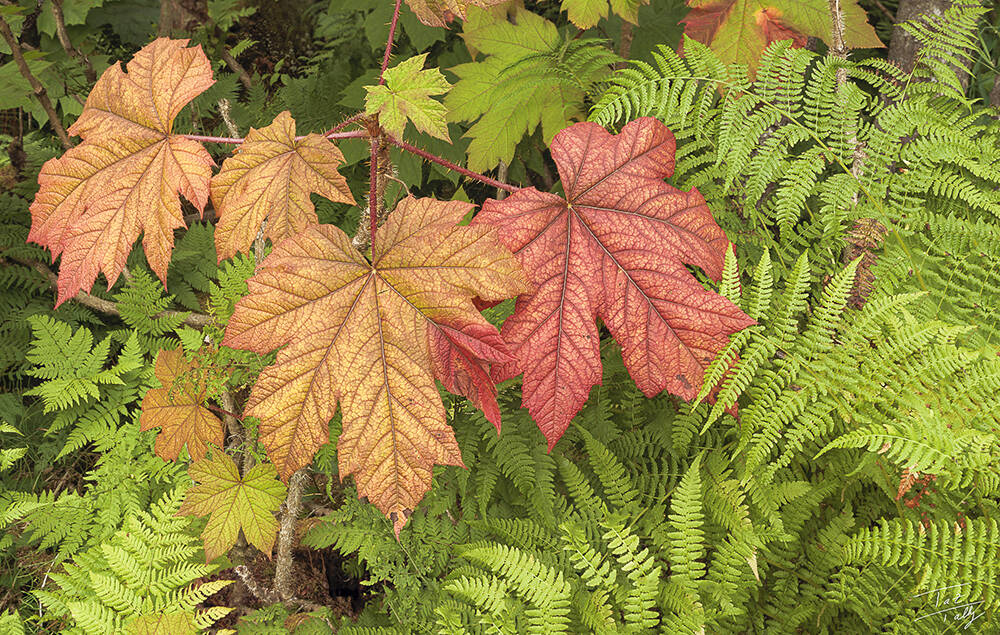
”Pratt Woods Bouquet” is a photograph taken by Taz Tally in September 2025 and is on display through November in his solo exhibit at the Art Shop Gallery in Homer, Alaska. Photo provided by Taz Tally